


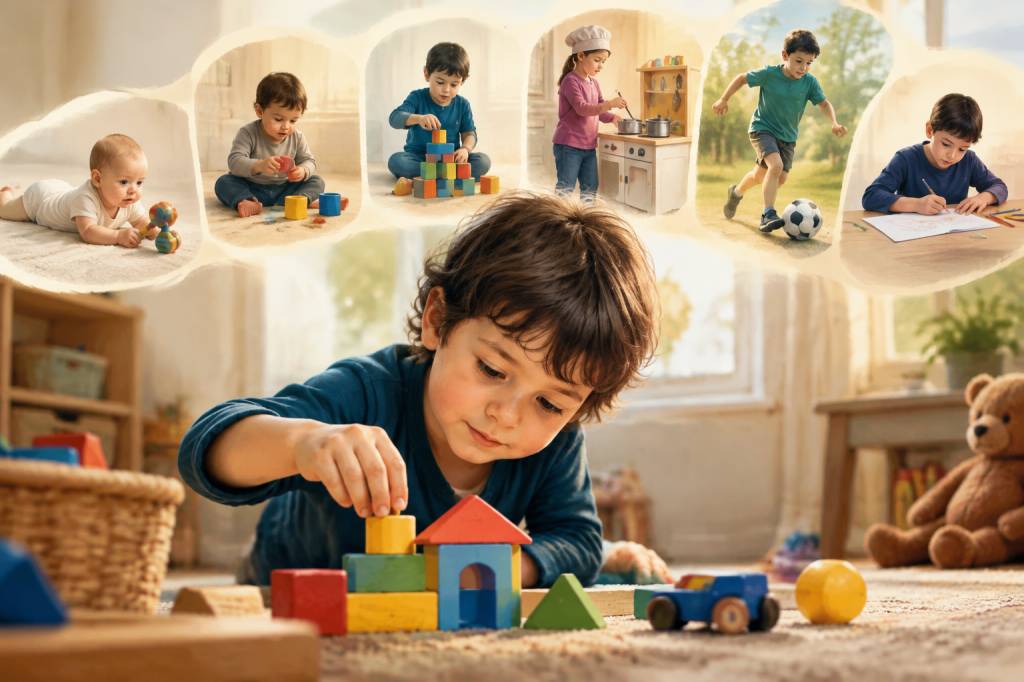
A toddler stacking the same three blocks again and again is not “just passing the time.” A preschooler playing kitchen with a stuffed bear is practicing language, imagination, and social understanding. Play may look simple from the outside, but it is one of the main ways children explore their world and learn how to move through it.
Parents often hear about “developmental levels of play” and wonder whether their child is on track. The reassuring answer is that play does not unfold like a neat staircase. Children move between different kinds of play depending on their age, mood, surroundings, and the people nearby. Knowing what these levels can look like helps you notice progress without turning playtime into another thing to measure.
What developmental levels of play mean
One widely used way to describe children’s social play comes from developmental psychologist Mildred Parten. Her framework identifies six patterns: unoccupied, solitary, onlooker, parallel, associative, and cooperative play. These patterns describe how children engage with other people during play—not how clever, creative, or capable they are.
They are not strict stages that a child passes through once and leaves behind. A child who happily plays with friends may still choose to build alone the next day. Even adults sometimes prefer a quiet project to a group activity; children are allowed the same variety.
It is also helpful to distinguish social patterns from types of play. Building a tower, pretending to be a doctor, exploring a sensory bin, and playing a board game are different kinds of activity. Any of them might happen alone, alongside another child, or as part of a shared game.
The six social patterns of play
Unoccupied play may look like a child watching their surroundings, shifting position, or briefly exploring whatever catches their attention. This kind of activity is common in very young babies, whose movements and attention are still developing. It can also appear in older children who are pausing, observing, or deciding what to do next. A quiet moment is not automatically a problem; sometimes a child is simply taking it all in.
Solitary play is independent play. A child might roll a toy car back and forth, fill and empty a container, or look through a picture book without seeking company. Babies and toddlers often spend much of their play this way, and older children may choose it too. Independent play gives children room to concentrate, experiment, and follow their own ideas.
Onlooker play happens when a child watches other children playing but does not join in. They may comment, ask questions, or simply observe. Imagine a toddler standing near a group building a sandcastle, fascinated by every scoop but not ready to pick up a shovel. Watching is a way of learning the rhythm of a game and deciding whether it feels inviting.
Parallel play means children play near one another, often with similar toys, but do not yet coordinate what they are doing. Two toddlers might sit side by side with blocks, each building a separate tower. They may glance at each other, imitate an action, or borrow an idea without creating one shared plan. This is a common and valuable form of early social play.
Associative play includes more interaction, but the children’s activities are not fully organized around a common goal. They may share crayons, talk about what they are drawing, or swap toys, while each follows a separate idea. There is connection, even if nobody has appointed themselves director of the whole production.
Cooperative play involves children working together in a more organized way. They might decide to build a zoo, assign roles, and agree where the animals belong. Cooperative play asks a lot of growing skills: listening, communicating, sharing ideas, adapting when plans change, and navigating disagreements. These abilities develop gradually, with plenty of practice along the way.
How play changes as children grow
Many babies begin by exploring their own bodies and immediate surroundings. A hand is fascinating; so is a crinkly cloth, a familiar face, or the sound of a toy being shaken. As movement and coordination grow, babies may bang, drop, mouth, or transfer objects from hand to hand. These actions are not random from a learning perspective: they help a child discover how things feel, sound, and respond.
During toddlerhood, children often focus on repetition and exploration. A toddler might put objects into a box, tip them out, and start again with the determination of a tiny scientist. They may play beside other children without sharing a story or a goal. That does not mean they are uninterested in people. They are learning what other children do while also building the skills needed to join in.
As language, imagination, and social understanding develop, pretend play often becomes richer. A block can become a phone; a spoon can become a microphone. Children may begin with simple imitation—feeding a doll, for instance—and later create longer stories with characters, problems, and solutions. In early childhood, children also become more able to negotiate shared plans, though taking turns and handling frustration can still be hard.
These are broad patterns, not deadlines. Development varies, and children may show different skills in different settings. A child who chats freely at home may be quiet in a busy playgroup. A child who loves pretend play may be less interested in puzzles. Temperament, culture, familiarity, disability, and access to playmates and materials all shape how play looks.
Why play matters beyond keeping busy
Play gives children a low-pressure place to practice skills they will use throughout life. When a child stacks blocks, they explore balance, size, and cause and effect. When they make up a story, they practice language and flexible thinking. When two children decide whose turn it is to pour the pretend tea, they are trying out social rules in a setting where the stakes are delightfully small.
Play can support several areas of development at once:
-
Thinking: experimenting, planning, remembering, and solving problems.
-
Communication: naming objects, describing ideas, listening, and telling stories.
-
Movement: building coordination through reaching, grasping, running, drawing, and manipulating objects.
-
Social and emotional growth: expressing feelings, noticing others, practicing cooperation, and coping with small setbacks.
-
Creativity: using materials in new ways and imagining possibilities beyond what is directly in front of them.
None of this requires a playroom full of expensive toys. A few safe household objects, books, blocks, crayons, or time outdoors can offer rich opportunities. A cardboard box can be a cave, a bus, or a very important delivery truck—sometimes all before lunch.
How parents can support play without taking it over
Your role does not need to be that of entertainer, referee, and activity director all at once. Often, the most helpful thing is to make time and space for a child to explore. Stay nearby, offer materials that suit their age, and follow their lead. If they are absorbed in sorting toy animals by color, you do not need to introduce a complicated storyline. Their idea is already doing useful work.
Try these gentle ways to encourage play:
-
Notice before you join. Watch for a moment to see what your child is working on. A simple observation—“You made the bridge really long”—can invite conversation without interrupting concentration.
-
Offer open-ended materials. Blocks, paper, washable art supplies, and everyday objects can be used in many ways. Open-ended toys leave room for children’s ideas.
-
Join when invited. If your child hands you a toy cup, you might say, “Thank you. Is there tea today?” Let them decide how the game unfolds.
-
Model social language. During a difficult moment, offer words such as “Can I have a turn when you’re done?” or “Let’s find another block.” Children learn these phrases through practice, not just reminders.
-
Make room for different play styles. Some children warm up slowly, prefer familiar activities, or enjoy quiet play. Gentle invitations are more helpful than pressure to join a group.
When conflict happens, it can be tempting to solve everything immediately. Sometimes children do need an adult to step in, especially if someone might get hurt. In other moments, a little support is enough: name what you see, help each child express a need, and suggest a next step. The goal is not perfect sharing on demand; it is gradually learning how to manage shared space and big feelings.
When to look more closely
Children do not need to show every kind of play at the same age, and one unfamiliar behavior is rarely enough to tell you anything definite. Still, if you have ongoing concerns about how your child communicates, engages with others, uses toys, or responds to play, it is reasonable to ask for guidance.
You might begin with your child’s pediatrician, family doctor, or early childhood professional. Describe what you notice across different settings and ask whether a developmental screening or referral would be useful. If your child has already lost skills they once used, mention that promptly. Seeking advice does not label a child; it helps you understand what support, if any, could make daily life easier.
Most of all, remember that play is not a performance, and your child is not auditioning for the role of “most advanced block builder.” Some days play is a complicated pretend restaurant. Some days it is putting the same lid on the same container twenty times. Both can belong to a childhood full of learning.
When you make space for curiosity, companionship, and a little room to try again, you are already supporting your child’s development. The best measure is not whether every play session looks impressive. It is whether your child has opportunities to explore, connect, and enjoy being exactly where they are today.