


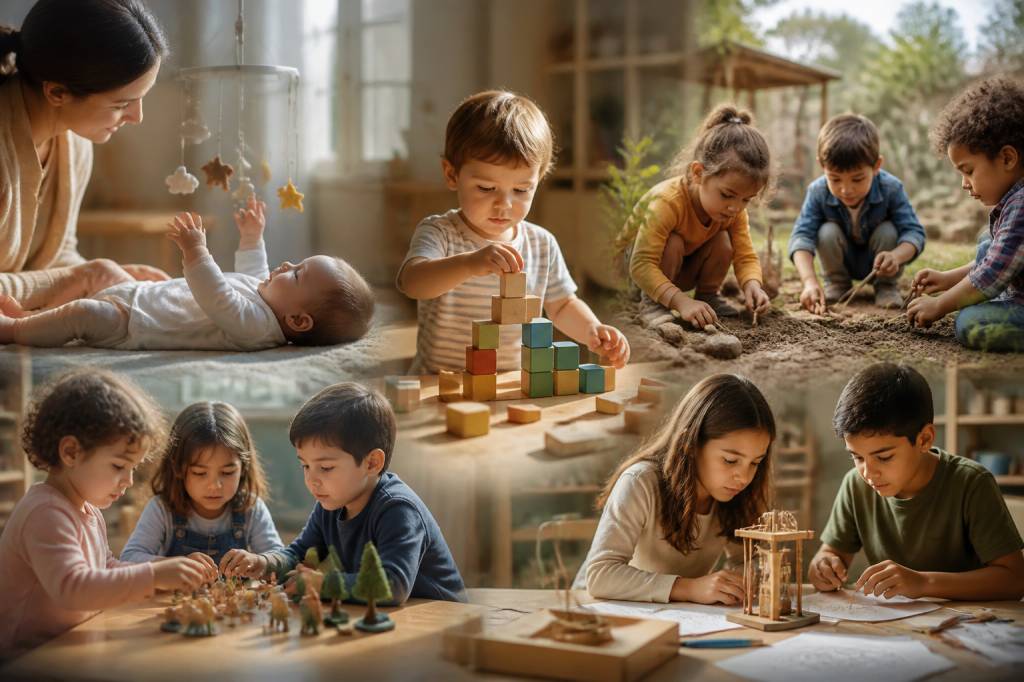
Play is often described as a child’s work, but that phrase can make it sound far more serious than it feels. To a toddler lining up toy cars, a preschooler pretending to run a bakery, or a baby repeatedly dropping a spoon from the highchair, play is simply a joyful way to explore the world.
Yet behind the giggles, repetition, and occasional living-room chaos, remarkable learning is taking place. Through play, children build relationships, develop language, strengthen their bodies, solve problems, and begin to understand who they are. The way children play changes as they grow, and each stage offers parents a gentle window into their development.
There is no single “right” way to play, and children do not all move through these stages at exactly the same pace. Some prefer watching before joining in. Others dive into every activity with enthusiasm—and leave a trail of blocks behind them. Both approaches can be perfectly healthy.
Let’s look at the developmental stages of play and discover how we can support children without turning every playful moment into a lesson.
Why play matters so much
Play gives children the freedom to practise skills in a safe, low-pressure environment. They can try, fail, change direction, and try again. A tower may fall, a puzzle piece may refuse to fit, or a pretend cup of tea may spill across the carpet. These small experiences teach persistence, flexibility, and cause and effect.
Play also supports several areas of development at the same time:
- Physical development: Running, climbing, grasping, stacking, and drawing strengthen coordination and body control.
- Cognitive development: Children learn to remember, compare, plan, experiment, and solve simple problems.
- Language development: Songs, stories, pretend conversations, and shared play introduce new words and communication skills.
- Social and emotional development: Play helps children express feelings, practise cooperation, and understand other people’s perspectives.
- Creative development: Open-ended materials invite imagination rather than one fixed outcome.
The most valuable toy is not necessarily the newest or most expensive one. A cardboard box, a wooden spoon, or a blanket fort can inspire just as much learning as a brightly packaged gadget. Sometimes, the less a toy does, the more a child gets to imagine.
Birth to around three months: discovering the world
During the first months of life, babies are not yet engaging in play as older children understand it. Their play is closely connected to sensory discovery and loving interaction with a caregiver.
A baby watches a face, follows a moving object with their eyes, listens to a familiar voice, and reacts to gentle touch. These simple moments help build the foundations for attention, communication, and emotional security. When you smile and your baby smiles back, a tiny conversation is already underway.
At this stage, play can be wonderfully simple:
- Talk, sing, and make gentle facial expressions.
- Place a high-contrast toy or picture within your baby’s view.
- Offer supervised tummy time for short periods.
- Let your baby listen to different safe household sounds.
- Gently move a soft toy from side to side to encourage visual tracking.
Babies can become overstimulated easily, so watch for signs such as turning away, fussing, or becoming unusually quiet. A pause is not a failure. It is your baby’s way of saying, “That was plenty for now.”
Around three to six months: reaching, grasping, and repeating
As babies gain strength and coordination, they become more active participants in play. They reach for objects, grasp them, bring them to their mouths, and shake them with great determination. The rattle that is vigorously tested at 6 a.m. is not merely a noisy object—it is a fascinating experiment.
Babies at this stage are learning about cause and effect. Shake the rattle, and it makes a sound. Kick the hanging toy, and it moves. Drop the spoon, and a parent may—almost magically—pick it up again.
Offer safe objects with different textures, shapes, and weights. Soft cloth books, teething toys, large fabric rings, and crinkly materials can encourage sensory exploration. Keep the environment simple enough that your baby can focus, and always follow age-appropriate safety guidance.
Face-to-face play remains especially important. Copy your baby’s sounds, pause for a response, and take turns making expressions. These early exchanges teach the rhythm of conversation long before words arrive.
Around six to twelve months: object play and social games
In the second half of the first year, babies often become wonderfully determined explorers. They may crawl toward a toy, pull themselves up to reach something interesting, or spend several minutes investigating how a container works.
Object permanence begins to develop during this period. Babies gradually learn that something still exists even when they cannot see it. Peekaboo is therefore much more than a way to make a baby laugh. The game supports memory, anticipation, and emotional reassurance. You disappear, but you return. What a comforting lesson.
Try placing a toy partly under a cloth and encouraging your baby to find it. Play “where did it go?” with a favourite object, or hide behind your hands and reappear with a smile. Fill and empty large containers together, or offer stacking cups that can be knocked down and rebuilt.
Babies also begin to imitate everyday actions. They may hold a toy phone to their ear, brush a doll’s hair, or bang a spoon against a bowl. These early gestures are the beginnings of pretend play and show how closely children observe the people around them.
Around twelve to eighteen months: functional and solitary play
Once children become toddlers, they often enjoy using objects in the way they were designed to be used. They push a toy car, place a piece into a shape sorter, stir pretend food, or give a stuffed animal a drink. This is sometimes called functional play.
Much of this play is solitary, meaning the child plays independently near others. A toddler may be perfectly content stacking blocks while a parent folds laundry nearby. Independent play supports concentration and confidence, although young children still benefit from regular connection and reassurance.
At this stage, offer toys that invite movement and simple problem-solving:
- Large blocks for stacking and knocking down.
- Push-and-pull toys for developing balance and coordination.
- Simple puzzles with chunky pieces.
- Board books with familiar objects and repetitive phrases.
- Musical instruments such as shakers and small drums.
Try not to rush in when a toddler encounters a challenge. A little pause gives them time to think. You might say, “The piece doesn’t fit there. What else could we try?” Your words offer support without taking over the discovery.
Around eighteen months to two years: imitation and parallel play
Toddlers begin to imitate more complex actions and show growing interest in what other children are doing. They may play beside another child with similar toys without truly playing together. This is known as parallel play.
Parallel play is an important social step. Children are learning how to share space, observe others, and gradually become comfortable with social interaction. It is completely normal for two toddlers to sit side by side, each guarding their own block tower as though it were a priceless architectural masterpiece.
Imaginative play also begins to blossom. A block can become a telephone, a blanket can become a cape, and a cardboard box can transform into almost anything. Support this creativity by providing open-ended materials rather than correcting the details of the story.
If your child gives a teddy bear a pretend injection, you might respond, “Teddy is being very brave. Are you the doctor?” This expands vocabulary and allows your child to process experiences through imagination.
Around two to three years: early pretend play
During the toddler years, pretend play becomes more purposeful. Children may feed a doll, put a toy animal to bed, or pretend to cook a meal. These actions often mirror routines they see at home.
Early pretend play helps children make sense of daily life. It can also help them explore emotions and experiences that feel difficult. A child who has recently visited the doctor may repeatedly examine a stuffed animal, perhaps giving it a very serious check-up and a remarkably generous supply of imaginary stickers.
Parents can encourage this stage by offering simple props:
- Plastic cups, wooden spoons, and empty food containers.
- Dolls, stuffed animals, and blankets.
- Hats, scarves, and other safe dress-up clothes.
- Blocks that can become houses, shops, or vehicles.
- Paper and chunky crayons for making signs, menus, or pretend letters.
At this age, children may still struggle with sharing, waiting, and managing strong emotions. Play is a gentle place to practise these skills, but expectations should remain realistic. Two-year-olds are not small adults with poor time-management skills; they are still learning what it means to have needs, feelings, and other people in the room.
Around three to four years: associative play and richer stories
Preschool children often begin to play more closely with one another, although their activities may still lack a shared plan. They might build a train track together, exchange pretend food, or dress up near each other while telling separate stories. This stage is often called associative play.
Language becomes increasingly important. Children negotiate roles, invent characters, ask questions, and retell familiar stories. They may also begin to understand that another person can have a different idea or wish, even if cooperation remains a work in progress.
You can support this development by joining the play as a thoughtful partner. Instead of directing the story, follow your child’s lead. Ask open questions such as:
- “What is happening in your shop today?”
- “Where is the train going?”
- “How does your character feel?”
- “What could we use to build a bridge?”
These questions encourage communication and problem-solving without turning play into an interrogation. Sometimes a simple comment—“You made a very tall tower”—is all that is needed to show interest.
Around four to six years: cooperative play
As children approach school age, play often becomes more cooperative. They create shared games, assign roles, follow simple rules, and work toward a common goal. Building a pretend restaurant, playing house, inventing a superhero mission, or organising a game of tag all require communication and flexibility.
Cooperative play supports essential life skills. Children learn to listen, compromise, take turns, repair disagreements, and adapt when someone changes the rules. They will not always manage these skills smoothly. A dramatic dispute over who gets to be the dragon is still part of the learning process.
Adults can help by staying nearby and offering calm guidance when necessary. Rather than solving every disagreement, describe what you see: “You both want the red truck. Let’s think of a way for everyone to have a turn.” Give children time to suggest solutions, and step in more directly when safety or emotional wellbeing is at risk.
School age: games, rules, and creative mastery
From around six years onward, many children become increasingly interested in games with rules, strategy, competition, and shared goals. Board games, card games, sports, construction projects, crafts, and complex imaginary worlds can all support development.
Rule-based play teaches children how to follow instructions, manage disappointment, plan ahead, and understand fairness. Winning can feel wonderful, while losing can feel like the end of civilisation. With patient support, children gradually learn that frustration is temporary and that play can continue after an unsuccessful turn.
Creative and project-based play is equally valuable. Building a model, designing a fort, writing a comic, or creating a miniature town encourages sustained attention and persistence. Resist the urge to perfect the project for them. A lopsided paper crown made independently often carries more pride than a flawless one produced by an adult.
How parents can support healthy play
The best support is usually a balance between connection and freedom. Children need adults who are present, interested, and available, but they also need room to lead.
- Protect unstructured time: Not every moment needs to be scheduled or enriched. Boredom can become the beginning of an excellent idea.
- Choose open-ended materials: Blocks, art supplies, fabric, boxes, and pretend-play props can be used in many ways.
- Follow your child’s interests: If dinosaurs, trains, or bugs fascinate them this week, use that enthusiasm as a bridge to language and learning.
- Model cooperation: Demonstrate taking turns, listening, and using calm words during shared play.
- Keep expectations age-appropriate: A preschooler may need help waiting, while an older child may be ready to negotiate rules.
- Value process over appearance: The learning happens while children explore, not only when they produce something that looks finished.
When play looks different
Children develop in individual ways, and play preferences can vary widely. Some children love pretend stories, while others prefer sorting, movement, drawing, or detailed construction. A child may also move between stages depending on tiredness, stress, environment, or who is playing nearby.
If you have ongoing concerns about communication, movement, social interaction, or a child’s ability to engage in age-appropriate activities, speak with your pediatrician or another qualified professional. Seeking advice is not an overreaction. It is one of the many ways a caring parent gathers support.
Most of all, remember that play does not need to be elaborate to be meaningful. A few minutes of peekaboo, a shared story before bed, or a cardboard box turned into a rocket can become a treasured part of childhood.
When children play, they are not simply passing time. They are building an understanding of themselves and the world around them—one block, story, muddy puddle, and enthusiastic game at a time. And when we slow down enough to join them, we get the privilege of seeing that learning unfold.