
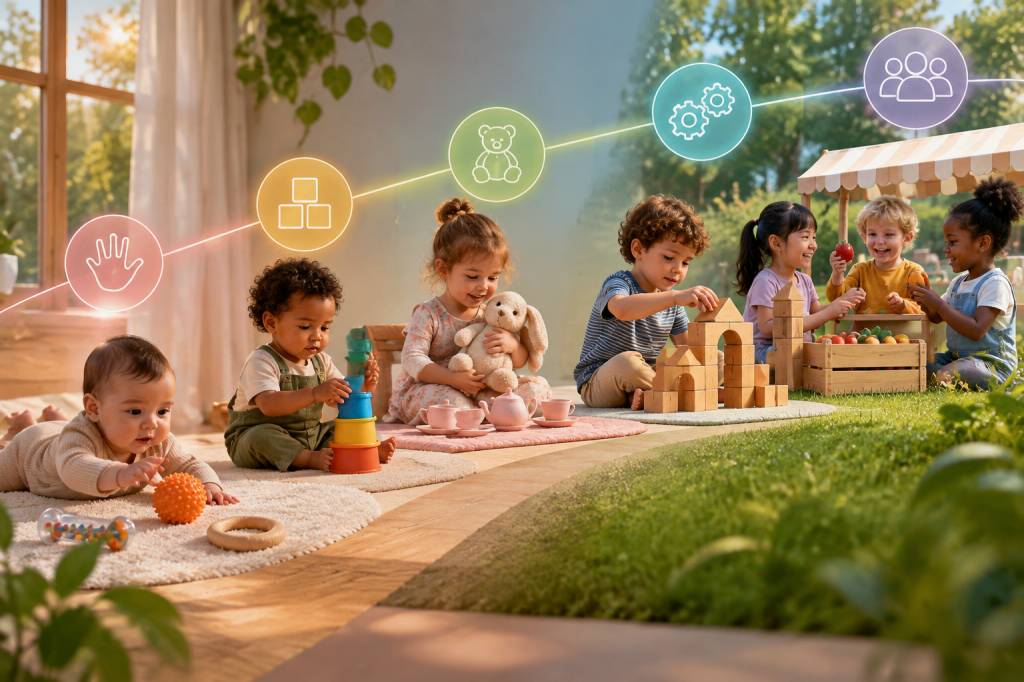
On a rainy afternoon, a cardboard box can become a house, a train, or a very convincing hiding place. To an adult, it may look like a box. To a young child, it is a chance to test an idea, make a choice, and invite someone else into a new world. Play is not simply a pleasant break from learning. In the early years, it is one of the main ways children learn about themselves, other people, and how the world works.
Understanding the stages of play can help us meet children where they are, without rushing them toward the next milestone. These stages are useful guideposts, not a strict schedule. Children move between them, and they may play differently depending on their mood, surroundings, or who is nearby. A child who is happy to play alone at home might be more interested in other children at the park. Both are perfectly ordinary.
Why play matters so much
When children play, they practice skills that will support them long after the toys are put away. Stacking blocks invites problem-solving. Pretending to feed a doll gives a child a chance to explore everyday routines and feelings. A game of chase strengthens coordination while teaching children to notice another person’s movements and boundaries.
Play can also help children build language, imagination, patience, and confidence. Not every moment needs to be turned into a lesson, though. Children benefit from the freedom to explore without an adult explaining what each object is “for.” Sometimes a spoon is a drumstick, a boat, or the ideal tool for relocating a pile of sand. The learning is happening even when the play looks wonderfully ordinary.
Researchers and educators often describe several broad stages of social play, including unoccupied play, solitary play, onlooker play, parallel play, associative play, and cooperative play. These descriptions can help us understand how children relate to others as they play. They are not a test, and there is no need to check them off like items on a shopping list.
Unoccupied play: noticing the world
In unoccupied play, a baby or young child may appear to be doing very little. They might watch light move across a wall, kick their feet, reach for a nearby toy, or pause to study a person’s face. This quiet exploration helps children take in their surroundings and begin to understand how their bodies and the world respond to one another.
For a baby, waving an arm and watching a mobile sway is already a small experiment: “When I move, something happens.” A safe floor space, a few age-appropriate objects, and a calm adult nearby offer plenty of material for this kind of discovery. You do not need to fill every pause with a new toy or a performance. A little time to look, listen, and move is valuable.
Follow your child’s cues and make sure the space is safe for their age and abilities. Babies explore with their mouths as well as their hands, so keep small objects and choking hazards out of reach. If your baby looks away or seems tired, a break may be more welcome than another activity.
Solitary play: doing it their own way
In solitary play, a child plays independently, focusing on an activity without trying to involve others. You might see a toddler filling and emptying a container, turning the pages of a sturdy book, or repeating the same block tower experiment—complete with the same dramatic crash—again and again.
Repetition is not a sign that a child is stuck. It can be how they explore cause and effect, build coordination, or feel secure as they master a new skill. The ninth attempt to fit a shape into a sorter may look familiar to you, but your child is still gathering information. Does it fit this way? What if I turn it? What if I try the other opening?
Independent play can be especially useful when a child is learning to concentrate or make choices. Stay close enough to offer reassurance, but try not to take over. If your child is working carefully on a puzzle, waiting a moment before stepping in gives them the chance to try their own solution. When they do ask for help, you can offer a gentle clue instead of solving it for them.
Onlooker play: learning from the sidelines
During onlooker play, a child watches other children play without joining in. They may study how a group builds a road, listens to a story, or takes turns with a ball. Even if they are standing at the edge of the activity, they are noticing how play works: what people say, how they use materials, and what happens when someone has an idea.
Adults sometimes worry that a child who watches is missing out. Often, watching is simply the child’s chosen way to take part for now. New settings can feel busy, and observing gives a child time to get comfortable before deciding what to do. At a playgroup, you might sit nearby and describe what is happening in a low-key way: “They’re rolling the ball to each other.” Then leave room for your child to keep watching or move closer.
There is no need to insist on an introduction or a turn. A warm invitation is enough: “Would you like to bring the blue ball over?” If the answer is no—or if your child answers with a determined little retreat—respecting that choice can help them feel safe enough to try another time.
Parallel play: side by side, not quite together
In parallel play, children play near one another, often with similar toys, but do not yet coordinate their activities. Two toddlers might sit at the same table, each making a tower from their own blocks. One may glance at the other’s work, then return to their own. They are sharing space and noticing each other, even without building a single joint masterpiece.
This kind of play is common in toddlerhood and can be a gentle bridge toward social play. Children may copy a movement or exchange a toy briefly, then go back to playing independently. From an adult’s point of view, the interaction may seem small. For a young child, being near another child while staying in control of their own activity is meaningful practice.
Try setting out enough materials for each child to explore. A few blocks, cups, toy animals, or crayons can make it easier for everyone to get started. When a conflict does arise, stay close and use simple language: “You both want the red truck. Maya is using it now. You can have a turn when she’s finished.” Young children need many calm reminders as they learn to wait and share; they do not arrive with those skills already installed.
Associative play: sharing ideas and materials
In associative play, children begin to interact more directly. They may share crayons, talk about what they are making, or exchange toys, while still pursuing their own ideas. Imagine two children drawing at one table. One asks for the yellow marker; the other passes it over. They chat about their pictures, but one is drawing a rocket and the other is making a very long-legged dog. There is connection, even if there is no shared plan.
These moments support communication, flexibility, and early cooperation. Children are practicing how to ask for something, respond to another person, and keep an activity going together. Their conversations may be short and their agreements temporary. A shared game can change direction quickly, especially when someone discovers that the cardboard box is now a bakery.
Adults can support this stage by providing open-ended materials and making room for conversation. Paper, washable markers, play dough, and blocks can be used in many ways. You can model useful phrases such as “Can I use that when you’re done?” or “Let’s make space for both pictures.” Keep expectations realistic: learning to share is a gradual process, not a switch that flips on a particular birthday.
Cooperative play: working toward a shared idea
In cooperative play, children begin to organize their activity around a shared purpose. They might take roles in a pretend restaurant, work together to build a blanket fort, or agree on rules for a simple game. This play calls on many developing skills at once: listening, planning, negotiating, remembering ideas, and adapting when the plan changes.
It can also bring big feelings. One child wants to be the shopkeeper; another has already decided that the shop only sells dinosaurs. A disagreement does not mean the play has failed. With support, children can begin to suggest solutions: take turns choosing roles, add a second shop, or let the dinosaurs sell groceries. Sometimes they will manage the problem themselves; sometimes they will need an adult to help everyone feel heard.
Rather than directing every step, try asking a question that leaves the next move to the children: “What could you do so there’s room for both ideas?” If they need more help, offer a simple choice. The aim is not to make the play perfectly smooth, but to help children practice repairing small bumps together.
What adults can do to make play richer
Children do not need a room full of expensive toys to play well. Familiar household items, simple art supplies, outdoor spaces, and time to explore can be enough. The best choice depends on a child’s age, interests, and safety needs. A cardboard box might become a fort for a preschooler, while a baby needs safe objects designed for mouthing and grasping.
A supportive adult does not have to lead every activity. Often, the most helpful approach is to be nearby, notice what captures a child’s attention, and join in only when invited or needed. You can add language without quizzing: “You put the small cup inside the big one,” or “That tower leaned, and then it fell.” These observations show interest and give children words for what they are doing.
When you do join, try following your child’s idea instead of quickly improving it. If a child says the play dough is soup, you can ask what ingredients the soup needs. You do not need to correct the menu. A pretend bowl of green play-dough soup is not a culinary recommendation; it is a wonderful invitation to imagine together.
A few everyday habits can make play easier to begin and sustain:
-
Offer a small selection of toys or materials, rather than putting everything out at once.
-
Make room for safe, unhurried play, including time outdoors when possible.
-
Let children repeat activities they enjoy; repetition can be part of learning.
-
Notice effort and curiosity, not only finished creations.
-
Help children name feelings and solve conflicts with calm, simple language.
-
Follow your child’s lead, while setting clear limits when safety or kindness is at stake.
Every child’s path through play is their own
The stages of play can offer a helpful picture of how children’s social experiences may grow, but they do not describe every child in exactly the same way. Temperament, culture, family life, neurodiversity, disability, age, and experience all shape how a child plays. Some children seek out group games; others prefer quieter activities or need more time to feel comfortable. A child may move between different kinds of play in the same afternoon.
Look for the ways your child explores, communicates, and finds enjoyment, rather than comparing them with another child’s timeline. If you have ongoing concerns about your child’s development or their ability to participate in everyday activities, talk with your pediatrician or another qualified professional. Asking questions is a caring step, not a reason to panic.
Most of all, remember that play does not have to look impressive to matter. A baby reaching for a soft toy, a toddler lining up cups, and preschoolers negotiating who gets to be the dragon are all learning in ways that fit their moment. When we offer time, safety, and a little room for imagination, we give children something precious: the chance to discover what they can do, one game at a time.