
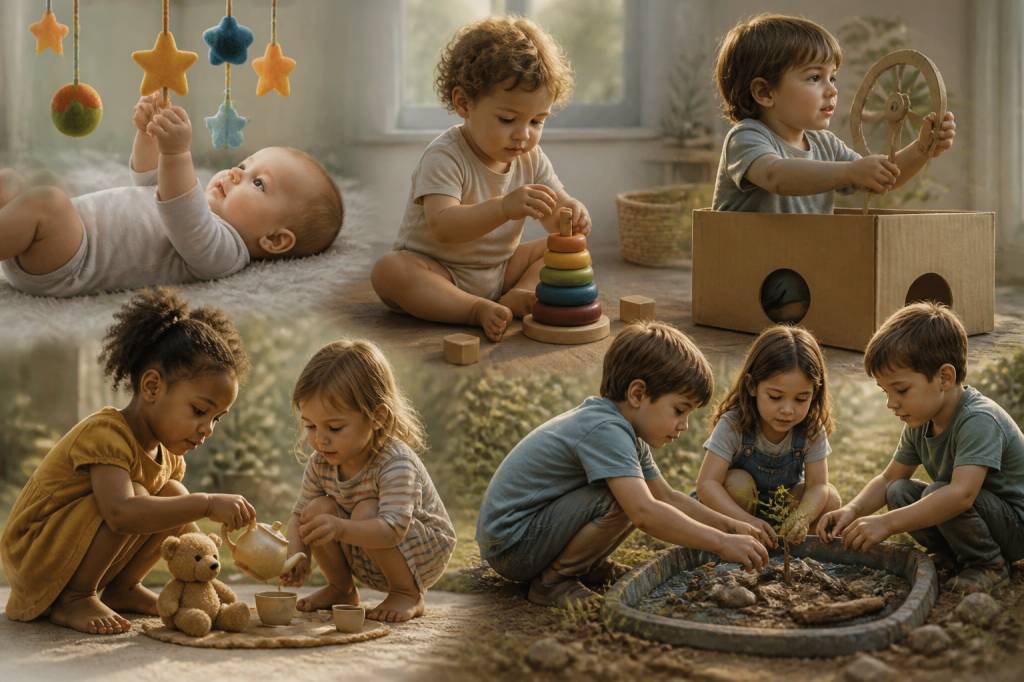
Play can look wonderfully ordinary: a baby pats a crinkly book, a toddler fills and empties the same cup, or two preschoolers sit beside each other while fiercely protecting their own blocks. Yet beneath these small moments, children are building language, confidence, coordination, creativity, and relationships.
As parents, we sometimes wonder whether our child is playing “the right way.” Should a baby be interacting more? Should a toddler share? Why does a preschooler prefer playing next to other children instead of with them? The reassuring answer is that play develops gradually, and every stage has something important to teach us.
Understanding the stages of play helps us respond with patience rather than pressure. It also gives us simple ways to create an environment where children can explore, experiment, and enjoy being children.
Why play matters so much
Play is not a break from learning. For young children, play is one of the main ways learning happens. Through it, they test ideas, practise new skills, make sense of emotions, and discover how the world works.
When a baby drops a spoon from the highchair for the tenth time, they are not trying to make mealtime difficult—although it may certainly feel that way when we are in a hurry. They are learning about cause and effect. When a toddler builds a tower and knocks it down, they are exploring balance, movement, and repetition. When a preschooler pretends to run a grocery shop, they are practising language, social rules, imagination, and problem-solving all at once.
Play supports several areas of development:
- Physical development: Running, climbing, grasping, stacking, and drawing strengthen the body and refine coordination.
- Cognitive development: Children learn to plan, remember, compare, predict, and solve problems.
- Language development: Songs, pretend play, stories, and conversations expand vocabulary and communication skills.
- Social and emotional development: Play gives children opportunities to express feelings, understand others, and practise cooperation.
- Creative development: Open-ended materials invite children to imagine possibilities without one “correct” result.
These areas overlap beautifully. A child building a pretend house with cardboard boxes may be strengthening their muscles, negotiating with a friend, inventing a story, and learning new words at the same time.
The early stages: discovering the world
Unoccupied play: the quiet beginning
Unoccupied play is often seen during the first months of life, although it can appear at other ages too. The baby may move their arms, stare at their fingers, kick their legs, or watch light shift across the wall. There may not be an obvious game, but the child is observing and discovering.
These small movements are the beginning of curiosity. A baby is learning what their body can do and noticing what happens around them. A parent might offer a soft rattle, a high-contrast picture, or a safe space on the floor where the baby can move freely.
There is no need to fill every moment with entertainment. A few calm minutes of looking, stretching, and listening are valuable. Sometimes the most supportive thing we can do is stay nearby and allow the baby’s attention to lead.
Solitary play: learning independently
Solitary play usually becomes more noticeable during infancy and toddlerhood. Children play alone, concentrating on their own activity without seeking interaction with other children. A toddler may line up cars, turn the pages of a board book, or place large beads into a container.
Solitary play is not a sign of loneliness or poor social development. It helps children build focus, independence, and confidence. Before a child can join a group game, they need time to become comfortable exploring materials and ideas on their own.
Parents can support this stage by providing a small selection of safe, simple toys. Blocks, stacking cups, chunky puzzles, play dough, fabric scraps, and containers often inspire more creativity than toys with flashing lights and a single purpose.
Try to resist correcting every action. If a child uses the blocks to make a “bed” instead of a tower, the play is still doing its job. In fact, the unexpected idea may be the most interesting part.
Watching and playing beside others
Onlooker play: learning by observing
During onlooker play, a child watches other children without joining them. They may stand close to a group at the playground, observe a sibling’s puzzle, or quietly watch children build with construction toys.
To an adult, it can appear as though nothing is happening. In reality, the child may be gathering information: How do the children take turns? What are they building? What happens when someone asks for a toy? Watching is a gentle way to study social behaviour before taking part.
We can support an onlooker without pushing. Instead of saying, “Go and play with them,” try a simple observation: “They are making a road with the blocks. I wonder where their cars are going.” This offers language and an invitation without turning play into a performance.
Parallel play: together, but separately
Parallel play often appears in toddlerhood and the early preschool years. Two children may sit close together, each playing with similar toys, without sharing a common activity. One child rolls a ball while the other stacks blocks. They may occasionally glance at each other, copy an action, or reach for a nearby toy, but they are not yet truly collaborating.
This stage is an important bridge toward more social play. Children are becoming comfortable near one another and learning through imitation. They may not be ready to share materials or agree on a story, and that is developmentally normal.
Sharing, in particular, takes time. A young child may understand the words “take turns” long before they are emotionally ready to hand over a treasured truck. Rather than demanding perfect sharing, adults can model simple language:
- “You are using the red cup. Maya can have it when you are finished.”
- “Let’s find another truck for your friend.”
- “You both want the shovel. We can use a timer for turns.”
It is also helpful to remember that parallel play can be peaceful and meaningful. Two children do not need to produce one shared masterpiece to benefit from being together.
From playing near others to playing with others
Associative play: sharing ideas and materials
In associative play, children begin to interact more directly, although their play may not yet have a shared goal. They may exchange toys, talk about what they are doing, imitate one another, or add pieces to the same general activity.
Imagine two children at a sensory table. One fills a cup with rice while the other makes a small “cake.” They may borrow a spoon, comment on each other’s creations, and laugh together, but they are not necessarily following one plan. Their play is connected, flexible, and full of social learning.
This stage brings more conversation and emotional complexity. Children practise asking, responding, negotiating, and coping when someone changes the game. Small disagreements are not always a problem to eliminate. With calm support, they become opportunities to learn.
Instead of immediately solving every conflict, we can help children name what is happening: “You wanted the blue block, and Leo is using it. What could we do?” Offering two realistic choices—waiting, finding another block, or building together—gives children a sense of agency.
Cooperative play: creating together
Cooperative play usually becomes more common during the preschool years. Children begin to share a purpose, assign roles, follow simple rules, and work toward a common idea. They may build a zoo, play house, invent a restaurant, or organise a pretend rescue mission for stuffed animals.
This is the stage many adults picture when they hear the word “playing together,” but it does not appear overnight. Cooperative play depends on skills that develop gradually: communication, emotional regulation, flexible thinking, memory, and the ability to see another person’s point of view.
Even when children are cooperating, the play may change direction every few minutes. A grocery store can become a dinosaur hospital, then suddenly a train station. Adults may feel the need to restore order, but children’s imaginative logic does not always require a timetable.
We can join in by following their lead. Ask, “What role should I play?” or “What does the baby dinosaur need?” Avoid taking over the story or turning it into a lesson. A child who directs the play is practising planning and communication; a child who listens and adapts is practising collaboration.
How to support every stage of play
Children do not move through these stages in a perfectly straight line. A four-year-old may enjoy cooperative pretend play in the morning and choose solitary drawing in the afternoon. A child may watch first in a new setting, then gradually join when they feel secure. This flexibility is normal.
A supportive play environment does not need to be expensive or elaborate. Consider these simple principles:
- Offer open-ended materials: Blocks, cardboard boxes, scarves, dolls, animal figures, crayons, and containers can become almost anything.
- Protect uninterrupted time: Children often need time to move from exploring to deeply engaging. Try not to interrupt immediately when the play is safe.
- Create comfortable spaces: A small rug, low shelf, or quiet corner can help children feel capable and organised.
- Follow the child’s interests: If your child loves vehicles, add roads made from masking tape. If they love animals, provide boxes for habitats and blankets for nests.
- Model social language: Use phrases such as “Can I join?”, “Your turn is next,” and “Let’s find a solution.”
- Keep expectations realistic: A toddler cannot consistently manage conflict like an older child. Guidance should match the child’s developmental stage.
Our presence matters too. Sometimes children need us to join their game; sometimes they need us to sit nearby with a cup of tea and quietly admire the tower. Both forms of support communicate: “Your ideas matter, and I trust you to explore.”
When play feels different
Children have different temperaments, personalities, cultures, and experiences. Some rush into a group, while others need a long period of observation. Some love imaginative games; others prefer movement, sorting, music, or building. There is no single personality that healthy play must resemble.
Still, if a child consistently seems unable to engage with any toys or activities, loses skills they previously had, appears deeply distressed during everyday play, or shows persistent difficulty communicating and connecting, it is worth sharing these observations with a paediatrician or child development professional. Seeking advice is not a judgement. It is simply a way to understand how best to support the child.
Play should also be safe and accessible. Supervise activities according to your child’s age, avoid small objects for babies and children who still mouth toys, and adapt materials for physical, sensory, or communication needs. Every child deserves a way to participate, whether that means using larger tools, visual choices, sensory breaks, or extra time.
The gift of letting children play
There is something humbling about watching a child learn through play. A cardboard box becomes a boat. A spoon becomes a microphone. A pile of cushions becomes a mountain that must be climbed before snack time. In these ordinary moments, children are not wasting time. They are developing the skills they will carry into relationships, school, and daily life.
When we understand the stages of play, we can notice progress where we once saw mess or repetition. The baby who watches is learning. The toddler who plays beside a friend is learning. The preschooler who negotiates the rules of an imaginary kingdom is learning—and probably enjoying a great deal of creative authority along the way.
Our role is not to rush children toward the next stage. It is to offer safety, time, encouragement, and room for wonder. With a little patience, play becomes more than an activity on the schedule. It becomes the language through which children discover themselves, one joyful experiment at a time.