
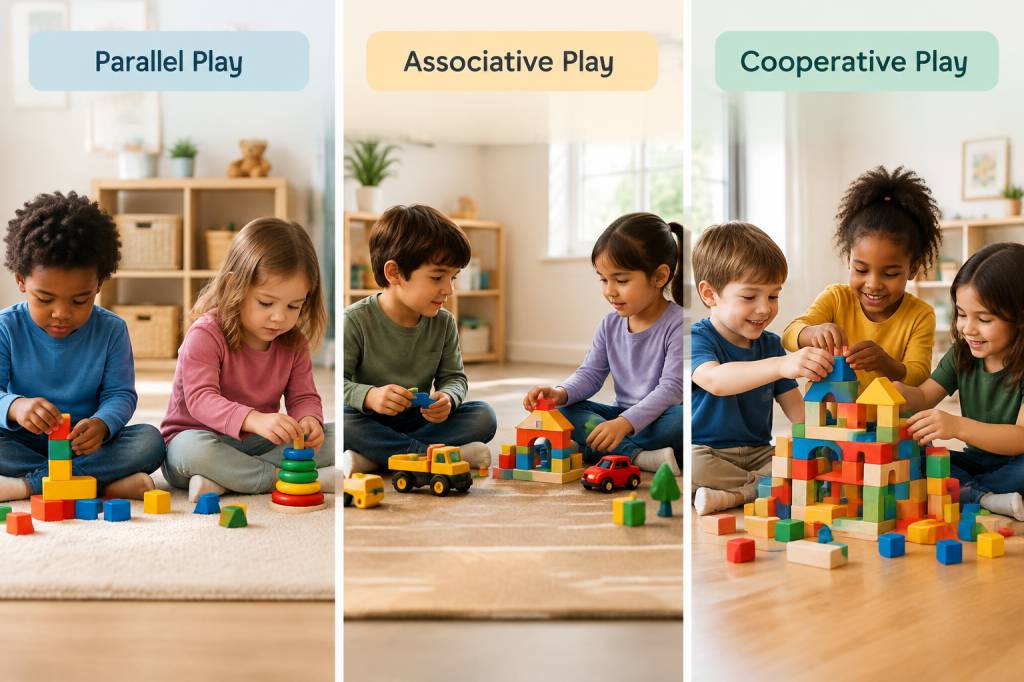
Two toddlers sit side by side on the rug. One stacks wooden blocks into a tower; the other carefully lines up toy animals. They are close enough to borrow each other’s crayons, but neither seems especially interested in sharing a plan. Then one child reaches for a block. The other offers one—and, suddenly, the animals are part of the tower’s grand opening.
That small shift from playing alongside someone to playing with them raises a common question: what is the opposite of parallel play? The short answer is cooperative play, when children work together toward a shared idea or goal. But there is an important step in between: associative play, when children interact and share materials without necessarily organizing their play around one common plan.
These labels describe helpful patterns, not a checklist children must complete on schedule. Play can move back and forth between them, and every child’s social development has its own rhythm. Understanding the differences can help you recognize what your child is practicing—and how to support them without turning playtime into a performance.
What parallel play looks like
Parallel play is when children play near one another, often with similar toys, but do not actively coordinate what they are doing. A child might roll a toy car along the edge of a play mat while another drives a truck across the middle. They may notice each other, copy a movement, or exchange a glance, yet remain focused on their own activity.
This kind of play is commonly associated with toddlers, though it can appear at other ages too. It often offers an early, comfortable way to be around peers. A child gets to explore the exciting business of another person’s presence without needing to negotiate every block, spoon, or pretend cupcake.
Parallel play is not a sign that a child is unfriendly or incapable of sharing. It can involve plenty of learning: watching, imitating, exploring materials, and getting used to a busy social setting. Sometimes a child is deeply interested in what a neighbor is doing but is not yet ready to join in. Quiet observation counts as engagement, even if it does not look like a conversation.
Parents may hear the silence and wonder whether to step in. Usually, there is no need to hurry the moment along. Sitting nearby, offering materials, and allowing children to choose whether to connect gives them room to find their own way.
So what is the opposite of parallel play?
If we use the term loosely, the opposite of parallel play is interactive social play: children are no longer simply playing beside one another; they are engaging with one another. In the familiar stages of play described by sociologist Mildred Parten, associative and cooperative play are two forms of this more social activity.
Associative play involves interaction, sharing, and conversation, but the children may still follow separate ideas. Cooperative play involves a shared purpose, with children coordinating roles or actions to make something happen together.
These are not two sides of a switch. A child does not wake up one morning having “finished” parallel play. They may build together for ten minutes, play independently for the next ten, and then invite a friend into a pretend game. The labels are useful for noticing patterns, not for measuring a child’s worth or predicting exactly what comes next.
Associative play: together, but not quite on the same plan
Imagine two children playing with toy dishes. One pours pretend tea; the other arranges plastic fruit. They chat, trade a cup, and pass a spoon back and forth. They are connected through the play, but they have not necessarily agreed to run a café or serve a particular customer. That is a good example of associative play.
Associative play may include sharing materials, commenting on what another child is doing, copying an idea, or moving between activities. The children are socially involved, but their play does not depend on a single shared goal. One child might decide the tea party is over and wander off to inspect the blocks. The other may carry on pouring. No grand meeting is required.
For a parent, this stage can look wonderfully ordinary. Children might play with sidewalk chalk and swap colors, take turns pushing cars down a ramp, or add separate pieces to a big pile of play dough. The interaction is real even when their ideas do not neatly match.
Associative play also gives children practice with social give-and-take. They can learn that another person has ideas, that materials may be shared, and that a game can change when someone else joins. These are meaningful skills, built through small, everyday exchanges rather than a perfect script.
Cooperative play: a shared idea takes shape
Cooperative play happens when children organize their play around a common goal, story, or set of roles. The same toy dishes might now become a restaurant: one child is the chef, another takes orders, and a third serves the food. They are working together to keep the pretend world going.
Other examples include building a block bridge together, making up rules for a game, putting on a puppet show, or pretending to care for a roomful of stuffed animals. Cooperative play often asks children to communicate, make decisions, adapt, and find ways to keep a shared idea moving. Sometimes it also asks them to accept that their friend has a different idea about what happens next. A tiny dinosaur may be perfectly happy to be a customer; it may not agree that the restaurant serves only imaginary broccoli.
Cooperation does not mean there will be no disagreements. In fact, conflict can appear precisely because children are invested in the same game. “I want to be the doctor” and “You can’t use that block” are not proof that play has failed. With adult support, these moments can become opportunities to practice taking turns, expressing a preference, and finding another way forward.
How the play stages differ
The main difference is how much children coordinate with one another. A quick comparison can make the distinction easier to spot:
- Parallel play: Children play near one another, mostly following their own activities.
- Associative play: Children interact, share or exchange materials, and may talk, but they are not committed to one shared plan.
- Cooperative play: Children work together within a shared game, goal, story, or set of roles.
In real life, the boundaries are often soft. A child may watch a peer, copy their tower, ask for a block, and eventually suggest building a castle. Is that one stage or several? The useful answer is that the play has become more interactive over time. You do not need to assign it a label while the children are busy deciding whether the castle has a moat.
When do children move beyond parallel play?
Parallel play is often seen during toddlerhood, while associative and cooperative play tend to become more common as children gain language, social experience, and the ability to manage shared activities. But there is no universal birthday at which a child should suddenly play cooperatively. Age ranges found in books and online are broad guides, not deadlines.
Children may be more ready to join a group in some settings than others. A familiar playmate, a favorite activity, a quiet room, or a well-rested morning can make participation easier. A crowded birthday party, a new environment, or one very prized toy can make it harder. Temperament, communication style, developmental differences, and past experiences all matter too.
It is also entirely normal for children to return to independent or parallel play after trying more social games. Playing alone can be restorative and enjoyable. The goal is not to make every moment of play collaborative; it is to give children opportunities to connect while respecting their need for space.
Gentle ways to support more social play
You do not need to direct every interaction or ask a child to share on demand. Often, the most helpful support is simple: create a welcoming setup, stay close enough to help, and let the children take the lead. Try these low-pressure ideas:
- Offer open-ended materials. Blocks, play dough, toy animals, large sheets of paper, and dress-up clothes can support many ideas without requiring children to follow one set of rules.
- Provide duplicates when you can. Two buckets, several crayons, or a small basket of similar cars can make it easier for children to begin alongside one another before they are ready to share.
- Notice shared interests. If both children are watching the same train, you might say, “You both noticed how fast it goes.” Then pause. They may pick up the connection themselves.
- Model useful language. Offer simple phrases such as “Can I have a turn when you’re done?” or “Let’s make a road together.” Children can borrow these words when they need them.
- Make room for different ideas. If one child wants a blue tower and another wants a red one, they could build two towers, add a bridge, or take turns choosing the next block.
- Keep pretend play light. You might introduce a gentle prompt—“The teddy bear is hungry. What could we do?”—without assigning every child a role or deciding how the story must end.
- Respect a child’s choice to watch. A child who observes before joining may be gathering information and building confidence. They do not need to be pushed into the middle of the game.
When a conflict arises, try describing what you see before rushing to solve it: “You both want the red shovel.” Then offer a manageable next step, such as taking turns, finding another shovel, or choosing a different tool. Young children often need help with the words and the plan, not a lecture on good sharing.
What if my child mostly plays alone?
Children can enjoy solitary play at many ages. Playing alone gives them time to explore an idea at their own pace, and some children need a little longer to feel comfortable in groups. The amount of social play a child shows on any particular day is not, by itself, a complete picture of their development.
It can help to notice the broader pattern. Does your child show interest in people in their own way? Do they communicate needs, enjoy familiar interactions, or engage with a trusted adult? If you have ongoing concerns about your child’s communication, social connection, or development, bring your observations to their pediatrician. You know your child’s everyday world, and your questions deserve to be heard. Seeking guidance is a way to understand what support may help, not a reason to assume something is wrong.
Let play grow at its own pace
Parallel play is not a social dead end. It can be a gentle beginning: children notice one another, become comfortable nearby, and gradually try small exchanges. Associative play adds interaction without requiring a shared plan. Cooperative play brings children together around an idea they can build, change, and enjoy as a team.
Some days, the biggest social victory may be a child handing over one wooden block. Another day, it may be a whole group inventing a restaurant with a menu, a chef, and a very demanding stuffed-animal customer. Both moments matter. When we give children time, welcoming materials, and steady support, we make room for connection to grow in the way that feels right for them.