


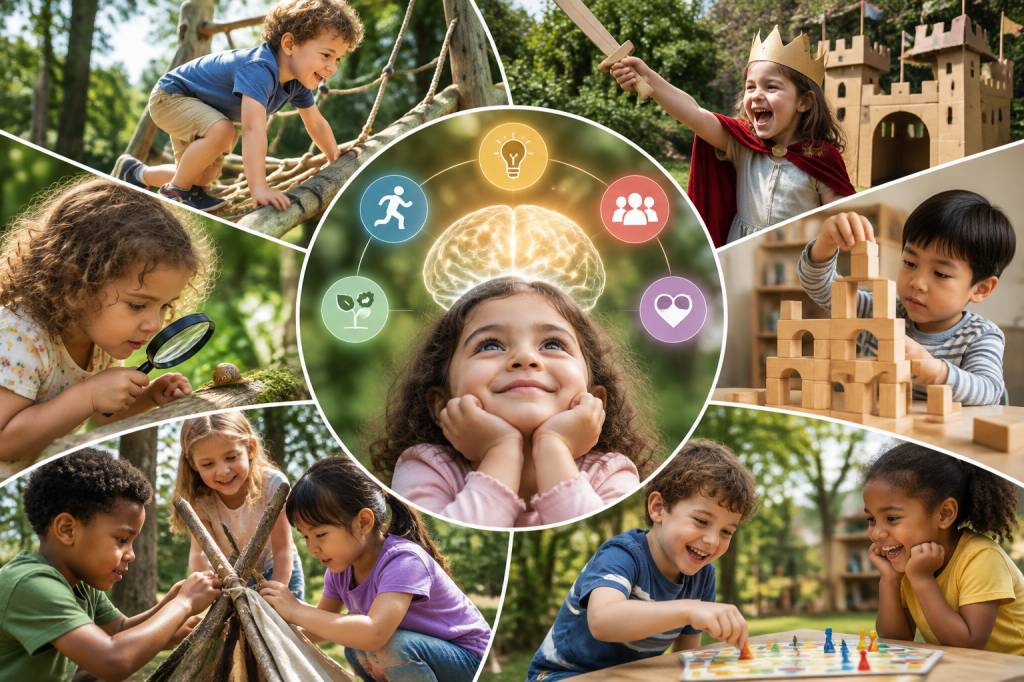
One afternoon, a toddler may spend ten quiet minutes turning a wooden block over and over. Nearby, an older child is building a tower, while a baby watches the whole scene from a blanket. It might look like three very different activities. In fact, each child is learning through play in a way that fits their moment.
Play is more than a way to pass the time. It gives children room to explore ideas, practice new skills, connect with others, and make sense of the world. Child development researchers often describe six types of play: unoccupied, solitary, onlooker, parallel, associative, and cooperative. These are useful ways to understand how play can change as children grow—not a checklist that every child must follow on a schedule.
A child may move between several types in one afternoon, or show different patterns depending on the setting, their energy, and who is nearby. There is no need to turn play into a performance. A loving, responsive adult and a little space to explore are often plenty.
Unoccupied play: noticing the world
Unoccupied play can look like almost nothing is happening. A baby might wiggle their fingers, gaze at a patch of sunlight, kick at a blanket, or pause to watch dust float through the air. Older children may wander around a room, pick up an object, put it down, and move on without an obvious plan.
But those small moments are full of discovery. Babies are learning that their bodies can move and that the world responds. A kick makes a mobile sway; a hand brushes a soft toy; a sound catches their attention. These are early experiments in cause and effect, attention, and sensory awareness.
You can support unoccupied play by making a safe, uncluttered space where your child can look, listen, and move freely. A blanket on the floor, a few age-appropriate objects, and a caregiver nearby can be enough. There is no need to fill every quiet moment with a toy or an activity. Sometimes the best offering is simply time.
Solitary play: happily playing alone
In solitary play, a child focuses on their own activity. A young toddler might stack cups, turn pages in a board book, or push a toy car back and forth. They may be so absorbed that another child playing nearby barely registers.
Playing alone gives children a chance to follow their own ideas. They can repeat an action, try something in a new way, and concentrate without needing to share or coordinate. A child building a block tower alone is practicing more than hand-eye coordination: they are making choices, solving small problems, and discovering what happens when the blocks are arranged differently.
Adults sometimes worry that a child who plays alone is missing out socially. Solitary play, especially in early childhood, is a normal and valuable part of development. It does not mean a child is lonely or unfriendly. A little independent play can also give a caregiver a rare moment to drink coffee while it is still warm—which, in parenting, counts as a small triumph.
Offer materials your child can explore safely, such as blocks, chunky crayons, or simple puzzles suited to their age. Stay available, but try not to take over. If your child wants to show you something, respond with interest; if they are deeply focused, let that concentration have room to grow.
Onlooker play: watching before joining
With onlooker play, a child watches other people play without joining in. They may stand beside a group at the playground, observe siblings making a pretend restaurant, or ask questions from the edge of a game.
It can be tempting to say, “Go play with them!” But watching is not necessarily a sign of hesitation that needs fixing. Children often learn by observing how a game works, what the other children are doing, and how they might take part. A child watching a game of make-believe may be gathering ideas and working up the confidence to join when it feels right.
Try acknowledging what your child notices: “They’re taking turns being the shopkeeper,” or “You’re watching how they build that track.” This shows that you see their interest without putting them on the spot. If they want help joining, you might offer a gentle bridge: “Would you like me to ask if there’s a job for another builder?” Then follow their lead. Sometimes they will say yes; sometimes they will keep watching a little longer.
Parallel play: playing side by side
In parallel play, children play near one another, often with similar toys, but do not yet share a common plan. Two toddlers might sit at the same table, each rolling play dough into their own collection of “snakes.” One may glance at the other, copy an idea, or offer a tool, then return to their own work.
This kind of play is common in the toddler years, though it can appear at other ages too. Children are learning to be comfortable near peers while staying in charge of their own activity. They may notice and imitate one another without needing to negotiate every detail.
Parallel play can be a gentle first step toward playing together. Set out enough materials to reduce unnecessary friction—two scoops, a few toy vehicles, or a generous supply of blocks. You do not have to insist that children share every object immediately. Sharing is a skill that develops with practice, support, and time, not a switch that flips on at a birthday party.
Associative play: sharing ideas and materials
During associative play, children begin to interact more directly. They may talk, trade toys, or share materials, but they are not necessarily working toward one agreed goal. Imagine two children playing with toy animals: one makes a farm, while the other builds a “hospital” beside it. They discuss which animals are sick, borrow a fence, and keep shaping their own stories.
This kind of play offers many chances to practice communication and flexibility. Children may learn to ask for a toy, respond to another person’s idea, or adjust their plan when a friend adds a surprising twist. These little negotiations can be messy. A disagreement over who gets the red truck is not proof that play has failed; it is often part of learning how relationships work.
When tensions rise, start by helping children put the problem into words. “You both want the red truck.” Then offer a simple option, such as taking turns or finding another vehicle for one child. Keep the solution manageable and avoid expecting young children to resolve every conflict on their own. Calm guidance gives them language and strategies they can gradually use themselves.
Cooperative play: working toward a shared idea
In cooperative play, children organize themselves around a shared goal or story. They might build a pretend spaceship, play family, create a road for toy cars, or invent rules for a game. Each child can take a role, contribute ideas, and respond to what the group is making together.
Cooperative play draws on many developing skills: planning, listening, turn-taking, imagination, and problem-solving. It also asks children to be flexible. The spaceship captain may want to fly to the moon, while the engineer insists the crew needs snacks first. Both ideas can find a place in the story—especially if someone remembers the pretend biscuits.
Adults can support shared play without becoming its director. Provide open-ended materials such as cardboard boxes, cushions, dress-up clothes, blocks, or toy figures. Ask a curious question now and then: “What does your ship need for its journey?” Then give children room to take the story somewhere you did not expect. Their ideas may be far more interesting than the plan we had in mind.
What the six types can—and cannot—tell us
These categories are a helpful lens, not a developmental scorecard. Children do not necessarily pass through each type in a neat sequence, and one kind of play is not better than another. A preschooler can enjoy solitary play, while a toddler may happily join a group activity with support. Temperament, familiarity, culture, language, disability, and the setting can all shape how a child plays.
It is also normal for a child to move in and out of social play. A busy birthday party might be tiring, while a familiar game at home feels easy. A child may watch first, join later, and return to playing alone when they need a break. These shifts can be part of how children manage energy and feel secure.
Rather than asking, “Is my child playing the right way?” it may be more useful to notice what they are practicing. Are they exploring, concentrating, observing, sharing ideas, or building a story with someone else? The answer can help you choose how to support them—by offering safe space, language, materials, or simply your calm presence.
Making room for meaningful play at home
You do not need a playroom filled with the latest toys to encourage learning. Children often find fresh possibilities in a few simple, safe materials. A cardboard box can become a cave; a wooden spoon can lead a parade; a pile of blocks can be a tower, a bridge, or an extremely ambitious birthday cake.
To make play easier to enjoy:
-
Choose materials that suit your child’s age and follow safety guidance, especially around small parts and babies who put objects in their mouths.
-
Leave some unhurried time in the day. Play can be hard to start when every moment is scheduled.
-
Watch before stepping in. A pause may be your child thinking, experimenting, or deciding what to do next.
-
Offer help when it is useful, such as naming a feeling or demonstrating how a toy works, then let your child take over.
-
Remember that connection matters more than getting an activity “right.” A few attentive minutes can mean a lot.
Play does not always look tidy, social, or especially productive from the outside. Sometimes it is a baby staring at their hands; sometimes it is two children building separate towers side by side; sometimes it is a whole living room transformed into a pretend airport. In each case, children are exploring what they can do and how the world responds.
When we notice the many forms play can take, it becomes easier to meet children where they are. We can offer encouragement without rushing them, join in without taking over, and trust that learning is often happening in the small, ordinary moments right in front of us.