


One afternoon, two toddlers sit beside each other in the sandbox. One fills a bucket; the other carefully empties a different bucket. They are close enough to share a shovel, but neither seems especially interested in sharing a plan. A year or two later, those same children might be building a “birthday cake” together, assigning roles and debating who gets to blow out the pretend candles.
That change can feel like a small miracle. It is also a gradual developmental journey. Cooperative play—the kind in which children share a goal, coordinate what they are doing, and respond to one another’s ideas—usually becomes more noticeable around age four. But children do not follow a calendar, and playing near someone is an important step along the way.
What cooperative play looks like
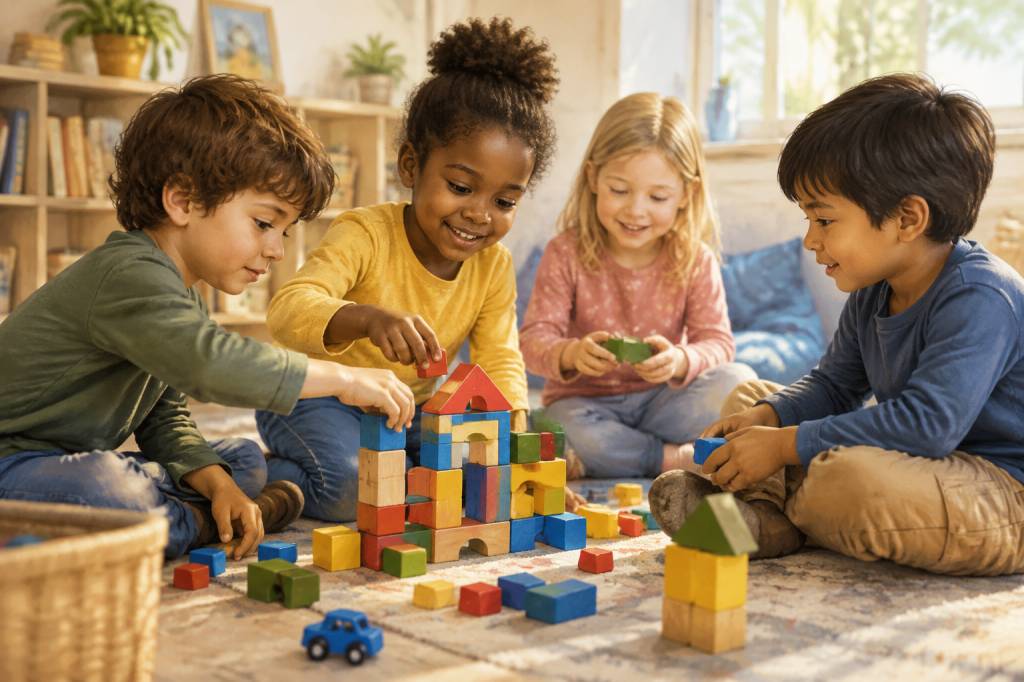
Cooperative play happens when children play with one another, rather than simply playing side by side. They may build one tower together, invent a game, take on different roles in a pretend kitchen, or work toward a shared goal in a simple board game.
The defining feature is not perfect teamwork. A group of preschoolers may agree that they are running a pretend grocery store and then spend several minutes arguing about who gets to be the cashier. That still counts as cooperative play. Negotiating, changing plans, and learning to listen are part of the work.
Cooperative play often includes skills such as:
- Sharing materials and making space for another child’s ideas.
- Taking turns or deciding who will do which part.
- Communicating a plan, even if the plan changes moments later.
- Working toward a shared goal or keeping a pretend story going together.
- Handling small disagreements with growing support from an adult.
Children may show some of these skills in one moment and find them much harder in another. A tired child who happily shared crayons in the morning may protect every block in the afternoon. That is not necessarily a step backward; energy, temperament, familiarity, and the situation all matter.
When do children begin playing together?
There is no single age when a child suddenly becomes a cooperative player. The commonly described stages of play offer a helpful guide, not a checklist or a deadline. They show how children’s social play often develops over time, with plenty of overlap between stages.
- Infancy: Babies enjoy watching faces, exchanging sounds, and responding to familiar people. This back-and-forth is an early foundation for social interaction, even though it is not yet play with a shared goal.
- About 1 to 2 years: Toddlers may play independently or notice what others are doing. They might imitate a sibling or briefly offer a toy, but sustained cooperation is still difficult.
- About 2 to 3 years: Many children enjoy parallel play: playing near another child, often with similar toys, without much shared planning. They may watch, imitate, or exchange a few words while staying focused on their own activity.
- About 3 to 4 years: Associative play often becomes more common. Children talk, share materials, and join one another’s activities, but they may not yet have a steady common goal.
- About 4 to 5 years and beyond: Cooperative play often becomes easier to spot. Children are more likely to organize a game, take on roles, follow simple rules, and keep a shared activity going.
These ages are broad estimates. Some children cooperate in short bursts before their fourth birthday; others prefer parallel play for longer. A child can also move between different kinds of play in a single afternoon. Development is less like climbing a tidy staircase and more like exploring a room full of interesting toys: children revisit familiar things as new skills grow.
Why parallel play matters
It is tempting to see two toddlers playing separately as a missed social opportunity. In fact, parallel play can be a very natural and useful part of learning. Children observe how others use toys, try out new actions, and become comfortable sharing space without the demands of coordinating every move.
Imagine a two-year-old watching another child stack cups. She may stack her own cups nearby, copy a particular shape, and occasionally glance over. She has not joined a team, but she is paying attention and learning from the moment. That quiet side-by-side play may be exactly right for her.
For some children, watching comes before joining. Others jump into a game enthusiastically, then leave when it becomes complicated. Both patterns can be part of healthy development. A child does not have to be constantly surrounded by playmates to build social skills; warm, responsive interactions with caregivers and familiar people matter too.
What makes cooperative play challenging?
Playing together asks a lot of a young child. To join a game, a child may need to communicate an idea, notice someone else’s signals, wait, cope with a change of plan, and manage the disappointment of not getting the preferred role. Those are big jobs for a still-developing brain.
Language can make a difference. A child who is still finding the words to say “Can I play?” or “Let’s make it taller” may rely on gestures, imitation, or simply moving closer. Temperament matters, too. Some children warm up slowly in groups; others are ready to direct the whole adventure before anyone has taken off a coat.
The setting can also help or hinder. A large, noisy group may be overwhelming, while one familiar playmate and a few open-ended toys can make joining in feel easier. Hunger, tiredness, and transitions can turn an otherwise promising game into a short-lived one. In other words, an unsuccessful playdate is not a reliable verdict on a child’s social future.
How to encourage play without taking over
Adults can make cooperative play easier by creating a welcoming opportunity and then leaving room for children to do the connecting. This can feel like a delicate balance: offer a little support, but resist the urge to become the director, referee, and costume department all at once.
- Start with a shared activity. Blocks, play dough, toy animals, water play, and pretend food invite children to contribute in different ways. A project with one “right” answer may leave less room for collaboration.
- Keep the group small at first. One familiar playmate can be more manageable than a room full of children. Short, low-pressure playtimes are often easier than expecting a long afternoon of harmony.
- Provide enough materials. Two buckets, several chunky crayons, or a generous pile of blocks can reduce unnecessary competition. You do not need a duplicate of every toy, but a little abundance can help.
- Model useful words. Try, “Can I add a road?” or “You can have the red cup when I’m finished.” Children often need to hear simple phrases many times before they can use them independently.
- Describe what you notice. “You are both putting animals in the barn” can help children recognize a shared activity without demanding that they cooperate on command.
- Allow small problems to be solved. Pause before stepping in, as long as everyone is safe. Children need chances to practice negotiating; they may surprise you with a solution.
If a disagreement gets stuck, a calm adult can help name the problem and offer a couple of workable choices. “You both want the firefighter hat. We can take turns, or we can find another hat for the next firefighter.” This does not guarantee instant peace—few sentences can—but it shows children what problem-solving sounds like.
When sharing is not the whole story
Parents often worry about sharing, especially when a toddler clutches a favorite toy while another child reaches for it. But sharing on demand is not the same as cooperative play. Young children are still learning about ownership, waiting, and other people’s perspectives. They may be more ready to take turns with a timer or a clear sequence than to hand over a prized object simply because an adult asks.
Try narrating the plan: “Maya is using the truck now. When she parks it, you can have a turn.” If a toy is especially precious, it is also reasonable to put it away before guests arrive. Protecting a favorite comfort item can make the rest of play feel safer.
Cooperation does not mean one child must always give in. A healthy shared game leaves room for both children to have ideas, make choices, and sometimes decide they would rather play separately. That last option is allowed. Children are not required to turn every playdate into a friendship storybook.
When should a parent ask for guidance?
Children vary widely in how they approach play, and differences in temperament, language, sensory preferences, culture, and development can shape what social play looks like. A child may communicate or connect in ways that do not match a familiar picture of pretend play, and that alone does not tell the whole story.
If you have concerns about your child’s communication, interactions, or overall development, bring them to your pediatrician or another qualified child-development professional. It can help to describe what you observe across different settings: how your child responds to familiar people, communicates needs, shows interest, and handles changes in play. You do not need to wait for a particular birthday to ask a question.
Seeking guidance is not a label or a prediction. It is a way to understand your child’s strengths and find support that fits. A professional can consider the full picture rather than judging development from one crowded playgroup or one afternoon when nobody wanted to share the blue truck.
Making room for the small beginnings
Cooperative play often grows from ordinary moments: a toddler copying a sibling’s tower, two preschoolers carrying a blanket together, or a child finally offering a pretend cookie to a friend. These moments may be brief and a little wobbly. They still matter.
Rather than asking whether your child is playing “the right way,” notice what they are practicing. Are they watching? Imitating? Inviting someone closer? Staying with a shared idea for a few minutes? Each small attempt offers a glimpse of skills still taking shape.
And if a playdate ends with one child building alone and the other happily arranging toy cars across the room, that can be a perfectly good afternoon. Togetherness does not have to be rushed. With time, patient support, and plenty of chances to explore, many children gradually discover the pleasure of making something up—and making it up together.