
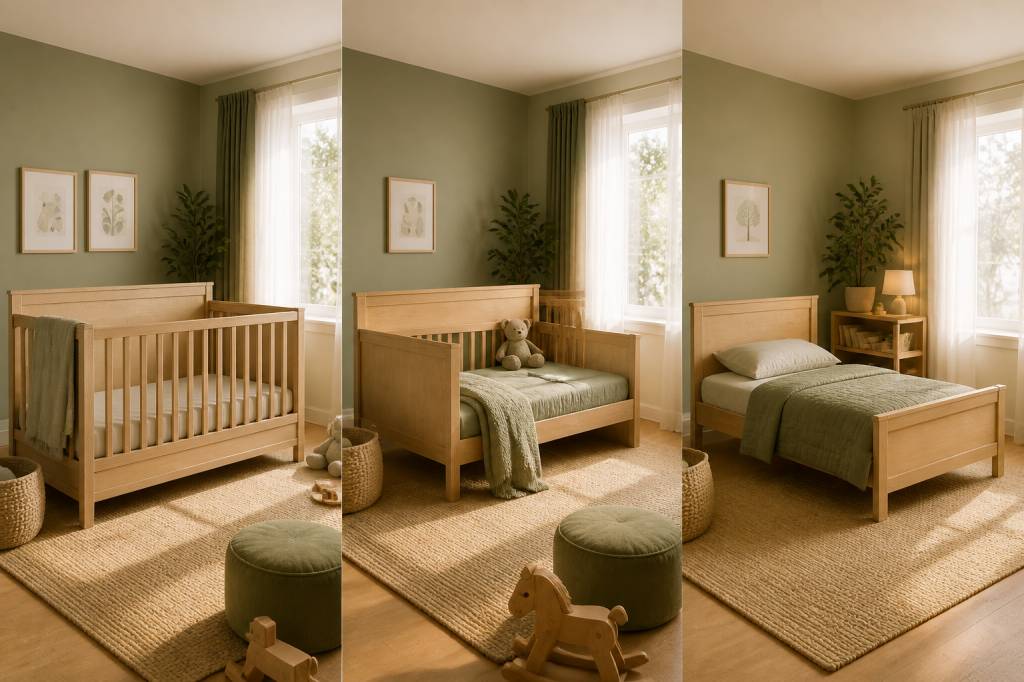
There is a particular moment in nursery planning when the room starts to feel less like a dream board and more like a living, breathing space. One day you are comparing swatches and tiny lamps, and the next you are wondering whether the crib you choose will still work when your baby is suddenly a toddler, then a curious little climber, then, somehow, a child who insists on arranging stuffed animals in precise rows before bed. That is where a 3 in 1 convertible crib quietly earns its place.
If you are preparing a nursery that needs to grow with your child, this kind of crib can be one of the smartest purchases you make. It is practical, space-conscious, and, when chosen well, beautifully aligned with the rhythm of modern parenthood: thoughtful today, flexible tomorrow. And since nursery budgets are often a balancing act between necessity and the sweet pull of adorable extras, a crib that adapts over time can feel like a small relief with lasting value.
What a 3 in 1 convertible crib actually does
A 3 in 1 convertible crib is designed to transition through three stages: a standard infant crib, a toddler bed, and typically a daybed. Some models can later be adapted into a full-size bed with an additional conversion kit, but the classic 3 in 1 setup focuses on those first three steps. It is made to stay with your child longer than a traditional crib, which means fewer big purchases during the early years.
At the newborn stage, the crib functions like any safe sleep space: secure sides, adjustable mattress height, and a sturdy frame. Once your child is ready for the toddler bed stage, one side is usually removed or lowered to create easier access. The daybed stage then offers a low, open sleeping setup that can feel less “babyish” for an older toddler or preschooler.
It sounds simple, but the real value lies in how it supports the very real chaos of growth spurts, changing sleep patterns, and the occasional bedtime negotiation worthy of a small diplomatic summit.
Why growing nurseries benefit from convertible furniture
Nurseries do not stay static for long. The soft, quiet room you build for a newborn often needs to become a more functional child’s room far sooner than expected. A convertible crib helps bridge that gap without forcing you to redesign the whole space every couple of years.
For families in smaller homes or apartments, this is especially helpful. Instead of storing a crib, shopping for a toddler bed, and later replacing that again, one piece of furniture carries the family through multiple stages. That can mean fewer headaches, less clutter, and better use of square footage.
There is also an emotional side to this choice. Many parents find comfort in continuity. A crib that stays in the room through the early transitions can make changes feel gentler for both parent and child. The bed may evolve, but the familiar frame remains. For children who thrive on routine, that visual continuity can be surprisingly reassuring.
Features to look for before you buy
Not all convertible cribs are created equally, and this is where many parents discover that “looks lovely online” is not the same as “works well for daily life.” Before committing, it helps to focus on a handful of practical features that matter far more than a perfectly staged product photo.
- JPMA or ASTM safety certification: Look for cribs that meet recognized safety standards. Safety should never be a guessing game.
- Adjustable mattress height: A higher setting helps early on when you are lifting a newborn in and out frequently. Lower settings become essential once your baby starts sitting or standing.
- Solid construction: Choose a crib with sturdy materials and strong joinery. A wobbly crib is not a charming imperfection; it is a red flag.
- Clear conversion kit availability: Make sure the toddler bed or daybed hardware is included or easily purchased later. Some parents only realize this after the crib has arrived, which is a stressful surprise no one needs.
- Compatible mattress size: Standard crib mattresses are usually best because they are easier to replace and accessorize.
- Smooth edges and safe finishes: Babies become toddlers, and toddlers touch everything. The finish should be non-toxic and the hardware well-secured.
- Easy-to-follow assembly: If furniture assembly tends to test your marriage or your patience, this matters more than you think.
One small but worthwhile tip: read beyond the product description and look at the instruction manual if possible. You want a crib that is not only safe and beautiful, but also something you can actually maintain without a quarterly engineering degree.
Choosing a style that grows with the nursery
A growing nursery benefits from furniture that feels timeless rather than overly themed. That does not mean the room must be plain. It simply means the crib should not rely on design elements that will look out of place after the baby phase.
Neutral finishes such as white, soft gray, natural wood, or warm taupe often age well. They work with evolving color palettes, changing decor, and the inevitable addition of new toys, books, and art projects on the walls. If you prefer a bolder statement, consider a strong crib color only if the rest of the room can flex around it.
Stacy-style honesty moment: it is easy to fall in love with a nursery look that feels perfect for a newborn, but children grow into their spaces quickly. A crib that still feels appropriate at age three is usually the more thoughtful investment.
Also consider the visual weight of the crib. Some models are airy and minimal, while others are more substantial. In a small nursery, a lighter design can keep the room from feeling crowded. In a larger nursery, a more grounded frame may help anchor the space.
Budgeting for the full journey, not just the first year
When comparing crib prices, it helps to think in stages rather than in one upfront number. A less expensive crib may seem attractive at first, but if it needs replacing after a year or two, the total cost can climb quickly. A 3 in 1 convertible crib often carries a higher initial price, but that cost can be easier to justify when spread across several years of use.
Still, budget-friendly does not mean buying blindly. Compare the crib itself, the mattress, and any future conversion parts. Some brands offer the crib at a reasonable price but charge more for the toddler rail or bed conversion pieces later. Others include more in the original package.
Here is a practical way to evaluate value:
- Estimate how long you expect to use the crib in each stage.
- Add the cost of any accessories or conversion kits.
- Compare that total to the cost of buying separate beds over time.
- Factor in resale value if you plan to sell or hand the crib down.
That last point matters. Well-made convertible cribs often hold value better than single-stage nursery furniture, especially when the finish is neutral and the condition is excellent.
Safety details that deserve your full attention
When it comes to baby furniture, safety is never the place for shortcuts. A crib may look sturdy on the surface, but the small details are what truly matter.
For the infant stage, check that the slat spacing is appropriate and that the mattress fits snugly without gaps. The crib should not allow a baby to slide between the mattress and the frame. Once your child is older, the conversion should still feel secure and stable, with no loose hardware or awkward transitions.
Pay attention to recalls as well. Even reputable brands can have issues, and it is wise to register your crib after purchase so you can be notified if anything changes. It is a simple step, but one of those parenting tasks that carries real peace of mind.
As your child grows, safe sleep practices evolve too. When converting to a toddler bed, make sure the room itself is ready: anchor furniture to the wall, keep cords out of reach, and remove anything that could be climbed, pulled, or used as a launching pad for mischief. Toddlers are charming little researchers, and their experiments are not always sleep-friendly.
Questions to ask before bringing one home
Before you add a crib to your cart, ask yourself a few honest questions. They can save you from a purchase that looks perfect in theory but feels frustrating in daily use.
- Will this crib fit comfortably in the room once other furniture is added?
- Is the style flexible enough to last beyond the baby stage?
- Are the conversion parts included, easy to find, and reasonably priced?
- Do I trust the construction and safety credentials?
- Will this crib still feel functional when my child is climbing, standing, and refusing naps with great conviction?
If the answers feel solid, you are likely looking at a crib that will serve your family well. If you hesitate on safety, fit, or long-term practicality, it may be worth continuing the search.
Making the crib work with the rest of the room
A convertible crib is only one part of the nursery, but it often sets the tone for everything else. Pairing it with versatile storage, a comfortable chair, and a changing area that can later be repurposed helps the room adapt as your child grows.
Think in layers. A crib that transitions well is strongest when surrounded by furniture that can also evolve. A dresser can become a clothing storage piece long after diapers are gone. Open shelves can hold board books now and school supplies later. Even a rug can shift from nursery softness to playroom practicality.
One helpful approach is to design around function first, decor second. The prettiest nursery in the world will not feel great if it is hard to move through at 3 a.m. when you are holding a sleepy baby and trying not to step on a squeaky toy. Choose a layout that supports feeding, soothing, changing, and eventually independent toddler movement.
When a 3 in 1 crib is the right choice
This type of crib is a strong fit for many families, but especially for those who want a long-term nursery solution without sacrificing style. It is useful if you:
- Want furniture that grows with your child
- Prefer a cleaner, less cluttered buying process
- Need to make the most of a smaller nursery
- Like the idea of continuity through early transitions
- Are willing to invest more upfront for better long-term value
It may be less ideal if you move frequently and do not want to transport large furniture, or if you prefer to refresh nursery furniture at each stage. In that case, separate pieces might suit your lifestyle better. The best choice is always the one that fits your home, your budget, and the rhythms of your family.
A thoughtful investment for the years ahead
A 3 in 1 convertible crib is not just a piece of furniture. It is a quiet companion through some of the most meaningful early years: the first sleepy nights, the first standing-up-at-the-rails moments, the first transitions into “big kid” sleep. It supports the changing needs of a growing nursery while giving parents a little more breathing room in their planning.
When chosen carefully, it offers more than convenience. It offers continuity, value, and the kind of flexible design that makes family life feel just a bit more manageable. And if there is one thing modern parenthood asks for again and again, it is not perfection. It is furniture that can keep up with real life, one phase at a time.
So if you are standing at the beginning of nursery planning, wondering whether a convertible crib is worth it, the answer is often yes, especially when your goal is a space that can stretch gracefully from infancy to early childhood. Choose well, choose safely, and choose with the next few years in mind. Your future self, balancing a bedtime story and a laundry pile, will be grateful.