
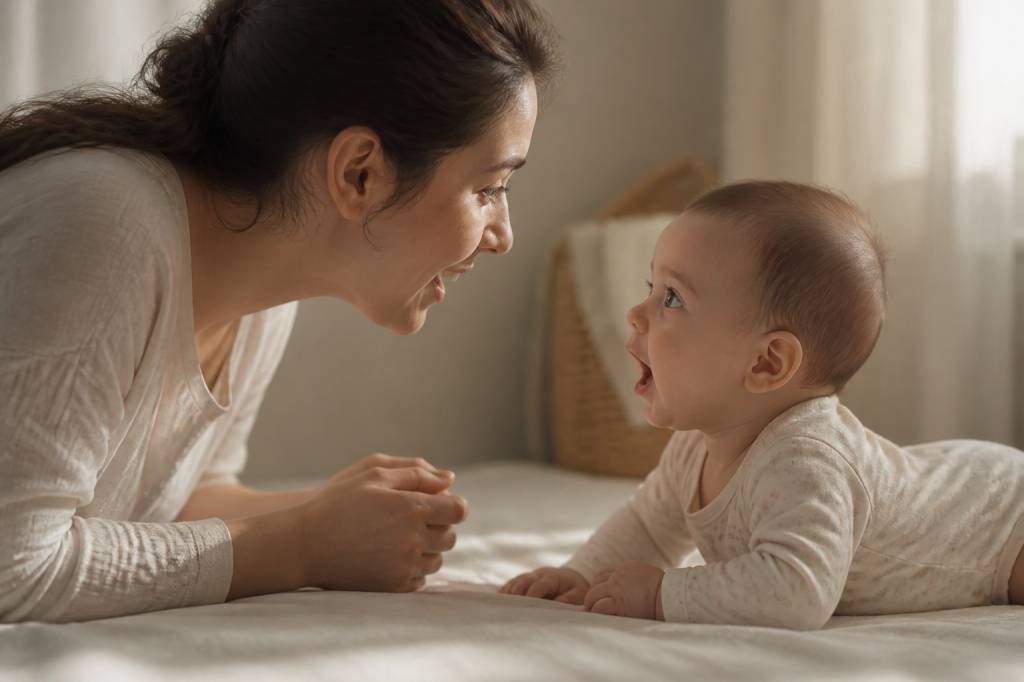
There is a special kind of music that fills a home during a baby’s first year: soft coos after waking, delighted squeals during diaper changes, and the wonderfully mysterious strings of sounds that seem to say everything and nothing at once. This is the babbling stage, one of the earliest and most exciting steps in your baby’s language development.
Babbling is more than adorable noise. It is your baby experimenting with the rhythm, volume, and sounds of human speech. Long before the first clear “mama” or “dada,” your little one is listening, practicing, and discovering that their voice can connect them with the people they love.
What is babbling?
Babbling refers to the repeated sounds babies make as they begin exploring speech. You may hear combinations such as “ba-ba,” “da-da,” “ma-ma,” or “ga-ga.” At first, these sounds may be simple and playful. Over time, they become more varied, intentional, and conversational.
It is important to remember that babbling is not the same as using words. When a baby says “ba-ba,” they may not be asking for a bottle or calling for a beloved blanket just yet. They are learning how sounds are formed and how their voice affects the people around them. Still, these early vocal experiments are an important foundation for future speech.
Every baby develops at their own pace. Some little ones are naturally chatty and fill the room with enthusiastic babble. Others are quieter observers who take their time before sharing their growing collection of sounds. Both patterns can be perfectly typical.
When does babbling begin?
Language development starts from birth, even before babies make recognizable speech sounds. Newborns communicate through crying, facial expressions, and body movements. During the first few months, many babies begin cooing, making gentle vowel sounds such as “ooh” and “ahh.”
Babbling often becomes more noticeable between four and six months. Around this time, your baby may begin combining consonants and vowels, producing sounds like “ba,” “ma,” or “da.” By six to nine months, many babies start repeating syllables: “ba-ba-ba” or “da-da-da.”
Between nine and twelve months, babbling may sound increasingly like a little conversation. Your baby might change their pitch, pause as if waiting for your reply, or use a long stream of sounds while waving, pointing, or reaching. It can feel as though they are telling you a very important story about the sofa, the family dog, or the spoon they just dropped for the twentieth time.
These age ranges are general guides rather than strict deadlines. Development does not follow a perfectly tidy calendar, and babies often focus intensely on one area while taking a brief pause in another.
How babbling changes over time
Babbling usually develops in several overlapping stages. Knowing what these stages may look like can help you notice your baby’s progress without turning every sound into a test.
- Early vocal play: Around two to four months, babies may coo, squeal, laugh, and experiment with their voices. They are discovering how it feels to make different sounds.
- Vocal exploration: Around four to six months, babies may blow raspberries, growl, shriek, and combine vowel sounds with early consonants.
- Repeated babbling: Around six to nine months, you may hear repeated syllables such as “ba-ba-ba” or “ma-ma-ma.” This is often called canonical babbling.
- Varied babbling: Around nine to twelve months, babies may combine different sounds and use changes in pitch and rhythm. Their babbling can begin to sound remarkably conversational.
- Early meaningful words: Near the end of the first year, some babies begin using a few sounds consistently to refer to familiar people or objects. Others need more time, and that can also be typical.
Some babies move through these stages quickly, while others linger in one phase. A baby who babbles a little later may still develop strong language skills, particularly if they are communicating in other ways through eye contact, gestures, facial expressions, and reactions to familiar voices.
Why babbling matters
Babbling helps babies practice the building blocks of speech. They are learning to coordinate their lips, tongue, jaw, and breath. They are also discovering that sounds can be repeated, changed, and combined.
At the same time, babbling teaches babies about social communication. When you answer your baby’s sounds, they begin to understand the rhythm of conversation: one person makes a sound, the other responds, and both people share attention. These early exchanges may be brief, but they are meaningful.
Babbling is also connected to listening. Babies learn the sound patterns of the language or languages they hear most often. A baby growing up in a bilingual or multilingual home may hear and eventually use different speech rhythms and sound combinations. Exposing your child to more than one language does not cause confusion. It gives them the opportunity to build a rich language foundation.
Simple ways to encourage early language
You do not need expensive toys or elaborate lessons to support your baby’s language development. The most powerful tool is your responsive presence.
- Talk through everyday moments: Describe what you are doing during dressing, feeding, bathing, or a walk. “We’re putting on your blue socks. One sock, and now the other.” Your baby may not understand every word, but they are absorbing your voice, rhythm, and expressions.
- Respond to babbling: When your baby says “ba-ba,” answer with “Ba-ba! I heard you.” This shows that their sounds matter and encourages them to communicate again.
- Pause and wait: Give your baby a few quiet seconds to respond. It can be tempting to fill every silence, but pauses teach the back-and-forth pattern of conversation.
- Copy their sounds: Imitating your baby’s squeals and syllables can make vocal play feel like a shared game. You can also add a new sound afterward, turning “ba-ba” into “ba-ba-ball.”
- Use gestures: Point to objects, wave hello and goodbye, and use simple gestures alongside words. Babies often understand gestures before they can say the corresponding word.
- Read aloud every day: You do not need to finish every page. Point to pictures, name familiar objects, and respond to your baby’s reactions. Repetition is welcome; babies are excellent little book critics and often request the same story with great determination.
- Sing songs and nursery rhymes: Songs offer repetition, rhythm, and exaggerated sounds. Clapping, bouncing, or using simple movements adds another layer of engagement.
- Reduce background noise: Turn off the television when possible and create moments for face-to-face interaction. Babies learn best when they can see your face and listen to your voice clearly.
Follow your baby’s interests
Language grows naturally through shared attention. If your baby is staring at a dog, talk about the dog. If they are reaching for a cup, name it: “Cup. You want the cup.” Following their focus makes language meaningful because the words are connected to something they already care about.
One of my favorite ways to encourage communication is to make ordinary routines a little more predictable. During a bath, you might repeat the same phrases: “Water on,” “Wash your toes,” and “All done.” Familiar words become easier to recognize when they appear in a consistent context.
Try not to worry about creating perfect learning opportunities all day long. Babies benefit from warm, responsive interactions, not from a schedule packed with activities. A few minutes of attentive conversation while preparing breakfast can be just as valuable as a carefully planned language game.
Babbling and hearing
Hearing plays an important role in speech development. Babies listen to the sounds around them and use what they hear as a guide while practicing their own voices. This is one reason newborn hearing screenings and regular checkups are so valuable.
Sometimes a baby may respond to loud sounds but still have difficulty hearing speech clearly, particularly if there is fluid in the ears or another hearing concern. If your baby does not seem to notice voices, does not turn toward sounds, or stops responding to sounds they previously noticed, mention it to a healthcare professional.
Trust your observations. Parents and caregivers often notice subtle changes before anyone else does. A question about hearing is not an overreaction; it is a thoughtful step in supporting communication.
When should you seek advice?
There is a wide range of typical language development, but certain signs are worth discussing with your baby’s pediatrician or a speech-language professional. You may wish to seek advice if:
- Your baby is not making cooing or other vocal sounds by around four months.
- Your baby is not babbling by around seven to nine months.
- Your baby rarely responds to voices or sounds.
- Your baby does not make eye contact, smile socially, or show interest in interacting.
- Your baby loses sounds or communication skills they had already developed.
- You have concerns about how your baby is communicating, even if they do not fit neatly into a milestone list.
These signs do not automatically mean that something is wrong. They simply suggest that a closer look may be helpful. Early support can make a positive difference, and asking questions early gives families more information and reassurance.
What if your baby is a quiet babbler?
Some babies are naturally more vocal than others. A quiet baby may still be developing communication through facial expressions, eye contact, gestures, movement, and attentive listening. Notice the whole picture rather than counting every syllable.
It can help to observe whether your baby tries to connect with you in other ways. Do they smile when you enter the room? Turn toward a familiar voice? Reach to be picked up? Share their excitement by looking at an object and then looking back at you? These social behaviors are all important parts of early communication.
Try to avoid comparing your baby with siblings, friends’ children, or videos online. One baby’s “first word” may arrive early, while another spends months perfecting expressive babble before speaking clearly. Developmental differences are common, and your baby’s journey does not need to match anyone else’s.
The beauty of those early conversations
Babbling can be messy, repetitive, and occasionally very loud. It may appear during a quiet moment in the library, at five in the morning, or precisely when you are trying to make a phone call. Still, these sounds are precious invitations to connect.
When you answer your baby, you are doing more than encouraging speech. You are showing them that communication is a shared experience. Their voice can reach another person. Their expressions are noticed. Their ideas, even the ones currently made up of “ga-ga-ga” and enthusiastic squeals, deserve a response.
So talk, listen, pause, sing, and enjoy the wonderfully imperfect conversations unfolding in your home. The words will come in time. For now, every coo, raspberry, and repeated syllable is your baby’s way of saying: “I’m here. Are you listening?”