
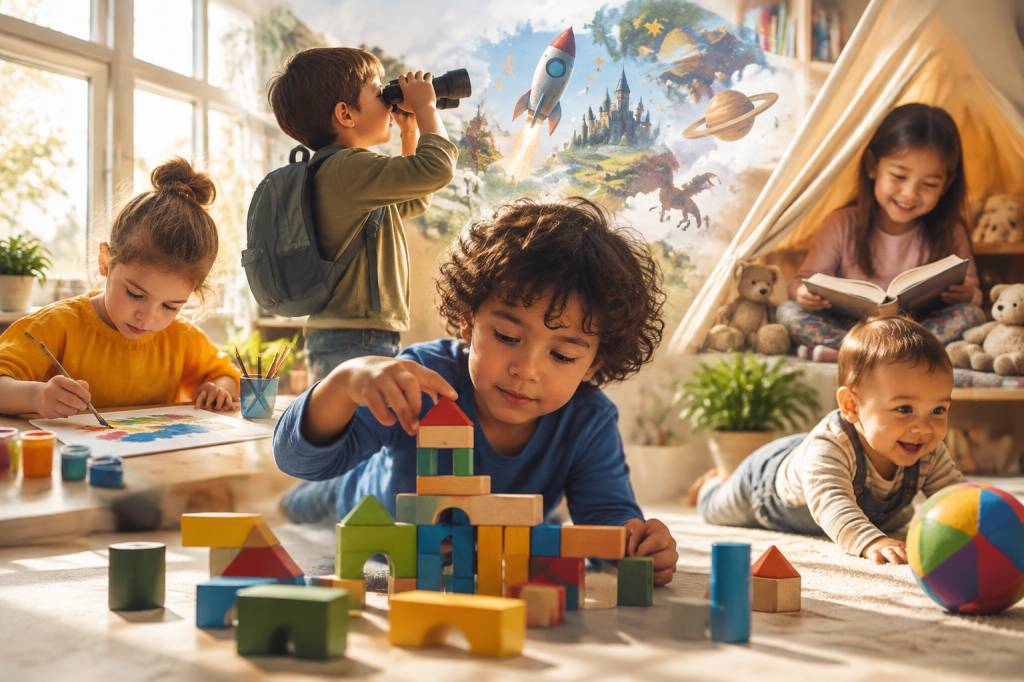
On a rainy afternoon, a cardboard box can become a rocket ship, a grocery store, or a very important house for three stuffed animals. The toys may be ordinary, and the box may be destined for recycling, but in a child’s hands, both become tools for discovery. Play can look like a break from learning. In reality, it is one of the ways young children make sense of the world.
Through play, children practice new skills, test ideas, build relationships, and move their bodies. They learn at their own pace, often without realizing they are learning at all. The best part for parents and caregivers? Supporting play does not require a packed schedule or a room overflowing with special toys. It begins with time, attention, and a little room for imagination.
Why play matters in childhood
Children learn by doing. When a toddler stacks blocks, knocks them down, and starts again, they are exploring balance, cause and effect, and persistence. When a preschooler turns a blanket into a cave, they are planning, imagining, and creating a story. These moments may seem simple, but they bring several areas of development together.
Play can support thinking and problem-solving, communication, emotional understanding, social skills, and physical coordination. These areas do not develop in separate boxes. A pretend tea party, for example, might involve pouring water, negotiating who gets which cup, practicing new words, and imagining what a guest might say.
Play is also a natural way for children to explore what interests them. A child who repeatedly builds a tall tower may be curious about height and structure. A child who lines up toy animals may enjoy patterns or sorting. Adults do not need to turn every game into a lesson. Often, simply noticing what captures a child’s attention gives them a helpful invitation to learn more.
Play builds thinking and problem-solving skills
Open-ended play gives children the chance to make choices and see what happens. Blocks, sand, water, art supplies, and pretend-play objects can be used in many ways, so there is no single “right” result. A tower that falls is not a failed project; it is useful information. The next attempt may have a wider base, fewer blocks, or a completely new design.
As children play, they practice skills such as remembering what they were trying to do, paying attention, making a plan, and adjusting that plan when something changes. These abilities develop gradually. A young child may need an adult nearby to help manage frustration, while an older child may be ready to work through a challenge for longer on their own.
Try offering a gentle prompt rather than solving the problem immediately. “What could make the bridge stronger?” leaves room for a child’s own ideas. If they ask for help, you might try one small suggestion and let them take it from there. The goal is not to make every activity a test of independence. It is to give children satisfying chances to experiment, with support available when they need it.
Imagination makes room for creativity
Creative play is not limited to drawing or music. It happens whenever a child invents a story, finds a new use for an object, or imagines what might happen next. A wooden spoon can be a microphone; a row of cushions can become stepping stones across a pretend river. Children learn that ideas can be made, changed, and shared.
Instead of asking only, “What is it?” try asking, “Tell me about what you made.” A child may have a whole story behind a scribble or a collection of pinecones. Listening gives them space to explain their thinking without worrying whether their creation looks a particular way.
Simple materials often do the job beautifully: paper, washable crayons, blocks, fabric scraps, empty boxes, or safe kitchen items. You do not need to supply a craft project with a perfect sample to copy. If a child asks you to make one, you can create alongside them, then let their version take its own delightful, slightly lopsided path.
Social play teaches children how to be together
Playing with other children gives them opportunities to practice sharing ideas, taking turns, listening, and working toward a common goal. These skills are not automatic. A disagreement over who gets to be the shopkeeper can be a real emotional storm in a small room. It can also be a chance to learn how to express a preference and hear someone else’s.
Adults can help by naming what they see and offering manageable choices. “You both want the red truck. We can use a timer, or you can find another truck together.” For younger children, parallel play—playing near another child with similar toys—may be a comfortable step before they begin to play together. Children vary in how much social interaction they want, and quiet play is valuable too.
When children pretend to run a restaurant, take care of a doll, or rescue a toy animal, they may also be exploring everyday relationships and feelings. You might notice them copying phrases they have heard or working through a situation in their own way. Follow their lead, and avoid pressing for explanations if they would rather keep the story moving.
Movement supports healthy growth
Running, climbing, dancing, digging, and balancing help children develop strength, coordination, and confidence in their bodies. Small movements matter as well: turning pages, stacking small blocks, stirring pretend soup, or making marks with a crayon all give little hands practice.
Active play does not need to be elaborate. A hallway can become a path for stepping over cushions, a park can offer room to run, and a walk around the block can turn into a search for leaves, birds, or interesting shapes. Follow age-appropriate safety guidance, supervise where needed, and adapt activities to your child’s abilities and environment.
Children also need different kinds of play. Energetic movement can be followed by quieter activities such as puzzles, looking at books, or playing with dough. There is no need to insist that every child enjoys every activity. The aim is to offer varied opportunities and notice what feels engaging, rather than to fill every moment with scheduled enrichment.
Play can help children understand feelings
Children do not always have the words to explain what they feel. Play can give them another way to express and explore emotions. A child might make a toy feel scared before starting a new activity, or act out a familiar routine with dolls. This does not mean adults should try to interpret every game as a hidden message. It simply helps to remember that play can be a safe space for trying out feelings and ideas.
When a child becomes upset during play, a calm adult presence can make a difference. You might say, “That was frustrating when the blocks fell.” Naming an emotion gently helps children connect words with what is happening inside. Then give them time. They may want comfort, a new attempt, or a pause before returning to the game.
Play can be joyful, but it does not have to be cheerful every second to be worthwhile. A child may feel challenged, disappointed, or uncertain while learning something new. What matters is that they have support, room to explore, and an adult who treats their feelings with care.
How adults can support play without taking over
It is tempting to step in with the clever idea, the right answer, or the fastest way to finish. Sometimes children do need help, and joining their game can be a lovely way to connect. But leaving some decisions to them gives their own ideas a chance to grow.
-
Follow their interest. If your child is fascinated by buses, look for buses on a walk, draw them, or build one from blocks.
-
Offer open-ended materials. A few blocks, paper and crayons, or a cardboard box can invite many different kinds of play.
-
Make time for unhurried play. Some children need a while to settle into an activity before their ideas begin to flow.
-
Notice effort, not just results. “You kept trying different ways to make it stand” says more than “You’re so clever.”
-
Join when invited. Let the child lead the story, even if your character has to eat invisible soup for the fifth time.
-
Keep safety and access in mind. Choose materials that suit your child’s age and needs, and adjust activities so they can take part as comfortably as possible.
Every child has a different temperament, pace, and way of engaging. Some jump into noisy group games; others prefer to watch first. Some love messy art, while others are happier arranging toy cars in a precise line. There is no need to compare one child’s play with another’s. Offer invitations, observe, and let their interests guide you.
Everyday moments count
Play does not have to appear on a family calendar as an official activity. Sorting socks, stirring pancake batter, watering plants, and inventing a story on the way to the store can all become opportunities to explore and connect. A toddler might match socks by color; an older child might help count them. Even a familiar routine can feel playful when there is time to talk, wonder, or take turns.
And when the day is busy, a few minutes of attentive play can still matter. Put down your phone, sit on the floor, and see what your child is working on. You do not need to direct, teach, or produce a perfect memory. Being present is enough to say, “I’m interested in your world.”
Childhood play is not an extra reward after learning is finished. It is one of the ways learning happens: through curiosity, movement, imagination, repetition, and relationships. A box becomes a ship, a fallen tower becomes a new plan, and a pretend conversation becomes practice for the real ones ahead. In these ordinary moments, children are building skills and confidence—one game at a time.