
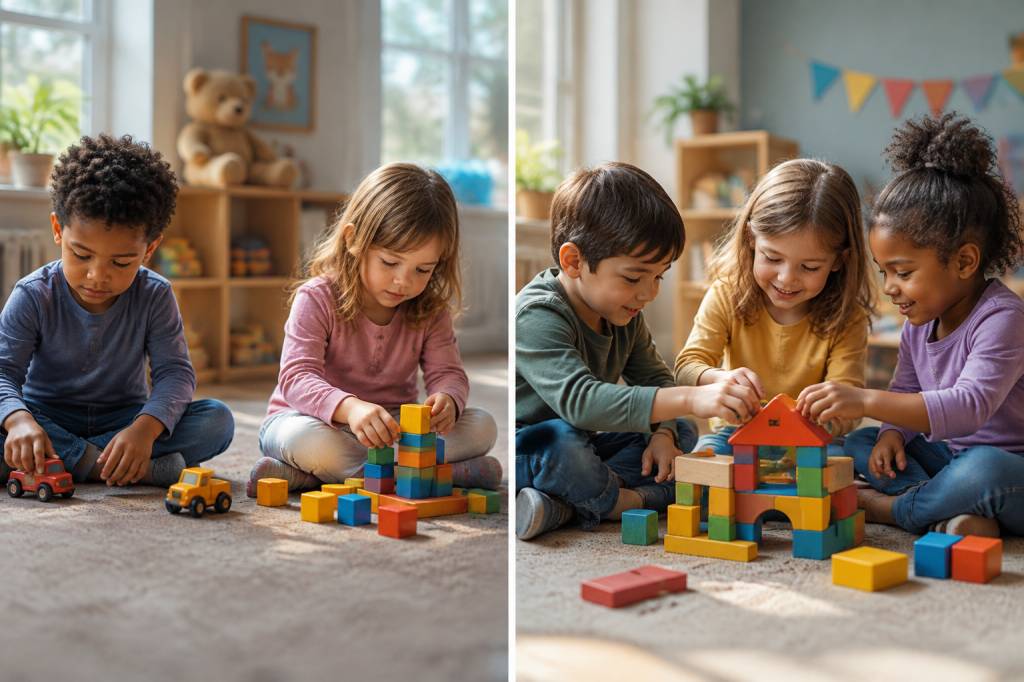
At the playground, two toddlers sit side by side, each pushing a toy truck through the sand. They glance at one another now and then, but neither seems interested in sharing. A few years later, those same children may be building a tower together, arguing over who gets the blue block, and somehow turning the disagreement into a game.
Both scenes are play—and both matter. Parallel play and cooperative play are often described as different stages of social development, but they are better understood as ways children learn to be with one another. Knowing what each looks like can help us support a child without rushing them into the next thing. After all, childhood is not a race, even when it occasionally involves a very fast tricycle.
What is parallel play?
Parallel play happens when children play near one another, often with similar toys or activities, but do not yet have a shared plan. A child might build a block tower beside a friend, draw at the same table, or scoop sand into a bucket while another child fills a bucket nearby. They are aware of each other, but each is mostly focused on their own play.
This kind of play is common in toddlers, especially around ages two and three. It can also appear at other ages, depending on the child, the setting, and the activity. A preschooler who is tired, adjusting to a new group, or deeply absorbed in a puzzle may choose to play alongside others rather than join in.
From an adult’s perspective, parallel play can look like “playing alone together.” That description is not far off—but it misses an important detail. Children are watching, listening, and learning. They may notice how another child stacks blocks, uses a pretend phone, or makes a truck rumble across the floor. Even without a conversation or shared game, they are taking in information about how play works.
What is cooperative play?
In cooperative play, children take part in a shared activity and work toward a common idea or goal. They might pretend to run a restaurant, build a blanket fort together, or organize a game of tag. The play has a social structure: children communicate, respond to one another, and make decisions together.
Cooperative play often becomes more noticeable during the preschool years, as children develop language, imagination, and the ability to consider what someone else might want. But there is no birthday on which a child is expected to suddenly master teamwork. Joining a game, waiting for a turn, changing a plan, and handling a disagreement are complicated skills. They develop gradually, through practice and plenty of imperfect attempts.
Cooperation does not mean children always agree. In fact, the little negotiations are often part of the learning. “You can be the doctor, and I’ll be the patient” may sound simple, but it involves listening, sharing an idea, and making room for another person’s perspective. Sometimes the negotiation takes longer than the game. That, too, is real practice.
The key differences at a glance
- Shared focus: In parallel play, children may enjoy the same space or materials but follow separate ideas. In cooperative play, they have a shared activity or story.
- Communication: Parallel play may involve little direct conversation. Cooperative play usually includes more talking, gestures, planning, or responding to a playmate.
- Roles and rules: Parallel play does not usually require agreed roles. Cooperative play may involve roles, turns, rules, or a common plan.
- Social demands: Parallel play lets children explore near others without needing to manage a group interaction. Cooperative play asks them to coordinate ideas and actions.
- Adult support: Children playing in parallel may simply need accessible materials and a comfortable space. A cooperative game may call for gentle help with turn-taking or resolving a disagreement.
These are helpful distinctions, not a checklist for measuring a child. A child can shift between both kinds of play in one afternoon—or even within a single game. The point is not to label every moment, but to understand what the child may be practicing.
How parallel play supports development
Parallel play gives children room to explore at their own pace while sharing a social environment. That balance can feel reassuring: a playmate is close by, but there is no pressure to keep up a conversation or follow someone else’s plan.
While playing alongside another child, a toddler may practice:
- Observation: Noticing how someone else uses a toy or approaches a problem.
- Imitation: Trying a new action after seeing it modeled.
- Independence: Choosing an activity and staying with it without needing a partner to direct the play.
- Comfort around peers: Getting used to other children’s voices, movement, and presence.
- Early social awareness: Beginning to notice that another child has their own ideas and interests.
For example, imagine two children at a water table. One pours water through a funnel. The other watches, then finds a funnel of their own. They may not be collaborating, but the second child has learned by observing and experimenting. In that small moment, play is doing a great deal of quiet work.
What children practice through cooperative play
Cooperative play brings more social pieces together. Children have to share attention, communicate their ideas, and adjust when a playmate does something unexpected. A pretend grocery store might involve deciding who is the cashier, choosing what to “sell,” and figuring out whether a wooden block counts as a loaf of bread. (It usually does.)
Through shared play, children can practice:
- Communication: Explaining an idea, asking a question, and listening to a response.
- Perspective-taking: Recognizing that a playmate may have a different plan or preference.
- Turn-taking and sharing: Working out how to use materials or take part in a game.
- Flexibility: Adapting when the story changes or someone suggests a new idea.
- Problem-solving: Finding a way forward when children want different things.
These abilities do not appear all at once. A child may happily play “restaurant” with a sibling but struggle to join a group game at preschool. Familiarity, energy, temperament, and the size of the group can all make a difference. One successful shared game does not mean a child will feel ready for every social situation—and that is perfectly ordinary.
Where does associative play fit?
You may also come across the term associative play. It describes play in which children interact and share materials, but may not yet organize their activity around one shared goal. For instance, children might talk and exchange toy cars while each making up a separate road-and-racing game.
Associative play can sit between parallel and cooperative play in common descriptions of social play. Still, these categories are not strict steps that every child climbs in the same order. A child may move among them depending on the day and the people around them. Think of them as different ways to play, not boxes a child must graduate from.
How to encourage social play without pushing
It is natural to wonder whether you should step in when your child plays alone beside other children. Often, there is no need. If everyone is safe and content, staying nearby and letting the play unfold can be more helpful than asking a child to share or join in before they are ready.
You can support connection in gentle, practical ways:
- Offer duplicate materials. Two buckets or a handful of similar blocks can make it easier for young children to play near one another without an immediate struggle over one prized toy.
- Choose activities with room for different approaches. Play dough, blocks, crayons, and sensory materials can work well for children who want to explore side by side.
- Model simple language. Try, “Can I use that when you’re finished?” or “Would you like to build next to me?” Keep the invitation easy to accept or decline.
- Narrate what you notice. “You’re both making roads for your cars” recognizes the shared space without insisting that the children are playing together.
- Support small moments of cooperation. You might suggest, “Could one person hold the box while the other puts the blocks in?” Then give them time to respond.
- Keep playdates manageable. A short visit with one familiar child can feel easier than a busy gathering with several new faces.
Try to avoid turning every play moment into a lesson. Children benefit from adult support, but they also need time to experiment, get absorbed, and work out small challenges in their own way. If a disagreement stays safe, a brief pause can give them the chance to try a solution before you offer one.
When children disagree
Conflicts are not proof that children cannot cooperate. They are often part of learning how. A child might grab a toy because they do not yet have the words to ask for it. Another may insist that the pretend game must follow their plan. Both children may need help expressing what they want and hearing what the other person wants, too.
A calm adult can describe the problem without assigning blame: “You both want the red shovel.” Then offer a simple next step: “Would you like to take turns, or find another shovel while you wait?” If the children are upset, helping them pause and settle may come before any problem-solving.
There is no need to expect perfect sharing from very young children. Instead, model clear, kind boundaries and help them practice the words and routines that make shared play easier. The goal is not to prevent every disagreement; it is to help children learn what they can do when one happens.
When should parents be concerned?
Play preferences vary widely. Some children are naturally observant and take time to warm up. Others jump into group games quickly. A child may enjoy playing near peers but rarely initiate a shared game, or may prefer one trusted friend to a larger group. On its own, any one of these patterns does not tell the whole story about a child’s development.
It can be helpful to look at the bigger picture: how your child communicates, responds to familiar people, explores interests, and manages everyday interactions. If you have ongoing concerns about social communication, play, or development—or if your child seems distressed by situations that other children enjoy—bring your observations to your pediatrician. You do not need to wait until you are certain something is wrong to ask a question.
And if your child is spending an afternoon quietly lining up toy animals beside another child’s carefully arranged animals, that may be just the right kind of play for today. Parallel play offers its own small invitations to observe, explore, and feel comfortable in company. Cooperative play will grow through experience, time, and the occasional shared tower that falls down before anyone is quite ready.