
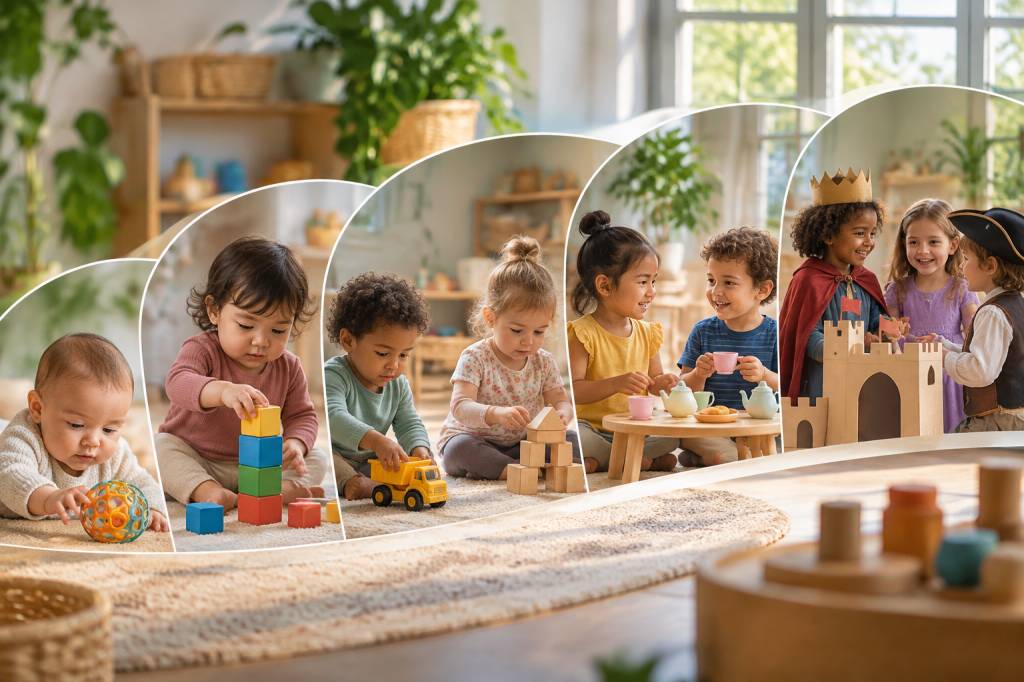
A toddler can spend ten minutes lining up wooden animals, then ignore them completely when another child arrives. A baby may watch a sibling build a tower without reaching for a single block. Are they playing “the right way”? Often, yes. Play unfolds in many forms, and each one gives us a small glimpse into how a child is making sense of the world.
Developmental researchers have described several stages of play, from quiet exploration to shared games with a common goal. These stages can help parents and caregivers notice emerging skills, but they are not a checklist or a race. Children move between them, linger in one, or show different kinds of play in different settings. The most important ingredient is time and space to explore safely, with a caring adult nearby.
Why play matters so much
Play is one of childhood’s most natural ways of learning. When a baby shakes a rattle, a preschooler pretends a cardboard box is a boat, or two children negotiate who gets the red crayon, they are practicing far more than the obvious skill in front of them.
Through play, children can build coordination, language, imagination, problem-solving, and social understanding. They experiment with cause and effect, try out new roles, and discover what happens when an idea does not work the first time. Play also gives children a way to express feelings they may not yet have the words to explain.
The stages often associated with early childhood were described by sociologist Mildred Parten. Her framework is useful because it helps adults recognize that watching or playing alone can be meaningful forms of play—not signs that a child is behind. The stages are best understood as broad patterns, not strict age deadlines.
Unoccupied play: taking in the world
In unoccupied play, a child’s activity may appear random. An infant might kick, gaze around the room, wave their arms, or briefly focus on a bright shape. A young toddler may wander from one object to another, pausing to touch a cushion or watch sunlight move across the floor.
This is not “doing nothing.” Babies are gathering information through their senses and learning that their bodies can affect the world. A kick makes the mobile sway; a hand brushing fabric reveals a new texture. These small discoveries form the beginnings of attention, movement, and curiosity.
You can support this kind of exploration without turning it into a lesson. Offer a safe space, a few age-appropriate objects, and a chance to look and move. A soft ball, a cloth book, or a clean wooden spoon may be more interesting than a basket of elaborate toys. Stay close, follow your child’s attention, and let them set the pace.
Solitary play: happily playing alone
During solitary play, a child plays independently and focuses on their own activity. A baby may repeatedly drop a soft toy and watch you retrieve it. A toddler might stack blocks, take them apart, and build the same tower again. A preschooler may draw a very serious family portrait in which everyone has seven fingers.
Playing alone can help children practice concentration, imagination, and self-direction. It also gives them room to repeat an action until it feels familiar. Repetition may not be thrilling for the adults in the room, but for a child it can be a satisfying way to test an idea: Will the tower fall if I use the big block on top? (Usually, yes. The investigation is still worthwhile.)
Independent play does not mean that a child wants to be left alone all day. Some children settle into it readily; others prefer an adult nearby. You can offer a calm invitation rather than a demand: “I’ll sit here while you decide what to build.” Comment on what you notice without taking over: “You’ve made a long line of blocks.” Then give your child time to continue.
Onlooker play: watching before joining
In onlooker play, a child watches other children play but does not join in. They might stand near a group rolling toy cars, follow a game with their eyes, or ask questions from the sidelines. It can look like hesitation, but watching is often a child’s way of studying how a game works before deciding what to do.
Imagine a toddler at a playgroup observing two children fill a bucket with sand. They may notice who holds the shovel, how the sand moves, and what happens when the bucket tips over. Even without picking up a tool, they are learning about the activity and the social rhythm around it.
Try not to rush a child with “Go play with them!” A warm introduction can help, but pressure may make the moment feel harder. You might say, “They’re making a road. Would you like to watch, or should we ask if there’s a place for another car?” Both choices are valid. A little distance can be a bridge to participation.
Parallel play: side by side, not quite together
In parallel play, children play near one another, often with similar toys, but do not yet organize their activity around a shared plan. One child builds a block tower while another builds a separate one. They may glance at each other, imitate an action, or swap a toy briefly, then return to their own play.
This is a familiar pattern among toddlers. They are discovering the pleasure of being near other children while still concentrating on their own ideas. Sharing, taking turns, and coordinating a game are complex skills; they develop with time and practice, not simply because an adult says, “You have to share.”
Adults can make parallel play easier by providing enough materials and a little room. If two children want the same truck, offering a second truck or helping them take turns may prevent frustration. You can describe the moment simply: “You’re both making roads. Maya has a bridge, and you have a tunnel.” This helps children notice each other’s activity without insisting they combine it.
Associative play: exchanging ideas and materials
In associative play, children interact more directly but may not have one shared goal. They might trade crayons, talk about their drawings, borrow pretend food, or add pieces to each other’s block constructions. The play is connected, even if the plan changes every few minutes.
A group playing with toy animals, for example, might share a barn and chat about which animal is hungry. One child may decide the horse needs a nap while another brings it a wooden carrot. There is cooperation in the exchange, but no one is necessarily directing a single storyline.
This stage offers plenty of practice in communicating needs and handling small disagreements. When a conflict arises, pause before solving it for the children. If everyone is safe, you might help name the problem: “You both want the green marker.” Then offer a simple way forward: “Would you like to use it first, or choose another color while you wait?” Children need support, but they also benefit from having a chance to try their own solutions.
Cooperative play: building something together
In cooperative play, children work toward a shared idea or goal. They might take roles in a pretend restaurant, build one large fort, play a simple game with rules, or organize a rescue mission for stuffed animals. There is more planning, negotiation, and awareness of what other players are doing.
Cooperative play can be joyful—and occasionally complicated. One child wants the fort to be a castle; another insists it is a spaceship. These disagreements are not proof that the play has failed. They are opportunities to practice flexibility, express preferences, and find a plan that makes room for more than one idea.
You can encourage cooperation with open-ended materials such as blocks, dress-up clothes, boxes, blankets, and toy figures. These materials invite children to invent their own possibilities. If play becomes stuck, offer a gentle prompt: “What could the spaceship need for its trip?” Then step back and let the children take the story where they choose.
These stages are not a ladder
It is tempting to picture the stages as a straight climb, with cooperative play as the final destination. Real childhood is less tidy. A preschooler may happily play alone after a busy morning with friends. A child who loves group games may spend an afternoon watching a new activity before joining. Tiredness, temperament, familiarity, the setting, and the other children present can all shape how a child plays.
Age ranges can offer a rough guide, but they should not be treated as deadlines. Children develop at different paces, and play skills do not all emerge at once. A child may show strong imaginative play while still needing help with turn-taking, for instance. Notice the whole child and the context, rather than judging one moment in isolation.
It is also helpful to remember that adults do not need to make every play experience educational. Children benefit from unhurried time to choose, repeat, and change their minds. The cardboard box does not need a lesson plan. Sometimes it just needs to be a train.
How to support play at home
Your role is not to direct every minute. Often, the most useful thing you can do is create a safe, welcoming environment and follow your child’s lead. A few simple habits can make room for richer play:
-
Offer a manageable selection of toys and everyday objects, rather than setting out everything at once.
-
Choose open-ended materials—blocks, crayons, play dough, fabric, and pretend-play items—that can be used in many ways.
-
Allow time for play to develop. Children may need to explore quietly before an idea takes shape.
-
Join when invited, but avoid correcting the story or showing the “right” way to use a toy.
-
Use simple observations and questions: “What do you think will happen next?” or “Where could the bear sleep?”
-
Keep play safe and supervise in a way that fits your child’s age and the materials being used.
Not every child has access to a large playroom or a shelf full of toys. A blanket, a few containers, a spoon, and a willing imagination can go a long way. Everyday routines can also become playful: sorting socks, pretending to deliver groceries, or making animal sounds on the walk home.
When to seek more guidance
Variation in play is normal, and no single play style tells the whole story of a child’s development. Still, if you have ongoing concerns about your child’s communication, interaction, movement, or interest in play, bring them up with your pediatrician or another trusted health professional. You know your child’s everyday rhythms, and your observations are worth sharing.
It may help to describe what you see in specific terms: “She watches the other children but rarely responds when they speak to her,” or “He used to pretend to feed his toys, but I haven’t seen him do that recently.” Clear examples give a professional more useful information than a label or comparison with another child.
Let the play be theirs
From a baby’s first curious reach to a group of children inventing elaborate rules for a backyard game, play changes as children grow. Each form has value: observing, exploring alone, playing alongside others, sharing materials, and building a common idea all help children learn in their own time.
So the next time your child lines up the animals instead of making them march, or watches a game before joining in, you can pause before stepping in. They may be practicing, imagining, and learning more than is visible at first glance. And if the animals eventually form a very serious parade around the living room, you have been invited to witness the next chapter.