
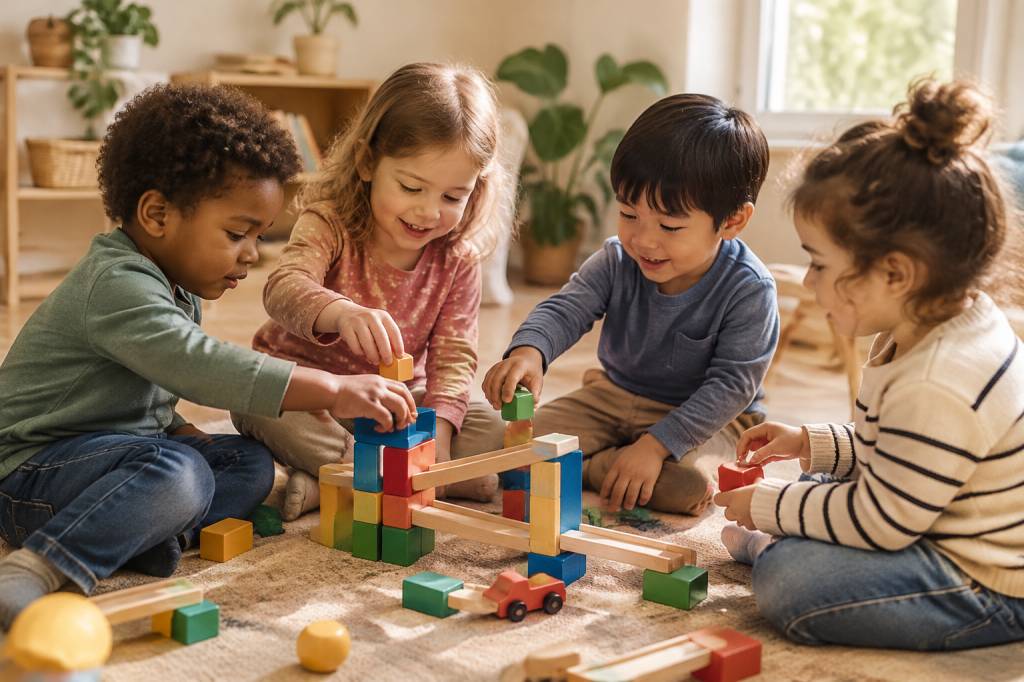
At the playground, two toddlers may spend a long time side by side, each busy with a bucket and shovel. One fills a bucket with sand; the other tips theirs over. They are close enough to share the shade, but not quite sharing a plan. Then, a year or two later, the same children might decide to build a road together, argue about where it should go, and negotiate who gets the red truck. Somewhere in between, play has changed from “near you” to “with you.”
That shift is called cooperative play, and many parents wonder when it begins. The short answer: it often becomes more noticeable between ages four and five, but there is no birthday when a child suddenly knows how to collaborate. Playing together is a skill that grows gradually, with practice, support, and plenty of ordinary childhood moments.
What cooperative play really means
Cooperative play happens when children play together toward a shared idea or goal. They might build a pretend restaurant, make a blanket fort, chase each other in a game, or work together to finish a puzzle. Each child has a role, and the play depends, at least a little, on listening and responding to someone else.
That does not mean everyone agrees, shares perfectly, or follows the rules without protest. A game can still involve a dispute over who gets to be the doctor—or whether the stuffed bear is even sick. Cooperation is not the absence of conflict. It is the growing ability to keep a shared activity going, make room for another person’s ideas, and find a way forward after a disagreement.
It is also different from simply being in the same place. Two children can play with similar toys beside each other without interacting much. That kind of play is meaningful too; children are watching, learning, and becoming comfortable around one another, even when they are not yet working together.
How play develops before children play together
Play does not move along a neat staircase, with every child stepping up at the same age. Children may move between different kinds of play depending on the setting, their mood, and the people around them. Still, a few broad patterns can help make sense of what you are seeing.
-
Solitary play: A baby or young toddler explores a toy, book, or object independently. This is not a sign of loneliness. It is how children investigate the world and build concentration.
-
Parallel play: Often seen in toddlers, children play near each other with their own materials. They may notice one another and imitate actions, but each child is mostly following an individual plan.
-
Associative play: Children begin to talk, exchange toys, or borrow ideas while playing. They may be involved in the same activity, but they are not always working toward one shared goal.
-
Cooperative play: Children coordinate their ideas and actions. They may agree on a pretend scenario, take on roles, or follow shared rules.
These categories are useful descriptions, not a scorecard. A child might collaborate happily during a familiar game and prefer parallel play with a new group. That is normal. Social confidence can depend on how tired a child is, how busy the room feels, and whether the toy in question is the one beloved truck that absolutely cannot be shared today.
When do children usually start cooperative play?
Many children begin showing early cooperative behaviors around ages three to four. They may take turns in a simple game, help a friend build a tower, or join a shared pretend-play idea for a few minutes. More sustained, organized cooperative play often develops around ages four to five and continues to grow during the early school years.
These are general ranges, not deadlines. A three-year-old may happily play “shop” with a sibling, while a five-year-old may spend a party quietly exploring blocks on their own. Both can be within the wide range of typical development. Children also bring different temperaments to play: some jump into a group immediately, while others watch for a while before joining.
Cooperation asks a lot of a developing child. They need to notice what another person wants, express their own ideas, take turns, adapt when the game changes, and manage big feelings when things do not go their way. These abilities develop over time. It makes sense, then, that cooperative play often becomes more complex as children become better at communication and self-regulation.
What it may look like at different ages
In the toddler years, play is often focused on exploring objects and repeating enjoyable actions. Toddlers might play beside a sibling, copy what another child is doing, or briefly exchange toys. These moments are early social practice, even if they do not yet look like a shared game.
Around ages three to four, children may begin building a simple story together. One child might announce that the couch is a boat, while another climbs aboard with a toy dog. The storyline may change every thirty seconds, and that is part of the charm. Children are starting to connect ideas, even when their plans are wonderfully unpredictable.
Around ages four to five, children often become more able to assign roles, make up rules, and keep a shared game going. They might decide who is the customer and who is the baker, or work together to construct a zoo from blocks. They may also be more invested in the rules—and very ready to explain when a sibling has broken them.
During the early school years, cooperative play can become more organized. Children may plan games, negotiate rules, and work toward a larger shared project. They still need help at times, especially when emotions run high, but they have more tools for talking through differences.
There is plenty of overlap across these ages. Think of these examples as windows into common patterns, not a timetable you need to enforce.
Why cooperative play matters
Playing together gives children a low-pressure place to practice skills they will use throughout life. In a pretend kitchen, they can try out language, take turns, make requests, and respond to someone else’s ideas. In a simple board game, they can practice waiting and coping with the disappointment of not always winning. In a shared block tower, they discover that another person’s plan may make their own even better.
Cooperative play can also support creativity. A story grows when one child adds a new character and another invents a problem for everyone to solve. Children learn that their ideas matter, and that other people have ideas too. That is a small but important lesson in belonging.
And it is not just about learning to share toys. It is about building the confidence to connect: to ask, “Can I play?” to suggest an idea, and to recover when a game changes direction.
How parents can encourage playing together
You do not have to stage a perfect playdate or coach every interaction. Children benefit from opportunities to play, time to practice, and an adult who can help without taking over.
-
Choose activities with a shared purpose. Building a fort, rolling dough, watering plants, or completing a large puzzle gives children something to do together without demanding complicated rules.
-
Keep the group small at first. One familiar playmate can feel easier than a busy room full of children. A shorter, relaxed visit may be more successful than a long afternoon with a packed schedule.
-
Offer enough materials. If every child is reaching for the same single truck, conflict is more likely. Duplicate toys are not always necessary, but having a few appealing options can make joining in easier.
-
Use simple language to support negotiation. You might say, “You both want the blue scoop. How could we take turns?” or “Maya is building a road. Do you want to add a bridge?” This gives children a starting point without deciding everything for them.
-
Notice cooperation when it happens. Specific encouragement can help children recognize their own efforts: “You waited while Sam had a turn,” or “You found a way to use both ideas.”
-
Allow some time to watch. A child who observes before joining may be gathering information and deciding how to enter the play. A gentle invitation is often more helpful than a push.
Try not to make sharing the only measure of social success. Children are still learning about ownership, boundaries, and turn-taking. It is fine to help them practice sharing, but it is also useful to offer words for setting limits: “I’m using this right now. You can have a turn when I’m finished.”
When play turns into conflict
Conflict is a normal part of learning to play together. A child may grab, insist on being in charge, change the rules, or abandon the game when someone else has a different idea. These moments can feel uncomfortable, particularly when another child is upset, but they are also chances to learn with an adult nearby.
Start by keeping everyone safe and naming what you see without assigning blame: “You both want to be the driver.” Then give children a manageable next step. They might take turns, choose another role, or find a second vehicle. Younger children often need an adult to offer concrete options because “work it out” asks for skills they may not have yet.
It can help to pause before stepping in if the children are safe and still trying to solve the problem. Not every disagreement needs an immediate rescue. But if someone is being hurt, overwhelmed, or repeatedly excluded, offer calm support. The goal is not to make every game smooth; it is to help children practice repairing the rough spots.
When to ask for guidance
Children develop at different rates, and a preference for independent play alone does not tell you that something is wrong. Consider the broader picture: how your child communicates, connects with familiar adults, responds to other children, and manages everyday interactions. A child may be shy in groups but warm and engaged one-on-one.
If you have ongoing concerns about your child’s communication, social interaction, or development, bring them to your pediatrician or another trusted health professional. You can describe what you notice, when it happens, and what helps your child feel comfortable. There is no need to wait for a particular age if something is weighing on you; asking questions is a caring part of parenting.
Let the play unfold
Cooperative play is less like a switch and more like a conversation that children learn to have over time. First they may play near one another. Then they borrow an idea, share a toy, or join the same story for a few minutes. Eventually, they may build something together, disagree about the roof, and find a way to keep going.
Those small steps count. A quiet moment of imitation, a turn offered without prompting, or an invitation to join a pretend game can all be signs of growing connection. Keep making space for play, offer support when it is needed, and remember that children do not have to collaborate beautifully every day. Sometimes the best evidence of progress is simply that tomorrow, they come back to the blocks and try again.