
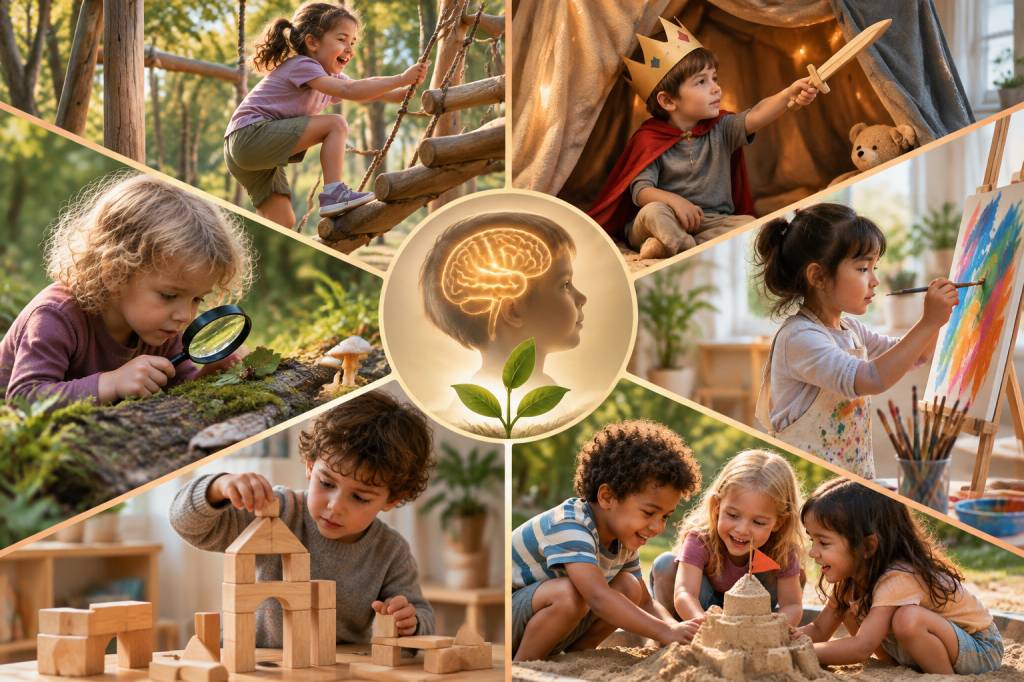
Some of the most important learning in childhood happens when nobody is holding a lesson plan. It happens on the living-room floor, where a wooden spoon becomes a microphone, a cardboard box becomes a ship, and a toddler spends ten very serious minutes dropping blocks into a basket. Play may look simple from the outside, but children are busy testing ideas, building relationships, and making sense of the world.
There is no need to fill every afternoon with elaborate activities or buy a shelf full of toys. Everyday moments offer plenty of invitations to play. Here are six kinds of play that support children’s learning and development, along with gentle ways to make room for them at home.
Physical play: learning through movement
Running, climbing, dancing, rolling, and kicking a ball are more than ways to burn off energy before bedtime. Physical play helps children develop balance, coordination, strength, and awareness of their bodies. It also gives them a chance to practise judging distance, adjusting their movements, and deciding what feels challenging but manageable.
For babies, physical play might mean reaching for a toy during tummy time or practising a new roll on a safe, clear surface. As children grow, it can become a game of follow-the-leader, a backyard obstacle course, or a determined attempt to hop from one rug to another without touching the “lava.”
Movement supports learning in less obvious ways, too. A child who is trying to catch a ball is practising attention and timing. A child navigating playground steps is planning, concentrating, and learning to trust their own abilities. These skills develop through practice, not perfection. A wobble is not a setback; it is part of the experiment.
Try offering a variety of safe ways to move rather than directing every step. Put on a favourite song and dance together, take a walk where your child chooses the route, or make a simple indoor path with cushions. Follow your child’s age, abilities, and comfort level, and supervise whenever the activity calls for it. The aim is joyful movement, not an Olympic tryout in the hallway.
Sensory play: exploring the world with the senses
Children learn by touching, listening, looking, smelling, and sometimes tasting. Sensory play invites them to notice how things feel and change: cool water, soft fabric, crinkly paper, smooth stones, or the sound of rice pouring into a cup. For babies and young children in particular, these experiences help connect sensations with words and ideas.
A simple water-play setup can keep a child absorbed as they fill, pour, splash, and watch. A bowl of safe household objects with different textures can prompt exploration, while playdough offers a satisfying mix of squeezing, rolling, and shaping. You do not need a complicated sensory bin. A damp sponge and a plastic cup may be all the inspiration a small scientist needs.
As your child plays, describe what you notice without turning the moment into a quiz: “The water feels cool,” or “That paper makes a loud, crinkly sound.” This gives children language for their experiences while leaving them free to investigate. If they are old enough, invite them to make predictions: Which object will sink? What happens when we add more water?
Keep safety in mind. Young children need close supervision around water and small objects, and materials should be appropriate for their age and any sensitivities. Sensory play is also personal: some children love sticky hands, while others would prefer to inspect the playdough from a respectful distance. Offer alternatives, and let curiosity grow at its own pace.
Exploratory play: experimenting and figuring things out
Exploratory play is the art of asking, “What happens if I try this?” A child might stack cups, turn a toy upside down, push a button repeatedly, or drop a block and watch it land. The repetition can test a grown-up’s patience, especially when the same object meets the floor for the twelfth time. For the child, though, each attempt is a chance to observe cause and effect.
This kind of play nurtures curiosity, problem-solving, and early scientific thinking. Children notice patterns, compare results, and adjust their actions. When a tower falls, they may try a wider base. When a toy will not fit through an opening, they might rotate it. Their solutions may be unconventional, but the thinking behind them is meaningful.
You can encourage exploration with open-ended materials such as blocks, nesting cups, safe kitchen utensils, or cardboard tubes. Rather than showing the “right” way to use an object, give your child time to test their own ideas. Ask a question if it feels natural: “What do you think will happen if we put the big block at the bottom?” Then pause and let them lead.
Not every experiment needs a tidy answer. Sometimes the learning is in noticing, trying, and trying again. If your child becomes frustrated, offer a small prompt or demonstrate one possibility, then hand the problem back. Support does not have to mean taking over.
Constructive play: making something from an idea
Constructive play happens when children use materials to build, create, or arrange something. Blocks become a tower, blankets become a den, and paper scraps become a collage that is, according to its artist, definitely a dragon. These projects help children practise planning, fine-motor control, spatial awareness, and persistence.
Construction does not have to produce a polished result. A toddler lining up containers is organising and comparing. A preschooler trying to build a bridge for toy cars is testing what can span a gap. An older child designing a pretend shop may be combining drawing, counting, storytelling, and negotiation all at once.
Offer materials that can be used in more than one way: blocks, reusable boxes, large sheets of paper, chunky crayons, or safe fabric pieces. You might keep a small basket of “making things” within reach and add new materials occasionally. There is no need to rescue every project from wobbling. A collapsing tower may lead to a better idea, and a lopsided creation still belongs on the fridge if its maker is proud of it.
When your child shares a creation, try asking about their thinking: “Tell me how you made that,” or “What is your favourite part?” These questions show interest without judging the result. They also give children a chance to explain, reflect, and build confidence in their own ideas.
Pretend play: trying on stories and feelings
In pretend play, a child can be a doctor, a shopkeeper, a dragon, or the grown-up who insists that everyone wear a scarf. Imaginative play gives children room to invent stories and explore everyday experiences from a safe distance. A familiar routine, such as going to the doctor or getting ready for bed, may reappear in their games as they make sense of what they have seen and felt.
Pretend play supports language, creativity, memory, and emotional understanding. When children assign roles, make up rules, or decide what happens next, they practise expressing ideas and considering different perspectives. A child caring for a doll may be repeating the comforting words they have heard from a caregiver. A toy dinosaur having a very bad day might be a playful way to explore big feelings.
You can join in without directing the whole story. If your child hands you an imaginary cup of tea, accept it with the seriousness the occasion deserves. If you are unsure what role to take, follow their lead and add a small detail: “The bear says the soup is very hot.” Everyday objects often do the trick, and an empty box may outperform an expensive costume by a wide margin.
Let pretend stories be playful, and avoid pressing for explanations when your child is not ready to talk. If a theme concerns you, stay curious and calm. Children often use stories to practise and process, but play alone cannot tell us exactly what they are thinking.
Social play: learning with other people
Playing with others gives children chances to communicate, cooperate, take turns, and work through disagreements. Social play changes with age and experience. A baby may enjoy watching a sibling or sharing a smile with a caregiver. Two toddlers may play side by side with similar toys without following the same storyline. Older children may plan a game together, negotiate rules, and decide who gets to be the dragon.
These interactions teach skills that are difficult to learn from instruction alone. Children practise noticing another person’s ideas, sharing space, waiting, and repairing a moment when play goes off track. They will not manage every interaction gracefully, of course. “You can have it when I’m finished” is a skill still in progress, not always a sentence that arrives on the first try.
Adults can help by staying nearby and giving children a little time to solve small problems for themselves. When needed, model useful language: “Can I have a turn when you’re done?” or “Let’s find a way for both of you to play.” For younger children, short activities with simple materials can make sharing easier. Parallel play counts, too; being near another child is often an important step toward playing together.
Not every child wants a busy group game. Some prefer one friend, familiar routines, or a little time to watch before joining in. Offer opportunities without treating a particular style as a problem. Social confidence grows through safe, repeated experiences, not pressure to perform.
Making space for play in everyday life
Children do not need adults to turn every moment into an educational activity. Often, the most helpful thing is to make time, offer a few appropriate materials, and pay attention to what captures your child’s interest. A walk can become a search for round objects. Setting the table can invite sorting. Waiting for dinner can become a silly song contest—though the family cat may decline to participate.
Try to notice what your child is practising rather than focusing only on what they make. Are they balancing, comparing, inventing, communicating, or returning to a tricky task? Your observations can help you choose what to offer next, but there is no need to rush from one activity to another. Repeating a favourite game is often how children deepen their learning.
And if play looks messy, slow, or gloriously nonsensical, that does not mean it is unproductive. A child may be building confidence one block at a time, testing a new idea with a splash, or rehearsing a story that matters to them. Your presence—warm, attentive, and willing to accept an imaginary cup of tea—is a powerful part of the experience.