
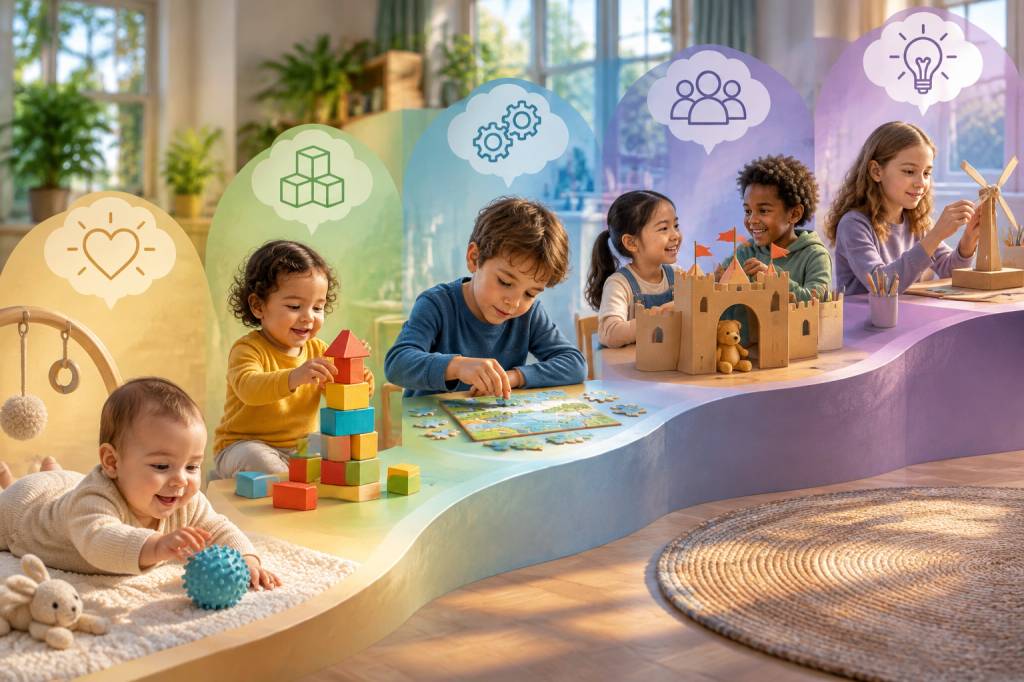
Some afternoons, the most interesting toy in the room is not a toy at all. It is a wooden spoon, a cardboard box, or the small pile of laundry that was supposed to be folded. Children have a wonderful way of turning ordinary moments into opportunities to explore. And while play can look delightfully simple from the outside, it is one of the ways children practice thinking, moving, communicating, and connecting with the people around them.
Play skills develop over time, but there is no single timetable every child must follow. Temperament, experience, access to playmates, and individual development all shape how a child plays. The ages below are broad guideposts, not a checklist. The goal is not to teach a child to play “correctly,” but to notice what captures their interest and make room for the next small discovery.
Birth to 12 months: exploring with the senses
For babies, play begins with looking, listening, reaching, touching, and tasting. A baby may stare at a familiar face, follow a bright object with their eyes, or discover that a hand can make a very interesting shape. These first experiments are the beginnings of learning: “What happens if I move?” “What is that sound?” and, eventually, “Will that object still exist if I cannot see it?”
During the first year, babies gradually gain more control over their bodies. They reach for toys, pass objects from hand to hand, bang two things together, and drop a spoon again and again. The dropping may feel like a tiny scientific experiment conducted at the dinner table. Your baby is exploring cause and effect, while you are learning how many times one spoon can be retrieved with a smile.
Simple, safe play is often best at this age. Try making eye contact and copying your baby’s sounds, offering a soft toy to grasp, or playing peekaboo with a cloth. A short song with gentle hand movements adds rhythm and connection. Follow your baby’s cues: looking away, fussing, or becoming still can be signs that they need a break.
- Offer a few age-appropriate objects with different textures, shapes, or sounds.
- Let your baby watch you do everyday tasks, such as folding a towel or stirring a bowl.
- Make space for supervised floor time so your baby can reach, roll, and explore.
Safety matters more than novelty. Choose toys that are made for your baby’s age, check for small parts, and stay close during play. A baby does not need a room full of gadgets to learn. Your face, voice, and calm attention are among the most compelling playthings around.
12 to 24 months: doing it again—and again
Toddlers often love repetition. They may fill a container and empty it, stack blocks only to knock them down, or insist on carrying the same stuffed animal from room to room. Repeating an action helps children test what happens and build confidence in their own abilities. It can also be wonderfully reassuring: the world feels a little more manageable when a familiar action has a familiar result.
At this stage, play may include simple pretending. A toddler might hold a toy phone to their ear, offer a doll a pretend drink, or push a box as if it were a car. These small make-believe moments draw on what children see in daily life. They are beginning to represent one thing with another and to act out experiences they are still figuring out.
Movement becomes a big part of play, too. Walking, climbing, dancing, and pushing or pulling toys all help toddlers understand what their bodies can do. If you have ever watched a toddler move a chair across the room with great determination, you have seen both a physical workout and a lesson in problem-solving.
- Give your toddler blocks, nesting cups, chunky puzzles, and containers to fill and empty.
- Use familiar routines as inspiration: pretend to feed a doll, wash a toy, or prepare a play meal.
- Offer safe places to move, with an adult nearby and obstacles appropriate to your child’s abilities.
Parallel play is common at this age: children may play beside one another without sharing a game. That is not a social failure. They are noticing other children, getting comfortable nearby, and learning through observation. Adults can model gentle turn-taking, but toddlers are still developing the language and self-control that sharing requires.
Two to three years: imagination takes shape
As toddlers become preschoolers, their pretend play often grows more elaborate. A blanket becomes a cave, a box becomes a bus, and a row of stuffed animals may be waiting for lunch. Children draw on memories and imagination to create little worlds. In the process, they practice language, planning, flexible thinking, and emotional expression.
Play also starts to include more short, simple sequences. A child may pretend to cook, serve food, and then wash the dishes—or make a toy animal “sleep” before waking it up again. You do not have to supply a storyline. A curious question can be enough: “Who is riding in your bus?” or “What does the bear need?” Then allow your child to decide what happens next.
Many children around this age begin to enjoy brief, simple games with others. They may follow a basic rule for a little while or take turns with support. Big feelings can still arrive when a game does not go their way. That is not a reason to avoid games; it is a chance to practice. Keep turns short, name what is happening, and show that waiting and trying again are skills children learn gradually.
- Provide open-ended materials such as crayons, play dough, blocks, and dress-up clothes.
- Join your child’s pretend play by following their lead rather than directing every scene.
- Read a familiar story together and invite your child to act out a favorite part.
At this age, “helping” with ordinary tasks can feel like play, too. A child sorting socks or wiping a small table is practicing coordination, categorization, and independence. It may take longer than doing the task yourself, but the process is the point. A slightly crooked pile of socks can still be a very successful morning.
Three to five years: stories, rules, and shared ideas
Preschoolers often build longer pretend-play stories. They might set up a shop, make a pretend doctor’s office, or decide that the living room is a forest. These games invite children to plan together, try out different roles, and negotiate what happens next. If one child wants to be the dragon and another insists that dragons cannot enter the castle, a whole conversation about rules may follow.
Children also begin to manage more structured games, puzzles, construction activities, and creative projects. They may enjoy matching, sorting, simple board games, and building something from a picture or an idea in their heads. These activities offer practice with attention, memory, early number concepts, and persistence. A tower that falls is not just a tower that fell; it is an invitation to wonder whether a wider base might help.
Social play becomes more coordinated for many children, although disagreements are still part of the learning. An adult can help without taking over: “You both want the red block. What are some ways to solve that?” Children may need suggestions, time, or a little help finding the words. The aim is not to prevent every conflict, but to help them practice repairing it.
- Keep art materials and building toys available for children to use in their own ways.
- Try simple games that involve waiting, matching, movement, or taking turns.
- Encourage outdoor exploration, such as looking for leaves, watching clouds, or navigating a safe obstacle course.
There is no need to turn every activity into a lesson. A child making a wonderfully lopsided clay pancake is already exploring shape, texture, and imagination. Enjoy the conversation and the process; the learning is woven through them.
Five to seven years: experimenting, planning, and playing by the rules
As children move into the early school years, their play may involve more detailed plans and more complex rules. They might design a pretend restaurant, build a fort with a specific purpose, or invent a game and explain how everyone should play. Games with rules can support self-control, memory, flexible thinking, and cooperation. They can also reveal that inventing a game is easier than agreeing on its rules—a useful discovery for everyone involved.
Construction, drawing, crafts, pretend play, physical games, and imaginative storytelling all remain valuable. Some children gravitate toward energetic group play; others prefer quiet, focused activities. A child who spends a long time building alone is still learning. Play does not have to be noisy or social to be meaningful.
Children this age can often take more responsibility for setting up and putting away materials, though they may still need reminders and help breaking a task into steps. They may also enjoy connecting play to real interests: maps, animals, music, cooking, or how things work. Following those interests is a good way to keep learning joyful rather than turning every question into a quiz.
- Offer materials that invite a project, such as recycled boxes, blocks, paper, or simple craft supplies.
- Let your child help invent a game, then talk through how to make the rules fair and clear.
- Make time for both active play and quieter activities, allowing your child to choose when possible.
How adults can support play at any age
Children do not need adults to plan every minute. Often, the most helpful thing is to provide a safe space, a few interesting materials, and time without rushing from one activity to the next. Watch before stepping in. What is your child trying to do? What might they be wondering? A pause gives them room to try their own solution.
When you do join, follow your child’s lead. Describe what you notice—“You put the small cup inside the big one”—or add a gentle prompt: “I wonder what would happen if we turned that block around.” These comments can extend play without turning it into a test. If your child changes the subject or walks away, let them. Play works best when children feel some ownership of it.
It is also worth remembering that not every child plays in the same way or on the same schedule. Some children watch before joining in; others learn by moving and touching. A familiar routine, a quieter corner, or a trusted playmate may help a child feel comfortable. If you have ongoing concerns about how your child communicates, moves, connects, or engages in play, bring them to your pediatrician. Your observations matter, and asking questions is a thoughtful way to support your child.
Most of all, play is not something children have to earn after the important work is done. It is part of the important work. Through a repeated game of peekaboo, a tower of blocks, a pretend cup of tea, or a very serious stuffed-animal meeting, children are making sense of the world—and inviting us into it, one small discovery at a time.