


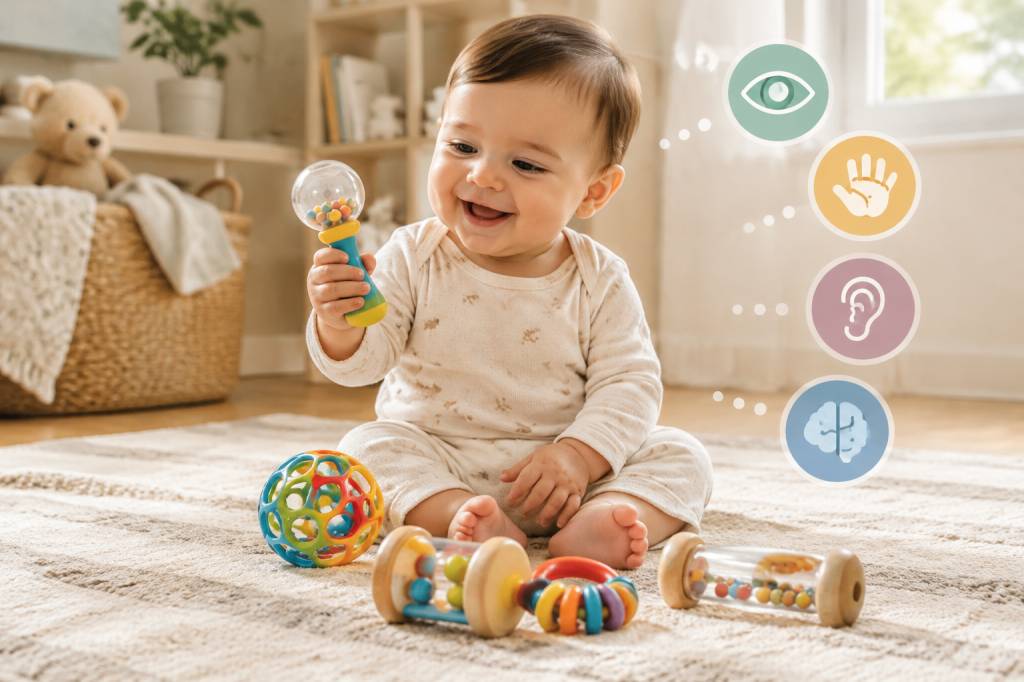
The first time a baby discovers that a rattle makes a sound, the look of surprise can be better than any toy. A small shake, a bright little jingle, and suddenly those busy hands have a new purpose. A good rattle can encourage reaching, grasping, listening, and curious play—all during ordinary moments on the play mat or in your arms.
But choosing one is not simply a matter of picking the cutest animal on the shelf. The best rattle for your baby should suit their age, abilities, and preferences, while meeting basic safety and care needs. Here are the details worth checking before you bring one home.
Start with your baby’s stage, not the age on the box
Age guidance on packaging is a helpful starting point, but babies develop at their own pace. One little one may be eager to reach for toys, while another is still happiest watching the world from a cozy spot. Think about what your baby can comfortably do today, and choose a rattle that invites the next small step without making play frustrating.
For a very young baby, a lightweight rattle with a clear, gentle sound may be easier to notice than a toy with lots of features. As your baby begins reaching and grasping, a narrow handle or an easy-to-hold ring can make the rattle more manageable. Older babies who can sit and explore may enjoy a toy with different textures or parts to turn and examine, provided it is designed safely for their age.
There is no need to rush toward a more complicated toy. A simple rattle can offer plenty to discover: a sound when it moves, a texture beneath the fingertips, and the satisfying realization that I made that happen.
Look for a shape that is easy to hold
Babies are learning how their hands work, and a toy that is too large, heavy, or awkward may be difficult to manage. Look for a rattle that feels comfortable in your hand and is appropriately sized for your baby’s current abilities. A slim handle, open ring, or soft loop may be easier for small fingers to grasp than a bulky shape.
Consider how your baby is likely to use it, too. A rattle will probably be shaken, dropped, turned upside down, and sampled with the mouth. Choose one that remains easy to hold from different angles and does not have small detachable pieces. If you are shopping in person, try holding it yourself. Could you imagine a baby gripping it without needing to stretch their fingers around a wide handle?
Weight matters. A lightweight toy is generally easier for a new grasper to lift and less tiring to hold. It may also be less uncomfortable if it slips from little hands. Still, an adult’s impression is not a substitute for checking the manufacturer’s age guidance and safety information.
Choose a sound that invites play without overwhelming the room
Rattles come with all kinds of sounds: soft rustles, gentle bells, crisp clicks, and louder shakes. There is no single sound that suits every baby. Some seem fascinated by a delicate jingle; others barely react until a toy makes a brighter, more noticeable noise.
When possible, listen before buying. A sound that seems cheerful in a busy shop can feel surprisingly loud during a quiet afternoon at home. Aim for a sound that is easy to hear but not harsh. Your baby’s face and behavior are useful clues: relaxed attention and a curious glance are encouraging; signs of discomfort may mean it is time to pause or choose something quieter.
Use the rattle gently and at a comfortable distance rather than shaking it right beside your baby’s ears. Babies do not need a constant soundtrack to learn. A few sounds followed by a quiet moment give them time to notice, respond, and enjoy the little conversation between you.
Offer textures, colors, and contrasts thoughtfully
Many rattles combine smooth, ridged, soft, or bumpy surfaces. These differences can make the toy interesting to explore with both hands and mouth. A baby may rub a textured section with their fingers one day and spend the next day investigating it with their lips. That is part of how babies learn about the world.
High-contrast patterns and clear colors can also attract a baby’s attention, especially when they are beginning to focus on objects. You do not need a toy with a dazzling collection of lights, patterns, and moving parts. A simple design with a few noticeable features can be easier to explore than a busy one that does everything at once.
Watch what your baby returns to. If they seem drawn to a particular color, shape, or texture, that preference can help guide your next choice. Their favorite toy may not be the one you expected—and sometimes the plainest rattle wins the starring role.
Make safety the non-negotiable feature
A rattle is likely to spend plenty of time in your baby’s mouth, so inspect it carefully before the first play session and regularly afterward. Follow the manufacturer’s age recommendations, warnings, and care instructions. Avoid toys with small parts that could detach, sharp edges, loose decorations, or sections that look cracked or poorly joined.
Pay special attention to the toy’s construction. If it contains a rattle insert or other internal component, it should remain securely enclosed during normal use. Avoid giving your baby a toy that is damaged, has an opening, or exposes its contents. If anything breaks or becomes loose, remove it from reach rather than trying to repair it with tape or glue.
Also be cautious with cords, ribbons, and long straps. These can create a strangulation hazard, so do not tie a rattle around a baby’s neck or attach it to a crib, stroller, or car seat with an improvised cord. If a product includes a clip or attachment, use it only as directed by the manufacturer and keep it out of the sleep space.
Check for product recalls and buy from a seller you trust. Safety guidance can change, and packaging may provide details about materials, age limits, and cleaning that are not obvious from a product photo. When in doubt, contact the manufacturer or choose a different toy.
Think about materials and everyday cleaning
Because babies explore with their mouths, a rattle needs regular cleaning. The easiest option is often the one that fits your routine: a toy that can be washed according to its label without special treatment or hard-to-reach crevices. Read the care instructions before purchasing, especially if you are considering fabric, wood, or a toy with a sealed internal mechanism.
Do not assume that every rattle can be boiled, put in a dishwasher, or soaked in water. Heat and moisture may damage some materials or allow water to enter a toy that is not designed to be submerged. Use the cleaning method specified by the manufacturer, and let the toy dry completely before returning it to play.
Look over the surface as you clean. A cracked finish, peeling coating, frayed fabric, or persistent odor is a reason to stop using the toy. Keeping one or two easy-to-clean rattles in rotation can be more practical than filling the toy basket with options that are difficult to maintain.
Match the toy to your baby’s temperament
Some babies are delighted by an energetic jingle; others prefer quiet, predictable play. If your baby is easily startled, begin with a soft sound and slow movements. If they seem interested but unsure, hold the rattle where they can see it and gently shake it once, then wait. Giving them a moment to respond can be more engaging than waving it continuously in front of them.
For a baby who enjoys exploring, a rattle with more than one texture may hold attention longer. For a baby who is easily distracted, a simple design might be just right. You are not trying to keep your little one entertained every minute. A short stretch of curious looking, reaching, or listening counts as meaningful play.
And if your baby ignores the new rattle completely? Put it away and offer it again another day. Babies have their own ideas about the day’s best activity, and sometimes that activity is staring intently at a window or attempting to eat their own sleeve.
Use the rattle as part of a shared moment
A rattle can support interaction as well as independent exploration. Sit facing your baby and gently shake it from one side, giving them time to follow the sound or turn toward it. Offer it within comfortable reach when they are ready, and let them decide whether to grasp it. When they make a sound, answer with a smile or a few words: “You shook it! I heard that.”
These simple exchanges help make play feel like a conversation. You do not need to quiz your baby or turn every moment into a lesson. Notice what they notice, describe what is happening, and follow their cues. If they look away, become fussy, or seem tired, take a break.
For safety, keep an eye on your baby during play and use the rattle only while they are awake and supervised. It is a plaything, not a sleep item. Keep it out of the crib or bassinet when your baby is sleeping, and follow safe-sleep guidance for your child’s age and sleep space.
A quick checklist before you buy
When you are comparing rattles, a few practical questions can make the choice easier:
- Is it suitable for my baby’s age and current abilities?
- Can my baby comfortably grasp and lift it?
- Is the sound pleasant and gentle enough for our home?
- Are all parts secure, with no sharp edges or small detachable pieces?
- Can I clean it according to clear manufacturer instructions?
- Does it have any cords or attachments that need special precautions?
- Does it invite the kind of play my baby seems to enjoy?
The best rattle is not necessarily the most expensive or the one with the most features. It is a safe, manageable toy that your baby can explore with interest and that you feel comfortable keeping clean and in good condition. Choose thoughtfully, follow the care and safety guidance, and let your baby lead the play. That first little shake may be small, but the discovery behind it is a lovely one.