
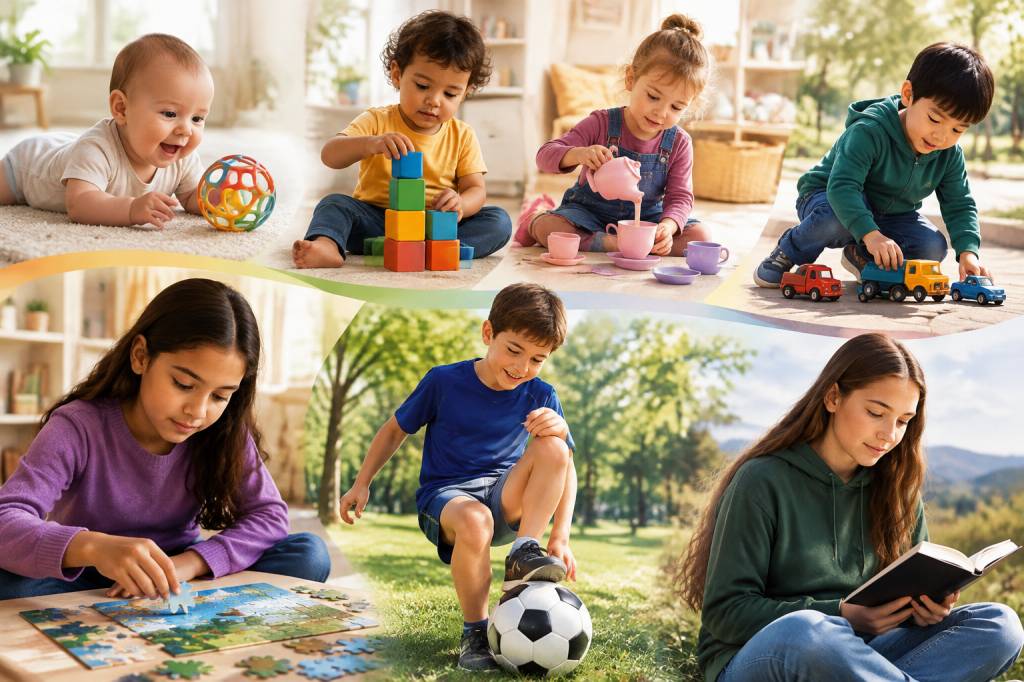
Play can look wonderfully ordinary: a baby batting at a spoon, a toddler carrying the same block from room to room, or a preschooler insisting that the living-room rug is a pirate ship. Yet these small scenes are doing important work. Through play, children explore relationships, test ideas, practice movement, and make sense of a world that is still very new to them.
There is no single right way to play, and children do not move through stages on a strict timetable. Age ranges offer a helpful map, not a set of deadlines. A child may return to a familiar kind of play when tired or adjusting to a change, then surprise you with a new skill the next day. The goal is not to teach every moment. It is to notice, make space, and join in when an invitation appears.
Birth to 12 months: discovering the world through the senses
For babies, play begins with connection and sensation. A familiar voice, a face leaning close, the soft rustle of a blanket, or the satisfying bang of a toy on the floor can all become part of an experiment. Babies are learning that their actions have effects: I kick, the mobile moves; I smile, someone smiles back.
Early play is often brief and repetitive. That repetition is useful, not a sign that a baby needs more complicated entertainment. A baby may gaze at a high-contrast picture, reach for a ring, or drop a toy and watch you pick it up. Each small exchange builds attention, coordination, and trust.
- Try: face-to-face songs, gentle peekaboo, soft cloth books, safe rattles, and supervised tummy time with a toy just within reach.
- Follow your baby’s cues: a relaxed gaze or excited kicks may mean “again,” while turning away, fussing, or rubbing the eyes may mean “I’ve had enough.”
- Keep it safe: choose age-appropriate objects without small parts, and stay close during floor play.
Peekaboo is a classic for good reason. For a young baby, the returning face is a joyful surprise; over time, the game also helps them begin to understand that someone can disappear from sight and still come back. And yes, adults are allowed to enjoy the dramatic reveal as much as the baby does.
12 to 24 months: moving, repeating, and making things happen
As babies become toddlers, their world expands at the pace of their feet. They may stack two blocks, push a toy across the room, fill a container and empty it, or proudly carry a ball from one end of the house to the other. These actions help develop balance, hand-eye coordination, and early problem-solving.
Toddlers often repeat a game many times. A cup goes into a box, comes out, and goes back in. A tower falls, and the builder begins again. To an adult, this can look like an unusually small plot. To a toddler, it is a chance to investigate: What fits? What happens if I push harder? Can I do it myself?
Language is also woven into play. Naming the objects a child points to, describing their actions, and leaving a pause for them to respond can support communication without turning play into a quiz. Try, “The red ball rolled under the chair,” rather than asking a string of questions. The first phrase gives the child words to borrow; the second may feel like a pop test.
- Try: blocks, nesting cups, chunky puzzles, balls, board books, pretend kitchen items, and safe containers to fill and empty.
- Make room for movement: provide a clear, supervised space for crawling, climbing over cushions, or practicing new steps.
- Play alongside: toddlers may enjoy being near other children without yet sharing a game with them.
At this age, “helping” may mean handing you the same sock three times or sweeping one small patch of floor with great seriousness. Letting children take part in simple routines can turn everyday life into meaningful practice.
Two to three years: imagination starts to take the lead
During the toddler years, pretend play often grows richer. A block becomes a phone; a stuffed animal needs a checkup; a spoonful of imaginary soup is served with great ceremony. These simple make-believe moments help children explore familiar experiences and try out new roles.
Children are also developing independence, though their wishes and abilities do not always arrive together. A child may want to pour the juice alone and then feel upset when it spills. In play, adults can offer small choices and manageable challenges: “Would you like the blue cup or the green one?” or “Should the bear have a blanket or a pillow?” The child gets to lead while you quietly keep the task within reach.
Playing near other children is still common. A pair of toddlers may build separate towers side by side, occasionally eyeing one another’s blocks. This is often called parallel play. It is a real part of social learning, even if it does not yet look like a shared plan. Taking turns, negotiating, and sharing are skills children need time and support to practice.
- Try: pretend food, dolls or stuffed animals, washable crayons, play dough used with supervision, simple dress-up items, and puzzles with a few large pieces.
- Offer words for feelings: “You both want the truck. Let’s find a way for each of you to have a turn.”
- Keep expectations flexible: an activity may last five minutes, or it may be revisited all afternoon.
Three to five years: stories, friendships, and big ideas
Preschoolers often turn play into a whole world. The couch becomes a mountain, a cardboard box becomes a bus, and a group of toy animals may be preparing for a very important picnic. Children begin to plan roles, tell longer stories, and draw on what they have seen in family life, books, and the wider world.
Make-believe can support emotional learning as well as language. A child acting out a visit to the doctor may be working through a real appointment. A pretend baby who needs comforting may give them a chance to practice care. Adults do not have to explain the meaning of every story. Sometimes the most helpful response is simply, “Tell me what happens next.”
Cooperative play—working toward a shared idea—becomes more possible, though disagreements are still part of the picture. A castle may have two kings, three firefighters, and a sudden rule change. Those negotiations give children practice listening, adapting, and expressing what they want. Your calm presence can help without taking over the whole story.
- Try: blocks and construction sets, simple board games, art materials, costumes, pretend shops, and outdoor games that involve running, balancing, or collecting.
- Support problem-solving: ask, “What could we try?” before offering a solution.
- Make space for creativity: an uneven paper crown or a lopsided tower may be exactly right for its young inventor.
At this age, children may also enjoy rules and simple games, but the rules can be wonderfully negotiable. If a game of tag has acquired a “resting dragon” who cannot be tagged while sitting down, you are witnessing imagination and rule-making in action.
Five to eight years: rules, projects, and deeper collaboration
As children enter the early school years, play often stretches into longer projects. They may invent a card game, build a detailed structure, create a comic, or spend days developing a story with friends. These activities bring together planning, creativity, memory, and persistence.
Games with rules become increasingly appealing. Children learn to wait, manage disappointment, keep track of turns, and understand that everyone follows the same plan. Not every child enjoys competition, and that is fine. Cooperative games, shared building challenges, or make-believe adventures can offer the same sense of teamwork without a winner and a loser.
Physical play remains important, too. Running, dancing, climbing, and ball games help children strengthen coordination and confidence. Different children prefer different kinds of movement, so offer variety rather than treating one sport or activity as the measure of success.
- Try: collaborative board games, craft projects, building materials, scavenger hunts, simple science explorations, and outdoor adventures suited to your child’s abilities.
- Let children take the lead: invite them to explain their game or show you how their construction works.
- Support healthy boundaries: agree on safe spaces, materials, and screen limits before play begins.
When a project goes wrong, resist the urge to rescue it immediately. A paper bridge that collapses can become a chance to test a wider base or different materials. You might say, “It fell. What do you think we could change?” The answer may be practical, imaginative, or both.
Making room for play in a busy family day
Children do not need a room full of toys to learn through play. Open-ended materials—blocks, paper, fabric scraps, cardboard boxes, and safe household objects—can invite more invention than a toy with only one purpose. Rotating a few available items can also make familiar toys feel fresh without adding clutter.
Some of the best play happens in the gaps between planned activities. A walk can become a search for smooth stones. Setting the table can turn into a sorting game. A few minutes of joining your child on the floor may be more valuable than an elaborate activity that leaves everyone tired. You do not need to perform enthusiasm on demand; your presence and attention matter more than a perfect setup.
It can help to observe before stepping in. What is your child trying to do? What are they enjoying? Are they asking for help, or simply concentrating? Waiting a moment gives children room to test their own ideas. When they invite you in, follow their lead: be the patient at the checkup, the customer at the pretend shop, or the passenger on the very bumpy cardboard bus.
When play looks different
Children vary in temperament, interests, development, and the way they connect with others. Some dive into group games; others prefer to watch first or play quietly on their own. A child may love imaginative stories but avoid messy materials, or enjoy building for a long time without saying much. These differences are not, by themselves, a reason to worry.
If you have ongoing concerns about your child’s communication, movement, interaction, or ability to enjoy play, bring them up with a pediatrician or another trusted health professional. You know your child’s patterns best, and asking questions is a thoughtful way to support them—not a judgment of your parenting.
Across every age, play offers children a safe place to try, repeat, imagine, connect, and begin again. The baby reaching for a rattle and the older child negotiating the rules of a backyard game are both learning in ways that fit their moment. We can offer time, a little room, and the reassurance that not every tower has to stay standing. Sometimes the best part is watching what a child builds next.