
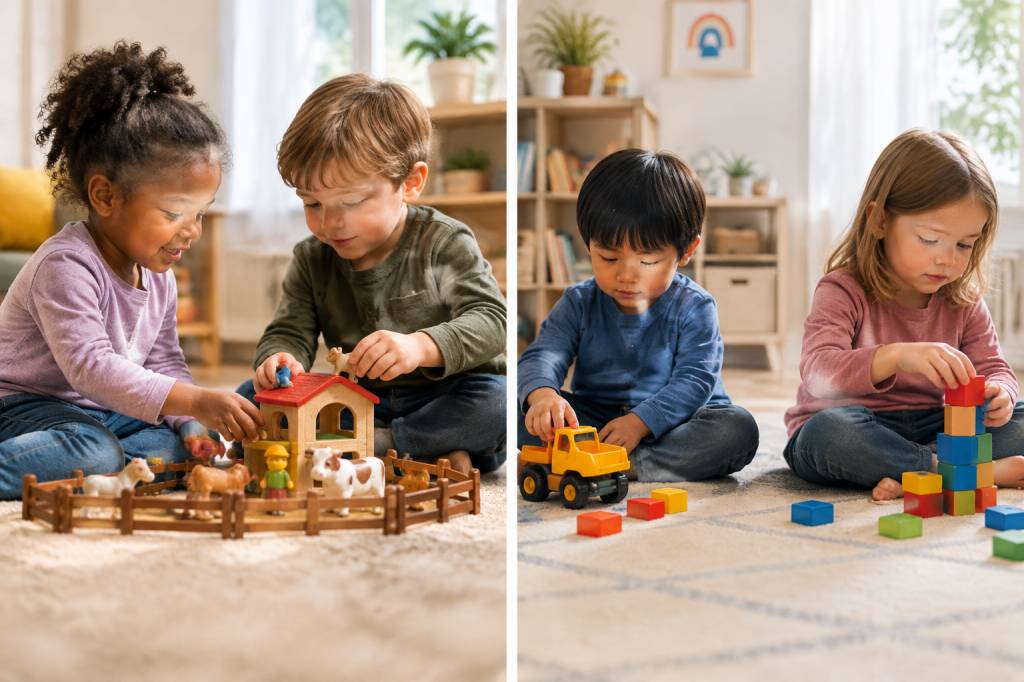
At the playground, two toddlers sit side by side in the sandbox. One is filling a cup with sand; the other is carefully building a hill. They glance at each other now and then, but neither asks to join in. A little later, one child offers the other a shovel, and suddenly the hill has a moat.
Both moments are play, and both can be meaningful. The first is often called parallel play; the second may be associative play. These terms describe different ways children engage with one another as their social skills grow. They are useful guideposts for parents and caregivers, not a checklist children need to pass.
Understanding the difference can make everyday play easier to read. A child playing beside someone without speaking is not necessarily lonely or unfriendly. And a child who shares materials but does not follow a group plan is not doing play “wrong.” Children learn connection gradually, one small exchange at a time.
What Is Parallel Play?
Parallel play happens when children play near one another, often with similar toys or activities, but without coordinating what they are doing. They may watch each other, imitate a movement, or borrow an idea without directly joining the other child’s game.
Picture two children at a table with blocks. One stacks a tower; the other builds a row of little houses. They share the space and may notice one another’s work, but each is mostly absorbed in a separate activity. That is a familiar example of parallel play.
This kind of play is common in toddlers and young preschoolers, though its timing varies from child to child. It can also appear at older ages, especially in a new setting, with unfamiliar peers, or when a child is tired and prefers to focus on their own activity. The stage is not a deadline, and children may move between different kinds of play in the same afternoon.
Parallel play may look quiet from the outside, but children are still gathering information. They notice how another child uses a toy, what happens when a block falls, and how people behave in a shared space. Sometimes a toddler will watch closely before trying the same action. That careful watching is part of learning, even when no conversation is happening.
What Is Associative Play?
Associative play involves more direct interaction. Children may talk, exchange toys, share materials, or take an interest in what one another is doing. They are connected through the play, but they are not necessarily working toward the same goal or following a set of agreed rules.
For example, a few children might use crayons at the same table. They comment on each other’s pictures, ask for the blue crayon, and pass around a sheet of paper. One child draws a dog, another makes a rainbow, and a third fills the page with energetic circles. They are interacting, but they are not creating one shared picture or planning a story together.
That distinction matters: association is not the same as cooperation. Children can share a play space and respond to one another without organizing their ideas into a common plan. A pretend restaurant where every child takes a role and follows a shared storyline is closer to cooperative play, which involves a higher level of coordination.
The Key Differences at a Glance
-
Interaction: In parallel play, children mainly focus on their own activity. In associative play, they engage more directly with each other.
-
Use of materials: Children playing in parallel may have similar toys but use them separately. During associative play, they are more likely to share or exchange materials.
-
Shared purpose: Parallel play usually has no shared activity. Associative play includes some connection around an activity, but children do not need to agree on one goal.
-
Communication: Parallel play can happen with little or no conversation. Associative play often includes comments, requests, gestures, or brief conversations.
-
Planning: Neither type requires a detailed plan. Associative play has more back-and-forth, while cooperative play adds more shared roles, rules, or goals.
The differences are useful, but real play does not always fit neatly into one box. A child might start by building alone, glance at a neighbor’s tower, offer a block, then return to independent play. Development is not a straight staircase. It is more like a path with pauses, loops, and occasional detours to inspect a particularly interesting leaf.
How These Forms of Play Support Development
Parallel play gives children room to explore at their own pace while becoming more comfortable around peers. They can practice concentrating, handling materials, and making choices without needing to negotiate every detail. Being near another child also offers a gentle introduction to shared space: whose turn is it, where do the toys go, and what happens when someone else reaches for the same truck?
It can also create a low-pressure opportunity to learn by watching. A child may see a peer roll a ball down a ramp and then try the idea independently. No instruction or invitation is required. The other child’s play becomes a small demonstration, and curiosity does the rest.
Associative play offers more chances to practice communication and social flexibility. Children learn to ask for a toy, respond to a suggestion, wait briefly, and notice another person’s ideas. They may experience small disagreements, too. A dispute over the red shovel can be frustrating, but with calm adult support, it can become an early lesson in expressing a need and finding another solution.
Neither form is more valuable in every moment. A child may benefit from watching quietly one day and from sharing ideas the next. What matters is having opportunities for a range of play, with adults close enough to help when needed but not so quick to manage every interaction that children lose the chance to try.
How to Tell What You Are Seeing
Rather than judging play by how talkative or lively it looks, notice how the children relate to one another. Are they simply using the same area? Are they watching and copying? Are they exchanging toys or responding to each other’s comments? These small details can help you identify whether the play is mostly parallel or more associative.
Imagine two toddlers at a water table. Each has a cup and pours water into a separate container. They are playing side by side, perhaps checking what the other is doing, but not yet interacting much. Later, one hands over a scoop and the other says, “More water!” They are now sharing materials and responding to one another, even if each child still has a separate idea about what to do next.
Adults sometimes expect a playdate to become a seamless partnership: matching costumes, one elaborate game, and no disagreements. A more realistic picture may include long stretches of independent play, brief moments of connection, and a sudden debate about whether a stuffed bear is allowed to eat pretend spaghetti. All of that can be part of healthy social learning.
Ways to Encourage Social Play Without Forcing It
Children are more likely to connect when the environment gives them something interesting to explore. A few simple choices can make shared play feel inviting without requiring anyone to perform friendliness on demand.
-
Offer open-ended materials. Blocks, play dough, toy animals, art supplies, and dress-up items can be used in many ways. Children can play separately with them, then naturally exchange ideas or materials.
-
Choose enough materials to reduce pressure. If there is only one beloved truck, conflict may take center stage. Having several similar options can give children more room to settle into play.
-
Keep the group manageable. A familiar playmate or a small group may feel easier than a busy room full of children, particularly for a child who is still getting comfortable socially.
-
Describe what you notice. Try, “You’re both making roads with the blocks,” or, “Maya gave you the scoop.” Gentle narration can help children notice each other’s actions without telling them exactly what to do.
-
Model simple phrases. When a child needs help joining in, offer words such as, “Can I build here?” or, “Would you like this cup?” Then leave space for the children to respond in their own way.
Try not to turn every quiet moment into a social assignment. “Go ask her to play” can feel like a large task to a young child who is still observing. Watching for a while may be the step that makes joining possible. You can stay nearby, offer a gentle suggestion, and respect a child’s decision to keep playing independently.
Helping With Disagreements
Sharing and turn-taking are learned skills, not automatic habits. If two children reach for the same toy, it can help to describe the situation neutrally: “You both want the truck.” Then offer a practical next step, such as taking turns, finding a timer, or choosing another vehicle while they wait.
For younger children, keep the language brief and concrete. “First Noah’s turn, then yours” may be more useful than a long explanation about fairness. A child may still protest; being disappointed does not mean the support has failed. The goal is not to prevent every difficult feeling, but to help children move through it safely and gradually build the skills to manage it.
Adults do not need to settle every minor difference. If the children are safe and working things out, a short pause can give them a chance to try their own solutions. If someone is being hurt, overwhelmed, or unable to communicate what they need, step in calmly and help restore safety.
When to Seek More Guidance
Children vary widely in how they approach play. Temperament, language development, familiarity with other children, sensory preferences, and the setting can all shape how a child participates. A child who prefers parallel play in a crowded classroom may be much more interactive with a familiar cousin at home.
Parallel play by itself is not a sign that something is wrong. If you have ongoing concerns about your child’s communication, social engagement, or development more broadly, bring them up with your pediatrician or another qualified professional. You do not need to wait for a particular birthday or compare your child with a neighbor’s. A professional can consider the whole picture and help you decide whether additional support would be useful.
Make Room for Their Own Pace
Parallel play and associative play are two ways children explore being together. In one, they share a space while following their own ideas. In the other, they exchange materials and attention, even if they are not yet building one shared plan. Both can be important parts of a child’s growing social world.
So the next time two little builders sit side by side, resist the urge to decide that they must become a team. Notice the quiet watching, the borrowed idea, or the unexpected offer of a shovel. Sometimes connection begins with a conversation. Sometimes it begins with two separate sandcastles and one very generous bucket.