
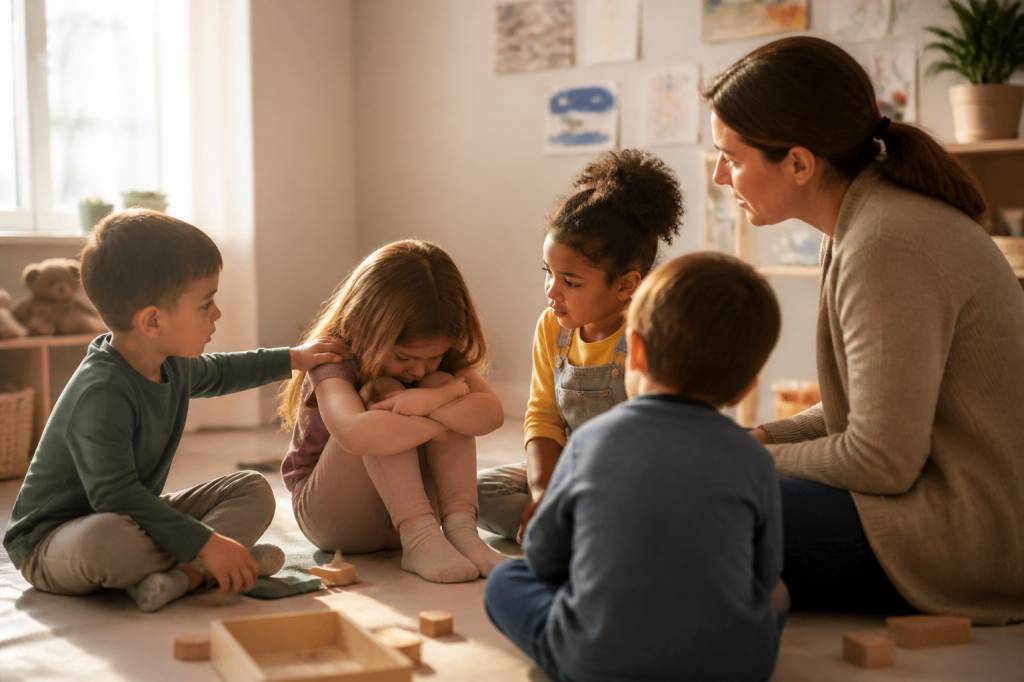
Early childhood is filled with small moments that reveal enormous growth. A toddler offering a favorite toy to a crying friend, a preschooler proudly saying, “I did it myself,” or a child hiding behind a parent before slowly joining a group—these everyday scenes are all part of social and emotional development.
Social-emotional development describes the way children learn to understand their feelings, build relationships, communicate their needs, and respond to the world around them. It does not happen all at once, and it certainly does not follow a perfectly tidy timeline. Children grow at different speeds, with their own temperaments, experiences, and little quirks.
As parents, we may sometimes wonder whether a behavior is “normal” or whether we should be doing more. The reassuring truth is that much of this learning happens through ordinary routines: cuddles, play, conversations, boundaries, and the quiet repetition of being there. Let’s look at practical examples of social and emotional development in early childhood—and how we can gently support them.
What social and emotional development includes
Social development involves learning how to connect with others. It includes sharing attention, taking turns, cooperating, communicating, forming friendships, and understanding simple social expectations.
Emotional development is the growing ability to recognize feelings, express them safely, manage strong emotions, and gradually develop empathy. A young child is not born knowing how to calm down after frustration or understand that another person may feel differently. These skills are built slowly, with loving guidance and plenty of practice.
Some important areas include:
- Recognizing and naming emotions
- Developing trust and secure relationships
- Expressing needs and asking for help
- Learning empathy and concern for others
- Managing frustration and waiting briefly
- Playing alongside and eventually with other children
- Following simple rules and repairing mistakes
- Building confidence, independence, and self-awareness
When a child struggles to share or has a dramatic reaction to a broken cracker, it does not mean they are being difficult on purpose. Their emotional “brakes” are still under construction. Adults provide the calm, structure, and language that children cannot yet create independently.
Building secure relationships
One of the earliest signs of healthy social-emotional development is a child’s growing sense of trust. Babies learn that a familiar adult will respond to their cries, offer comfort, and help them feel safe. This foundation supports later confidence: a child who feels secure can gradually explore the room, meet new people, and return to a trusted caregiver when reassurance is needed.
For example, a baby may look toward a parent during a new experience, smile after hearing a familiar voice, or settle when held. A toddler may wander a few steps away at the playground, then glance back to make sure a parent is still nearby. This “checking in” is not clinginess or manipulation. It is a healthy way of using a trusted adult as a secure base.
Parents can nurture this development through predictable responses and warm connection. Say hello when your baby wakes, describe what is happening during care routines, and respond with patience even when the request is communicated through an impressive amount of crying. Consistency helps children learn, “My feelings matter. Someone will help me.”
Recognizing and expressing emotions
Young children experience powerful emotions long before they have enough words to explain them. A two-year-old may cry, throw a toy, or collapse dramatically on the kitchen floor because “sad,” “disappointed,” and “overwhelmed” are not yet available in their vocabulary.
Emotional development can be seen when children begin to identify feelings in themselves and others. A preschooler might say, “I’m mad because she took my truck,” or notice, “He looks scared.” Even when the words are imperfect, the child is beginning to connect inner experiences with language.
Parents can support this process by naming feelings without approving unsafe behavior:
- “You are disappointed that playtime is over.”
- “You look worried because the dog barked.”
- “It is okay to feel angry. I will not let you hit.”
- “You wanted the blue cup, and we have the green one today.”
This does not make a child more emotional. It gives the emotion a map. Over time, children learn that feelings can be noticed, talked about, and managed rather than feared or acted out.
Learning to self-regulate
Self-regulation is the ability to manage attention, impulses, emotions, and behavior. It is one of the most important—and most gradual—parts of early childhood development. A toddler who can wait a few seconds for a snack, pause before grabbing, or accept comfort after becoming upset is practicing self-regulation.
It is helpful to remember that regulation develops in relationship. Children often need an adult to lend them calm before they can find it within themselves. A quiet voice, a gentle hug, a familiar song, or a simple routine can help bring a very upset child back to a manageable state.
Try keeping your language short during emotional storms. Long explanations rarely reach a child who is already overwhelmed. Instead, you might say, “You are safe. I’m here. Hands are gentle.” Once the child is calm, you can talk about what happened and consider what might help next time.
Simple routines also support regulation. Regular meals, adequate sleep, outdoor movement, and warnings before transitions can make a surprising difference. Sometimes the difference between a peaceful trip home and a theatrical parking-lot performance is a snack. Parenting contains many profound lessons, and occasionally the lesson is “never underestimate a banana.”
Developing empathy
Empathy is the growing ability to notice and care about another person’s feelings. It develops over time and begins with simple observations. A young child may watch a crying baby, bring a blanket to a parent who looks tired, or pat a friend after a minor accident.
These early gestures may be brief or inconsistent, but they are meaningful. Children are learning to shift their attention away from their own immediate experience and consider someone else’s. At first, empathy is often connected to what they have personally experienced. A child who has been comforted with a favorite stuffed animal may offer that same toy to someone who is upset.
Adults can encourage empathy by making emotions visible:
- “Your brother is crying. I think he may be startled.”
- “Grandma looks happy to see you.”
- “The child fell. What could we do to help?”
- “You noticed that she was sad and brought her the doll.”
Stories are especially useful. Pause while reading and ask, “How do you think the character feels?” or “What might help?” There is no need to turn every bedtime book into a lesson. A gentle question here and there is enough to help children practice seeing the world from another perspective.
Playing with other children
Play offers a window into social development. Babies may enjoy face-to-face games such as peekaboo, smiling and responding to another person’s expressions. Toddlers often engage in parallel play, staying near other children while playing with their own toys. They may appear to be playing separately, but they are watching, imitating, and learning social patterns.
As children approach the preschool years, they gradually begin to participate in shared play. They may build a block tower together, pretend to run a restaurant, or create rules for a game. Cooperation is still fragile, of course. A child may happily announce, “We are all going to be superheroes,” and then become deeply offended when another child chooses to be a dinosaur.
Conflicts are not evidence that social development has failed. They are opportunities to practice it. Children need support to use words, listen, negotiate, and repair relationships.
When two children want the same toy, an adult might say:
“You both want the fire truck. We are going to take turns. Maya can use it for two minutes, and then Leo will have a turn. You can play with the garage while you wait.”
Very young children may not manage a long wait, so keep expectations realistic. Sharing is a developing skill, not a personality test. Forced sharing can create more distress; guided turn-taking is usually more helpful.
Growing independence and confidence
Social-emotional development also includes a child’s emerging sense of self. Toddlers often say “me,” “mine,” and “I do it!” with remarkable enthusiasm. While the repeated insistence can test anyone’s patience, it reflects an important developmental step: the child is discovering personal preferences, abilities, and agency.
A preschooler choosing between two shirts, helping pour water, or putting shoes near the door is practicing independence. These small responsibilities build confidence and teach children that their actions have meaning.
Offer choices within clear limits:
- “Would you like the red cup or the yellow cup?”
- “Do you want to put on your pajamas before or after brushing your teeth?”
- “Would you like to carry the napkins or place the spoons?”
Too many choices can be overwhelming, especially when a child is tired. Two acceptable options are often enough. The goal is not to hand over the entire household management system to a four-year-old, but to give them safe opportunities to participate.
Understanding rules, limits, and repair
Children learn social expectations through repetition and relationships. They begin to understand that some behaviors keep people safe, that family routines have patterns, and that actions affect others. A toddler may stop when told, “The stove is hot,” although reminders will certainly be needed. A preschooler may learn that toys are put away before a new activity begins.
Rules are most effective when they are clear, brief, and consistent. Focus on what the child can do rather than only what is forbidden. Instead of “Don’t be rough,” try “Use gentle hands.” Instead of “Stop yelling,” try “Use an indoor voice.”
Mistakes are also opportunities to learn repair. A genuine apology may not come naturally at first, and requiring a child to say “sorry” before they understand what happened can make the words feel empty. You can model repair by saying, “You knocked over her blocks. Let’s help rebuild them,” or “You grabbed the crayon. Give it back, then ask for a turn.”
Repair teaches responsibility without shame. Children learn that making a mistake does not make them bad—and that relationships can be cared for after something goes wrong.
How parents can support healthy development
The most powerful support is not a complicated program or a perfectly organized activity schedule. It is responsive, everyday connection. Talk with your child, listen to their attempts to communicate, and make time for shared play. Put down the phone when you can, but do not punish yourself when real life interrupts. Children need emotionally available parents, not endlessly entertaining ones.
A few practical habits can make a meaningful difference:
- Get down to your child’s level when speaking.
- Use emotion words during ordinary moments, not only during meltdowns.
- Keep routines predictable when possible.
- Prepare children for transitions with simple warnings.
- Model calm problem-solving and respectful communication.
- Read stories that include friendship, feelings, and cooperation.
- Allow safe, age-appropriate choices and responsibilities.
- Praise specific behaviors: “You waited for your turn,” rather than only “Good job.”
- Make space for active play, rest, and unhurried connection.
It is also important to consider temperament. One child may rush toward every new activity, while another observes quietly from a parent’s lap before participating. A cautious child is not necessarily lacking confidence, and an energetic child is not necessarily poorly behaved. Supporting development means respecting the child in front of us while gently helping them stretch their skills.
When to seek additional guidance
Every child develops differently, and occasional challenges are part of childhood. Still, parents should trust their instincts if they notice ongoing concerns about communication, relationships, emotional responses, play, or behavior. A pediatrician, early childhood professional, or child development specialist can offer perspective and recommend support when needed.
Consider seeking advice if a child consistently seems unable to engage with caregivers, rarely responds to social interaction, loses skills they previously had, cannot communicate basic needs in an age-expected way, or experiences emotional and behavioral difficulties that significantly interfere with daily life. Reaching out is not an admission of failure. Early support can make new skills easier to develop and can reassure families who are carrying unnecessary worry.
Social and emotional growth is built from countless small experiences: being comforted after a tumble, hearing a feeling named, waiting for a turn, helping clean up a spill, and trying again after a difficult moment. These moments may look ordinary to us, but to a young child they are lessons in trust, connection, compassion, and resilience.
With patient guidance and a safe relationship, children gradually learn that emotions can be understood, friendships can be repaired, and challenges can be faced one step at a time. And while the journey may include plenty of noise, negotiation, and mysteriously missing socks, it is also filled with the quiet wonder of watching a small person become more fully themselves.