
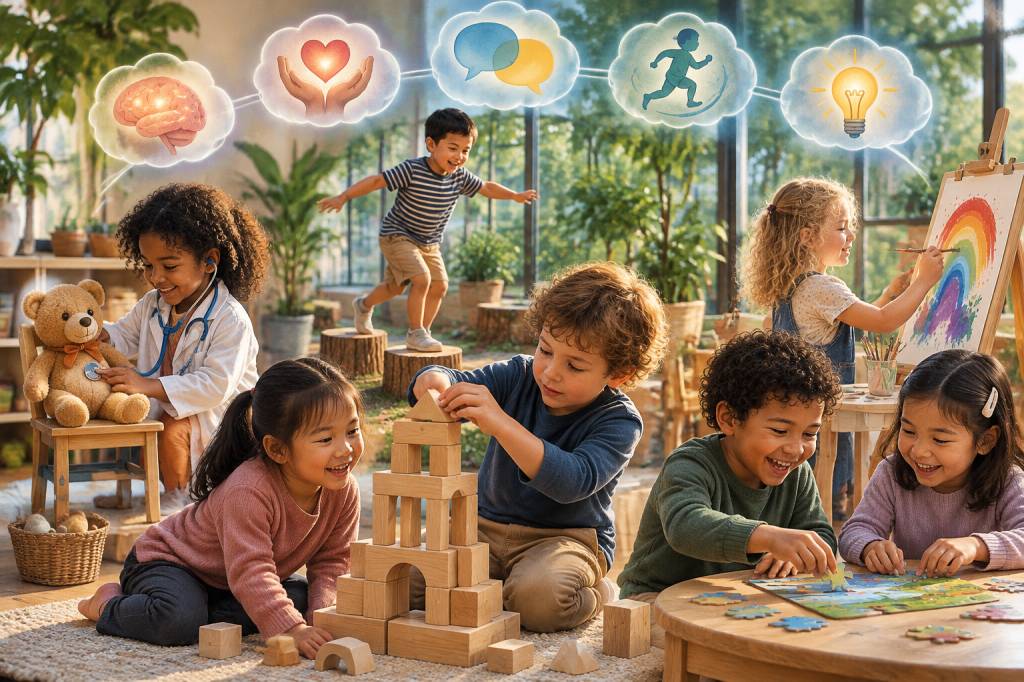
On a rainy afternoon, a cardboard box can become a rocket ship, a blanket can turn into a forest, and a wooden spoon can be just about anything except a wooden spoon. To grown-ups, it may look like a lovely mess. To a young child, it is serious work: imagining, testing ideas, practicing new skills, and figuring out how the world fits together.
Play is not a break from learning in early childhood. It is one of the main ways children learn. Through play, little ones build language, movement, confidence, and relationships—often without realizing they are doing any of it. That does not mean every moment needs an educational purpose or a carefully planned activity. In fact, some of the richest play begins with a child’s own idea and a parent who is happy to follow along.
What play skills look like
Play skills are the abilities children use to explore, imagine, communicate, and interact with others. They grow gradually, and they do not follow one exact timetable. A baby may study a rattle by shaking it and watching it fall. A toddler may stack blocks, knock them down, and start over. A preschooler may assign everyone in the room a role in a very important pretend bakery.
These moments involve more than entertainment. Children are learning how objects work, practicing hand and body control, expressing ideas, and making sense of social situations. As their skills develop, their play often becomes more varied and complex. A child might move from filling and emptying a container to pretending it is a cooking pot, then inviting someone else to join the game.
Development is individual, though. Some children prefer physical play; others are drawn to books, puzzles, or imaginative stories. A child may also enjoy playing alongside other children before feeling ready to share a game with them. These differences are normal parts of how young personalities and abilities unfold.
How play supports learning
Play gives children a safe place to try things out. A tower falls, so they make its base wider. A toy animal will not fit through a gap, so they turn it sideways. In these small experiments, children practice problem-solving and early reasoning. They notice what happens, make a guess, and try again—an approach that serves them well long after the blocks are put away.
Play also offers practice with focus and flexibility. A child building a road may have to stick with a plan, then adapt when the pieces do not line up. A pretend game may change direction when a stuffed bear suddenly needs a doctor. Learning to shift gears, wait, and keep going after a small frustration takes time. Play gives children many low-pressure chances to practice.
And then there is the joy of discovery. When a child pours water between cups, watches a ball roll down a ramp, or hears a new word in a story, curiosity is doing its work. We do not need to turn every discovery into a lesson. A warm “I wonder what will happen next?” can be enough to help a child keep exploring.
Language grows through play
Play creates natural reasons to communicate. Children name objects, describe what they are doing, ask questions, and tell stories. Even before a child has many words, gestures, sounds, and facial expressions help them share attention with someone else. A baby pointing toward a toy is already inviting a little conversation.
During pretend play, children often borrow language they have heard in everyday life. A toy might need to “wait its turn,” or a doll might be told, “We’re going to the store.” These playful scenes help children practice new words and explore how conversation works. They may also reveal what a child is thinking about, even when they cannot yet explain it directly.
Adults can support language without turning play into a quiz. Instead of asking a stream of questions—What color is it? How many are there? What is that?—try adding a gentle comment: “Your blue car is going under the bridge.” Then pause. The child may respond, repeat a word, or simply continue playing. That quiet space gives them time to take the lead.
Movement, coordination, and confidence
Play gets bodies involved. Reaching for a toy, fitting puzzle pieces together, scribbling, climbing, dancing, and kicking a ball all help children practice different kinds of movement. Small hand movements support tasks such as turning pages and using crayons. Bigger movements build balance, strength, and awareness of where the body is in space.
There is no need to fill every room with specialty equipment. A cushion path, a safe place to dance, or a basket of blocks can offer plenty of opportunities to move. Everyday objects are often compelling precisely because children have not yet decided what they are “supposed” to be. A cardboard tube may become a tunnel, a telescope, or the world’s least reliable microphone.
When a child chooses a challenge and works it out at their own pace, they also build confidence. We can stay close, make the space safe, and offer help when needed without taking over. There is a big difference between rescuing a child from every wobble and letting them know we are nearby while they try.
Play is practice for being with others
Playing with another person involves a surprising number of skills: noticing what the other person wants, sharing attention, taking turns, and coping when the game does not go exactly as planned. These abilities take time to develop. A toddler who clutches every toy is not necessarily being unkind; they may still be learning what sharing means and how to handle the feeling of letting something go.
For young children, playing near one another can be a meaningful step. Two toddlers may build separate towers side by side, occasionally watching or copying each other. Over time, they may begin to exchange toys or share a simple idea. Cooperative games usually ask for more flexible communication, so it is helpful to keep expectations matched to a child’s age and temperament.
When disagreements arise, a calm adult can help put feelings into words: “You both want the truck. Maya is using it now. Let’s find another one, or we can wait for a turn.” The goal is not to make every playdate perfectly peaceful. It is to show children a path through the difficult moment, one small step at a time.
How adults can encourage play
Children do not need an adult directing every minute of their play. Often, our most useful role is to provide a safe space, a little time, and a few open-ended materials. Blocks, cups, fabric scraps, crayons, toy animals, and household containers can invite more possibilities than toys that do only one thing.
Try watching before stepping in. What has caught your child’s attention? What are they trying to do? If they seem absorbed, let the moment continue. If they invite you in, follow their idea rather than adding your own rules. When the stuffed dog is apparently the teacher, it may be wise to accept the appointment.
A few simple ways to make room for play include:
- Set aside a little unhurried time, even if it is only ten minutes between everyday routines.
- Offer safe materials that can be used in more than one way.
- Describe what you notice instead of testing your child’s knowledge.
- Join in when invited, while allowing your child to guide the story.
- Make space for outdoor exploration and movement when it is practical and safe.
- Let children return to favorite games; repetition can be comforting and useful.
Some days, play will be wonderfully elaborate. Other days, a toddler will put one block on the floor and announce that the activity is finished. Both days count. Children also learn from ordinary moments: helping put groceries away, splashing in the bath, looking at a picture book, or watching a caregiver fold laundry. A little shared attention can turn routine into connection.
When play feels difficult
Not every child jumps easily into a new activity or group. Some need time to watch before joining. Others are sensitive to noise, reluctant to share materials, or happiest with familiar games. A quieter style of play is not automatically a problem. Notice what your child enjoys, what helps them feel secure, and whether they are gradually exploring in their own way.
If you are concerned about your child’s communication, movement, social interaction, or interest in play, bring it up with a pediatrician or another trusted child-development professional. You do not need to wait until a concern feels urgent to ask a question. Sharing specific examples—what you see at home, what is easy, and what seems challenging—can make the conversation more useful. Seeking guidance is not a judgment of your parenting; it is one way of supporting your child.
Small moments, lasting growth
It is easy to wonder whether we are offering enough: enough activities, enough stimulation, enough perfectly arranged time. But children do not need a childhood planned down to the minute. They need opportunities to explore, people who respond with warmth, and room to practice being curious, capable, and connected.
So the next time your living room becomes a pretend restaurant or a pile of cushions transforms into a mountain, you can let the game unfold. Listen to the story, offer a hand if it is needed, and enjoy the view from the floor. In those ordinary, playful moments, children are building skills they will carry with them—and they are building a sense of belonging, too.