
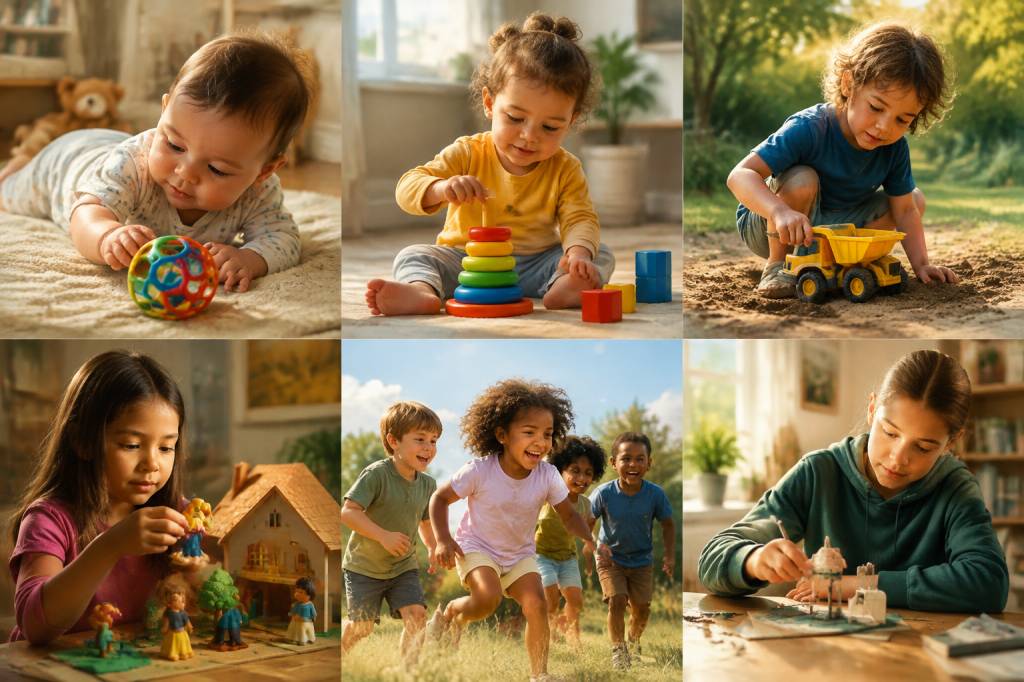
A toddler stacks three blocks, knocks them down, and starts again. Nearby, another child watches carefully without joining in. Across the room, two preschoolers race toy cars side by side, each following a very different story. To an adult, these moments may look like simple play. To a child, they are ways of exploring, practicing, and making sense of the world.
Play does not follow one perfect path, and children rarely move neatly from one kind to another. Still, child development experts often describe six stages of play that can help us understand what children are learning as they grow. These stages are useful guideposts—not a checklist, a timetable, or a reason to worry if your child seems to linger in one place.
Knowing what to look for can help us offer the right kind of support: sometimes a safe space, sometimes a few interesting materials, and often the freedom to let a child lead.
Why play matters so much
Play is one of the ways children learn before they have the words to explain what they are discovering. A baby reaches for a soft toy and learns about movement. A toddler fills and empties a cup, testing what fits and what falls. Older children invent a game together and practice listening, negotiating, and handling disappointment when the rules change.
Through play, children build skills in several areas at once. They may strengthen their bodies, develop language, experiment with ideas, or learn how to share space with other people. A pretend grocery store, for instance, can involve counting, conversation, imagination, and a surprising amount of discussion about who gets to be the cashier.
Play is also meant to be enjoyable. The goal is not to turn every block tower into a lesson or every puddle into a science project. A child’s delight, concentration, and curiosity are meaningful in their own right.
The six stages of play
The stages below are commonly associated with the work of sociologist Mildred Parten, who studied how young children interact during play. They describe different patterns of behavior, especially social behavior. They are not rigid age categories: children may move between stages depending on their mood, surroundings, confidence, or the people nearby.
Unoccupied play: watching, moving, and noticing
Unoccupied play is often seen in babies and very young children. A baby may wiggle, stare at their hands, kick at a blanket, or turn toward a sound. They may not appear to be playing with a clear purpose, but they are taking in sensations and learning that their bodies can affect what happens around them.
Picture a baby on a play mat, watching sunlight shift across the wall. A grown-up might be tempted to bring over a toy right away. But a quiet moment of looking, reaching, or listening can be valuable too. The baby is observing, testing movement, and beginning to connect actions with results.
How to support it: Offer a safe, comfortable space with a few age-appropriate things to notice, such as a soft cloth, a baby-safe mirror, or the sounds of everyday life. Stay close and responsive, without feeling that you need to entertain your baby every second.
Solitary play: enjoying play on one’s own
In solitary play, a child focuses on their own activity, often without trying to involve others. They might roll a ball back and forth, sort toy animals, or build a tower while other children play nearby. This kind of play is common in babies and toddlers, but older children can enjoy it, too.
Playing alone is not automatically a sign that a child is lonely or struggling socially. It can mean they are absorbed in an idea, practicing a skill, or simply enjoying some quiet. Many adults recognize the appeal of being left alone with a favorite task; children deserve that breathing room as well.
How to support it: Make a few inviting materials available, such as blocks, chunky crayons, puzzles, or pretend-play objects suited to your child’s age. Let your child decide what to do with them. If they are concentrating, try not to interrupt just to show them a “better” way.
Onlooker play: learning by watching
During onlooker play, a child watches other children play but does not join in. They may stand near a group, follow the action with their eyes, or ask questions about what is happening. From the outside, it can look like they are doing nothing. In fact, they may be studying the social landscape: how the game works, what the other children say, and how to enter without disrupting it.
At a playground, a child might watch a group take turns going down the slide for several minutes before trying it. That pause can be part of their process, not a problem that needs fixing. Watching gives children a chance to gather information and build confidence at their own pace.
How to support it: Give your child time. You might describe what you notice—“They’re taking turns rolling the ball”—without insisting that your child join. If they seem interested, you can offer a gentle opening, such as asking whether they would like to roll a ball over to the group.
Parallel play: side by side, each in their own world
In parallel play, children play near one another, often using similar toys, but do not yet coordinate their activities. Two toddlers may sit beside each other with separate tubs of blocks. One builds a bridge while the other makes a tower. They notice each other, and may occasionally copy or comment, but each child remains focused on their own play.
This is a familiar stage in toddlerhood, but parallel play can continue at different ages and in new settings. It offers a gentle way to become comfortable around peers. Children can share a space without having to share every toy, idea, or decision.
How to support it: Set up enough materials for children to play alongside each other without constant competition. At a playdate, for example, duplicate favorites can help prevent a toy dispute before it begins. You can stay nearby and help with simple requests: “You can ask if she is finished with the truck.”
Associative play: connecting without a shared plan
In associative play, children begin to interact more directly. They may share materials, talk about what they are doing, and borrow one another’s ideas, but they are not necessarily working toward the same goal. One child might build a road while another drives a car along it, then they swap toys and keep playing without deciding on a single story.
This stage brings more conversation and social practice. Children experiment with asking, offering, copying, and responding. The play may shift quickly: a pretend picnic becomes a parade, then a search for a very important missing spoon. Flexibility is part of the fun, even if the adults are still trying to understand the plot.
How to support it: Provide open-ended toys that invite children to contribute their own ideas, such as play dough, blocks, dolls, or toy animals. Support communication without directing every exchange. If a disagreement arises, help children find words for what they want, while leaving space for them to work out small problems themselves.
Cooperative play: sharing an idea or working toward a goal
In cooperative play, children organize their activity around a shared purpose. They may decide to build a fort, act out a story, play a simple game, or set up a pretend restaurant. Roles and rules become part of the experience: who takes the orders, who cooks, and whether the stuffed bear is allowed to ask for dessert before dinner.
Cooperative play often becomes more noticeable as children develop stronger language, self-regulation, and social understanding. It calls on many skills at once. Children have to communicate their ideas, listen to others, make decisions, and cope when someone suggests changing the plan. It is not always peaceful, but even a disagreement can offer practice in repairing a moment and trying again.
How to support it: Offer opportunities for shared projects, but keep expectations realistic. A family puzzle, a pretend shop, or a blanket fort can invite teamwork without requiring children to agree on every detail. If play becomes tense, you can help children name the problem and suggest a fair next step rather than taking over the whole game.
Stages are guideposts, not a race
It can be tempting to compare children: one seems eager to join a group, while another prefers to watch. But the six stages describe patterns, not a measure of a child’s worth or future social abilities. A child may move among several kinds of play in one afternoon. They might play alone at home, observe at a busy birthday party, and cooperate with a familiar cousin the next day.
Context matters. A new classroom, a tired afternoon, a different language, or an unfamiliar group can all affect how a child plays. So can temperament. Some children warm up quickly; others need time to look around before joining. Neither approach is inherently better.
It is also normal for older children to enjoy solitary play. Reading, drawing, building, or inventing a private story can be restful and absorbing. The important question is not whether a child is always playing socially, but whether they have chances to explore different kinds of play and feel supported in their relationships.
How adults can encourage healthy play
Children do not need elaborate toys or a perfectly planned schedule to benefit from play. A cardboard box can become a bus, a cave, or an extremely exclusive hotel. What matters most is having time, a safe environment, and adults who notice when support is needed—and when it is better to step back.
- Follow your child’s lead. Watch what captures their attention before suggesting the next activity. Their idea may be simpler, stranger, and much more interesting than yours.
- Offer open-ended materials. Blocks, crayons, fabric scraps, and pretend-play objects can be used in many ways, giving children room to experiment.
- Make room for unhurried play. Constantly switching activities can make it hard for a child to develop an idea. Even a short stretch of uninterrupted time can help.
- Join when invited. If your child hands you a toy phone, answer. If they want to build together, follow their plan before adding your own suggestions.
- Let small challenges happen. A tower that wobbles or a game that needs a new rule can be an opportunity to try, adapt, and problem-solve.
- Keep safety in view. Choose materials that suit your child’s age and supervise closely where needed, especially around small objects, climbing, water, or outdoor play.
When to look for extra guidance
Children vary widely, and one play moment cannot tell you everything about their development. Still, if you have ongoing concerns—for example, your child rarely shows interest in interacting with others, seems unable to communicate basic needs, or has lost skills they once used—it is reasonable to talk with your pediatrician or another qualified child development professional. You do not need to wait until a concern feels urgent to ask a question.
In everyday life, it helps to notice the whole child rather than focus on a single stage. Are they curious? Do they find ways to engage with people or objects? Are there situations in which they seem more comfortable? Sharing specific observations with a professional can make a conversation more useful than relying on a label alone.
Let play unfold
From a baby’s first reach to a group of children planning an elaborate pretend adventure, play changes as children grow. Each stage offers its own kind of discovery: noticing, concentrating, observing, sharing space, connecting, and cooperating. These experiences help children practice for life, but they are also life itself—full of wonder, small frustrations, and unexpected stories.
So the next time your child spends ten minutes putting a toy in a box and taking it out again, you can resist the urge to offer a more “productive” activity. They may be learning exactly what they need to learn in that moment. And if the box becomes a spaceship, well, that is a very good reason to keep the afternoon open.