
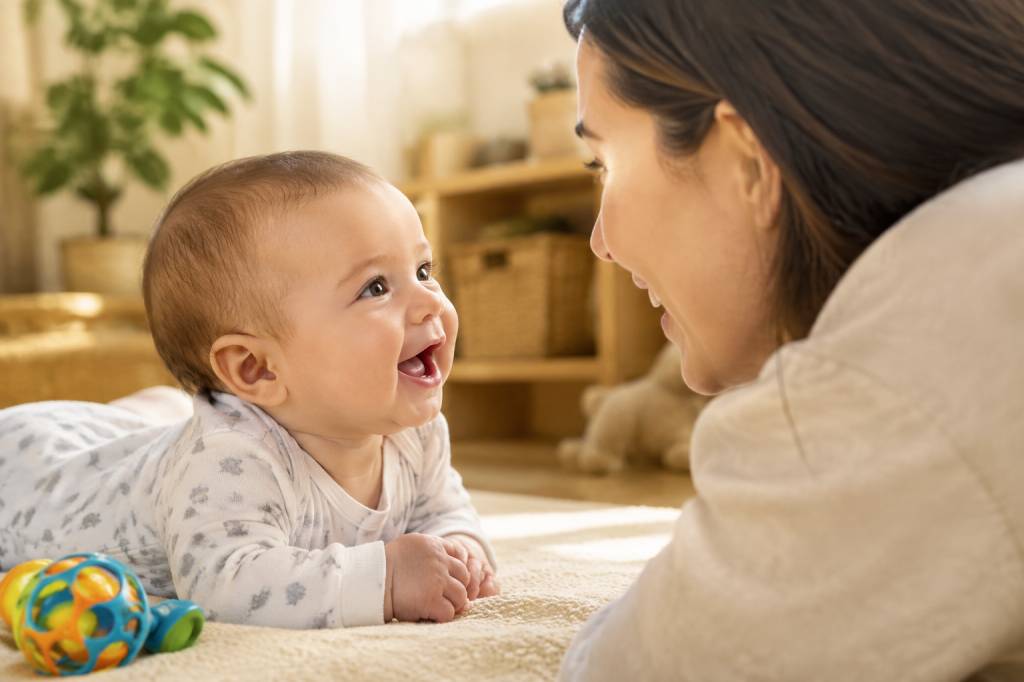
The first time a baby strings together “ba-ba-ba” or “mamama,” it can feel like a tiny conversation has begun. You may find yourself answering with great seriousness, even if the topic appears to be the spoon. That instinct is lovely: your baby is experimenting with sounds, and your warm response helps make communication feel rewarding.
Babbling is an important step in language development, but it doesn’t arrive on one exact birthday. Babies follow their own timelines, and the sounds they make can vary widely. Here’s what babbling may look and sound like, how you can encourage it, and when it may be helpful to check in with your child’s healthcare provider.
What counts as babbling?
Babbling is the stage when babies begin making speech-like sounds, often by joining a consonant to a vowel. Think “ba,” “da,” or “ma,” followed by playful repetitions such as “bababa.” These sounds aren’t usually words yet. Your baby is exploring how the mouth, tongue, and voice work together.
Babbling is different from early cooing. A young baby may make soft “oo” and “ah” sounds, squeal, or gurgle. Over time, the sound play often becomes more varied and begins to include consonants. Some babies repeat the same syllable, while others mix sounds together or seem to sing their own little melody.
It can sound like a story, a question, or a detailed report on the state of the nursery. Your baby isn’t necessarily saying something specific, but they are practicing the rhythm and patterns of conversation: making a sound, pausing, listening, and responding.
When do babies start babbling?
Many babies begin experimenting with speech-like sounds around 4 to 6 months. Repeated consonant-vowel babbling, such as “ba-ba-ba” or “da-da-da,” often becomes clearer between about 6 and 10 months. These are general ranges, not deadlines. Some babies babble earlier, some later, and some spend a while making other kinds of sounds before adding repeated syllables.
By around 9 months, many babies use a wider range of sounds and may repeat combinations such as “mamamama” or “babababa.” The Centers for Disease Control and Prevention includes making lots of different sounds—such as “mamamama” and “babababa”—among developmental milestones for 9-month-olds. A milestone describes what most children can do by a certain age; it is not a test your baby has to pass on a particular day.
Babbling also develops alongside other ways of communicating. Your baby may look toward you, smile, reach, gesture, or make a sound to get your attention. Those small exchanges count. Communication is more than speech, and every baby’s path includes a mix of listening, watching, moving, and making sounds.
How babbling often changes over time
There is no single sound sequence every baby follows, but you may notice some broad changes during the first year:
-
In the early months: Your baby may coo, gurgle, squeal, and make vowel-like sounds. They may also quiet down or look toward a familiar voice.
-
Around 4 to 6 months: Sound play often becomes more varied. You might hear laughter, squeals, growls, or the occasional consonant mixed into a vocalization.
-
Around 6 to 10 months: Many babies begin repeating syllables, such as “dadada” or “bababa.” They may change their pitch and volume as if taking a turn in a conversation.
-
Near the end of the first year: Some babies use gestures, understand familiar words, and say one or more meaningful words. Others are still busy practicing sounds. Both receptive communication—what your baby understands—and expressive communication—what they say or signal—matter.
These age ranges are guides, not a scorecard. Development can be uneven: a baby may be a champion babbler but take longer to sit, or focus on movement and have a quieter stretch with sounds. If you’re unsure how your child’s development is progressing, your pediatrician can help you look at the whole picture.
What babbling might sound like at home
Babies often babble most when they feel comfortable and have someone’s attention. You may hear it during a diaper change, while getting dressed, or in the quiet minutes after a nap. Some babies are vocal from the moment they wake up; others prefer to save their commentary for a particular audience—often the family cat.
At first, the sounds may be soft and brief. Later, your baby might repeat a syllable with different emphasis: “BA-ba-ba!” They may pause while you speak, then take another turn. That back-and-forth can feel wonderfully conversational, even when neither of you has quite settled on a topic.
Not every day will bring a new sound. A baby may be more vocal in one setting than another, or quiet when tired, hungry, overwhelmed, or focused on a new skill. Look for patterns over time rather than judging progress by one afternoon.
How to encourage your baby’s babbling
You don’t need flashcards, a special toy, or a perfectly planned language lesson. Everyday connection gives your baby plenty of chances to hear speech and try out sounds. The aim isn’t to make your baby talk on demand; it’s to show them that communication is a shared, enjoyable experience.
-
Answer the sounds. If your baby says “ba,” you might smile and say, “Ba! I hear you.” Then pause. That little space gives them a chance to respond.
-
Talk face to face. When it’s comfortable, get close enough for your baby to see your expressions and mouth movements. Your animated eyebrows are part of the show.
-
Narrate ordinary moments. “Here comes your blue sock,” or “I’m opening the curtains” gives your baby a steady stream of meaningful language connected to what’s happening.
-
Read and sing together. You can point to pictures, repeat a favorite line, or make up a song about bath time. Babies do not require a polished performance; enthusiasm is quite enough.
-
Copy and expand. If your baby makes a sound, try echoing it and adding a simple word. For example: “Ma-ma! Mama’s here.” Keep it playful rather than turning it into a quiz.
-
Make room for pauses. Conversation needs turns. After you speak, wait a few seconds. Your baby may answer with a look, a movement, or a sound.
Follow your baby’s attention, too. If they are looking at a ball, talk about the ball. If they have had enough, a break is more helpful than one more round of “Can you say mama?” Babies learn through warm, responsive exchanges, not pressure.
Does it matter if your baby hears more than one language?
No. Babies can learn from more than one language, and families can speak the languages that feel most natural and meaningful to them. A multilingual baby may use sounds or words from different languages, and development can look a little different from child to child. Hearing more than one language does not cause a language delay.
Keep talking, singing, and reading in the languages you use with your family. If you have concerns, share them with your child’s healthcare provider and mention every language your baby hears and uses. A fuller picture helps professionals understand your child’s communication.
Babbling, words, and what comes next
Repeated sounds can sound remarkably like words. If your baby says “mama” while looking at you, it’s tempting to announce that the first word has arrived. Sometimes a sound becomes a word when your baby uses it consistently and intentionally to mean a particular person or thing. Before that, “mama” may simply be a fun sound to practice—though you are welcome to enjoy the moment either way.
Words are only one part of early communication. Babies may use eye contact, facial expressions, reaching, pointing, or other gestures to share what they want and notice. You can respond to those signals by naming what your baby is looking at or reaching toward: “You see the dog!” This connects their experience with language without demanding a spoken answer.
When to talk with your healthcare provider
Babies develop at different rates, but it is always reasonable to bring up a concern. You know your baby’s everyday patterns best. If your baby is not making sounds you expect, seems not to respond to sounds or voices, or stops using a skill they previously had, talk with your pediatrician or another qualified healthcare professional.
Hearing is closely connected to learning speech sounds, so mention any concerns about how your baby responds to noise or voices. Even if your baby passed a newborn hearing screening, new questions about hearing are worth discussing. Your provider can review development, check hearing if appropriate, and explain whether a speech-language evaluation or other support may be useful.
It can help to note what you’ve observed: the sounds your baby makes, how they respond when you speak, and whether they use gestures or look toward familiar voices. You do not need a perfect log. A few examples can make the conversation easier.
Enjoy the conversation as it unfolds
Babbling is less a performance than an invitation. Your baby is exploring sound, learning that voices connect people, and finding ways to join the family conversation. Some days the nursery may be full of “dadada”; other days, silence may simply mean your little listener is busy taking everything in.
Answer when you can, share stories about the ordinary things around you, and let your baby set the pace. These small exchanges—one sound, one smile, one patient pause—are how communication begins to grow.