
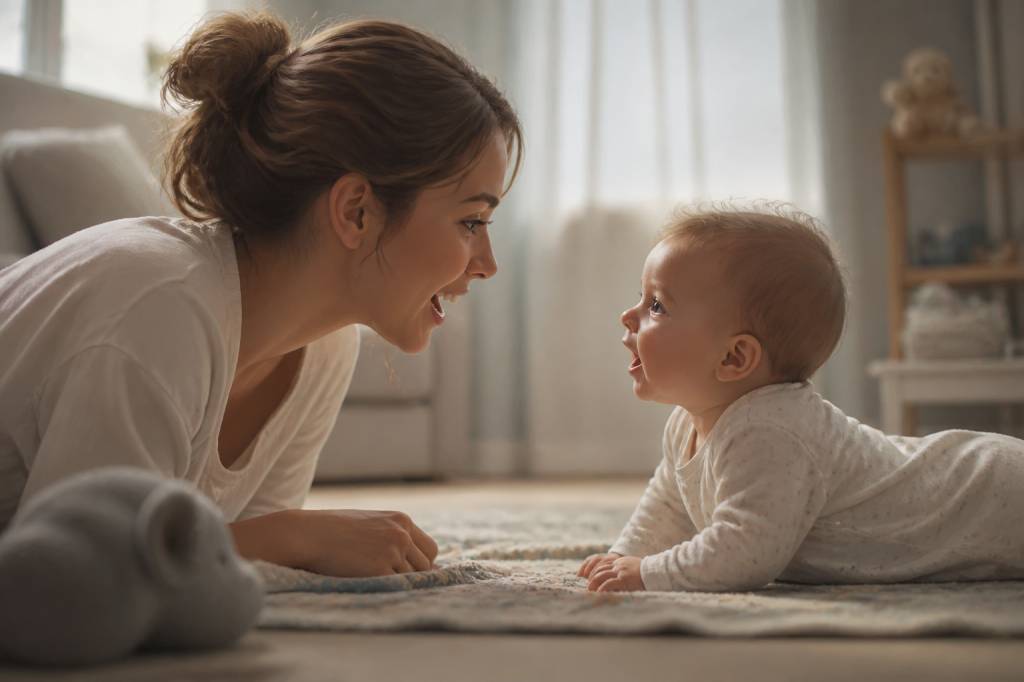
There is something wonderfully memorable about a baby’s first sounds. A soft “ah-ah” from the crib, a series of delighted squeals during diaper changes, or a determined “ba-ba-ba” from the high chair can make an ordinary day feel like a tiny conversation has begun. And in many ways, it has.
Babbling is one of the earliest building blocks of communication. Long before babies say their first recognizable words, they are experimenting with sounds, rhythms, facial expressions, and turn-taking. Every coo and babble is part of a fascinating journey toward language—not a performance to grade, but an invitation to connect.
So, what do those adorable sounds mean? When should you expect them? And how can you encourage your baby’s early communication without turning playtime into a language lesson? Let’s explore these early vocal discoveries together.
What is babbling?
Babbling is the stage when babies begin combining vowel and consonant sounds, often repeating them in playful sequences. It is different from crying, which is usually linked to a specific need, and different from cooing, which tends to involve longer, more open vowel sounds such as “oo” or “ah.”
Babbling may sound like “ba-ba,” “da-da,” “ma-ma,” or “ga-ga.” At first, the sounds may be simple and repeated. As your baby grows, babbling often becomes more varied, with changes in pitch and volume that resemble the rhythm of real speech.
It is worth remembering that babbling does not always carry a precise message. When your baby says “ba-ba-ba,” they may not be asking for a bottle or calling for a particular person. They may simply be exploring what their mouth, tongue, and voice can do. Still, these experiments are important. Your baby is learning that sounds can attract attention, express excitement, and create a response.
The journey from cooing to first words
Every child develops at their own pace, but early communication often follows a general pattern. Some babies move quickly from one stage to the next, while others spend more time enjoying a particular kind of sound.
- Around 2 to 4 months: Babies often begin cooing with gentle vowel sounds such as “ah,” “oh,” and “oo.” They may vocalize when they are content and watch your face closely while you respond.
- Around 4 to 6 months: You may hear squeals, laughter, growls, and playful changes in pitch. Your baby is discovering that their voice can be loud, soft, high, or low.
- Around 6 to 9 months: Canonical babbling often appears. This includes repeated consonant-vowel combinations such as “ba-ba-ba” or “da-da-da.”
- Around 9 to 12 months: Babbling may sound more conversational. Your baby might pause while you speak, imitate some sounds, and use gestures such as pointing or waving.
- Around 12 months and beyond: Some children begin using a few meaningful words. Others continue babbling while gradually adding recognizable words to their communication.
These age ranges are general guides, not deadlines. A baby who is early with gestures may take longer with sounds, while another may babble enthusiastically but not point much yet. Development is not a race, and there is no prize for arriving first—although parents naturally celebrate every tiny milestone as if it deserves a parade.
Common babbling examples and what they may express
Babies do not use sounds in exactly the same way adults use language, but their vocal patterns can offer clues about what they are feeling or practicing.
“Ah-ah” or “oo-oo”: These open vowel sounds are often early coos. Your baby may make them when relaxed, alert, or interested in your face. Try answering with a similar sound. This creates a simple, joyful back-and-forth.
“Ba-ba-ba” or “da-da-da”: Repeated syllables are classic babbling. Your baby is practicing how to move the lips and tongue while coordinating breath and voice. The repetition may also be exciting because it produces a predictable result.
“Ma-ma” or “na-na”: These sounds may eventually become meaningful words, but at first they are usually vocal experiments. If your baby says “ma-ma” while looking at you, you can respond warmly: “Mama is here.” Over time, connecting the sound with the person or object can help build understanding.
High-pitched squeals: Squealing often signals delight, excitement, or simple curiosity about the voice. A baby may squeal when seeing a favorite toy, meeting a familiar person, or discovering that everyone in the room turns around when the sound begins.
Growls and raspberries: These funny sounds are part of oral exploration. Blowing raspberries helps babies experiment with their lips, tongue, and airflow. It can also be a wonderfully silly social game—especially when you take turns making the sound.
Changing pitch and rhythm: When babbling begins to rise and fall like speech, your baby is learning the musical side of conversation. They may be practicing how to take a turn, signal excitement, or keep your attention.
Instead of asking, “What exact word is my baby trying to say?” it can be more helpful to ask, “What is my baby practicing right now?” That small shift takes away pressure and helps you notice the learning beneath the sound.
How babies learn communication through interaction
Language develops through relationships. Babies learn not only from hearing words but also from watching faces, studying gestures, and experiencing the rhythm of responsive conversations.
When your baby makes a sound and you answer, they begin to understand a powerful idea: communication works. My voice reaches you, and your voice comes back to me. This early exchange is the foundation of turn-taking, a skill that later supports conversations, play, and classroom learning.
Imagine your baby says, “Ba-ba.” You pause, smile, and reply, “Ba-ba! You found your ball.” Your response does several things at once. It acknowledges the sound, gives it meaning within the moment, and introduces a useful word. There is no need to correct the baby or demand repetition. Your warm attention is already teaching.
Simple ways to encourage early communication
You do not need flashcards, expensive programs, or a perfectly quiet home to support your baby’s language development. Everyday moments are full of opportunities.
- Talk during routines. Describe what is happening while you dress, feed, bathe, or change your baby. “Here is your clean shirt. One arm in, and now the other.” Familiar routines provide repeated words and predictable context.
- Copy your baby’s sounds. If your baby says “oo,” say “oo” back. Imitation shows that you are listening and makes vocal play feel like a shared activity.
- Pause for a response. After speaking, wait a few seconds. Babies need extra time to organize a sound, movement, or facial expression. That pause tells your baby that their turn matters.
- Use expressive faces. Smile, raise your eyebrows, and gently change your tone. Babies are drawn to faces and often learn meaning through the combination of words and expressions.
- Sing familiar songs. Songs offer repetition, rhythm, and exaggerated sounds. You do not need a perfect singing voice. Your baby is your most forgiving audience—and probably your most enthusiastic one.
- Read picture books every day. You do not have to read every sentence. Point to pictures, name objects, imitate animal sounds, and let your baby touch the pages. “Look, a dog! Woof, woof!” is a perfectly valuable reading moment.
- Follow your baby’s attention. If your baby is studying a spoon, talk about the spoon. If they are watching the family pet, name the pet. Words are easier to understand when they match what your baby is already noticing.
- Use gestures with words. Wave while saying “bye-bye,” point while naming an object, and open your hands for “all gone.” Gestures give babies another route into communication.
- Reduce background noise. Turn off the television during some playtime and move closer when speaking. A calmer sound environment makes it easier for your baby to notice voices and patterns.
Responding to babbling without pressure
It is natural to feel excited when your baby begins making new sounds. You may find yourself repeating “Say mama!” several times, especially after a long day when you are ready for that first word. But communication grows best through connection rather than testing.
Instead of asking your baby to perform, respond to what they offer. If they babble while reaching toward a cup, you might say, “You want your cup. Here is your cup.” If they squeal during peekaboo, answer with a playful “I see you!” This approach keeps communication meaningful and enjoyable.
Try not to compare your baby’s sounds with those of another child. One baby may babble constantly, while another communicates more through eye contact, smiles, or gestures before becoming especially vocal. Temperament matters, and quiet does not automatically mean a lack of understanding.
When to speak with a pediatrician
Most differences in early communication are perfectly ordinary, but it is always appropriate to share questions with your child’s healthcare provider. You know your baby best, and asking for guidance is an act of care—not an overreaction.
Consider discussing your concerns if your baby does not seem to respond to loud sounds or familiar voices, rarely makes eye contact, stops using sounds or gestures they previously used, or shows little interest in vocal interaction. If your baby is not babbling by around 9 months, or if you are worried at any point, a pediatrician can help assess hearing, development, and possible next steps.
Hearing plays an important role in language development, and a hearing check may be recommended when a baby is not responding to sounds or progressing as expected. Early support can be helpful, so you do not need to wait until your concerns feel “serious enough.”
Making room for the little conversations
Babbling can happen anywhere: in the grocery cart, during a sleepy morning cuddle, or while your baby investigates the mysterious greatness of a wooden spoon. These sounds may seem small, but they carry an important message. Your baby is discovering their voice and learning that relationships are built through response.
Answer the coos. Celebrate the raspberries. Leave space for pauses. Name what your baby sees, share a song, and enjoy the wonderfully imperfect rhythm of your early conversations.
One day, the babbling may turn into a recognizable word, and you may wonder how that tiny voice grew so quickly. Until then, every “ah,” “ba,” and delighted squeal is worth listening to. Your attention is the first language lesson your baby will ever receive—and it is taught with love.