
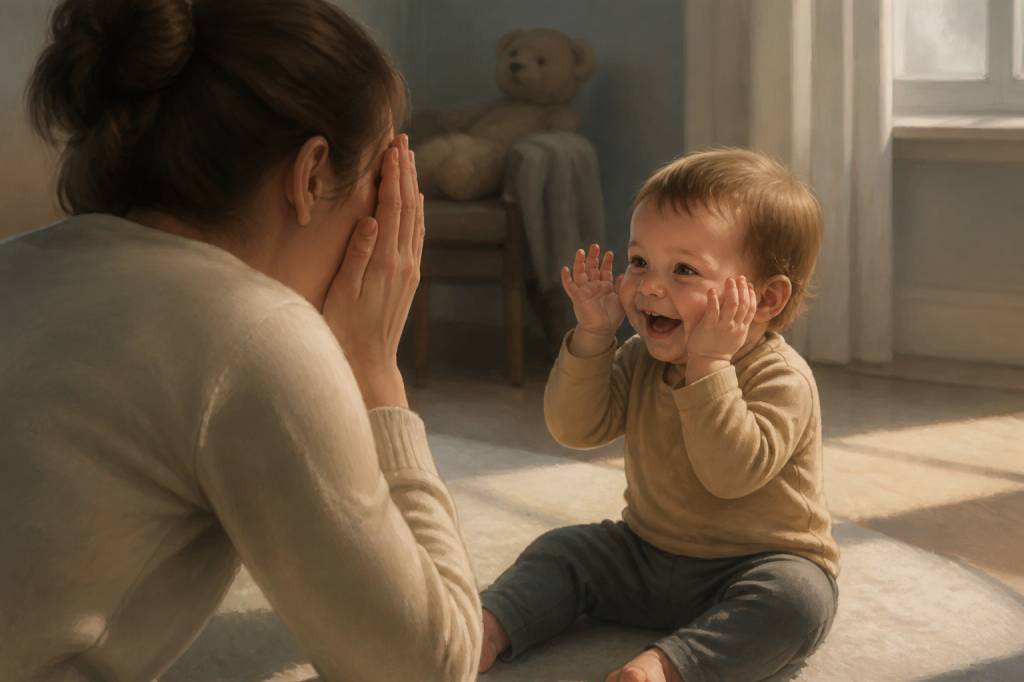
There is a moment almost every parent knows: you cover your face with your hands, pause for just long enough to create suspense, then reveal yourself with a cheerful “Peek-a-boo!” Your baby’s eyes widen. Their mouth opens into a smile. Sometimes a delighted squeal follows, as if you have performed the most astonishing magic trick in the world.
To us, peek-a-boo may seem wonderfully simple. To a baby, however, it is a small lesson in how the world works. This familiar game supports emotional connection, early learning, communication, and even the foundations of problem-solving. Behind that adorable burst of laughter is a busy little mind making sense of absence, surprise, and reunion.
So why do babies love peek-a-boo so much? And what are they learning each time your face disappears behind your hands?
Why peek-a-boo is so exciting for babies
For young babies, the world is made up of people, sounds, colors, and sensations that are still new. Your face is one of the most familiar and comforting sights they know. When it suddenly disappears, their attention is captured immediately. When it returns, they experience a happy surprise and a sense of relief.
The game combines several things babies naturally enjoy:
-
Familiarity: Your voice and face provide comfort and security.
-
Surprise: The brief disappearance creates anticipation.
-
Repetition: Babies love patterns they can begin to recognize.
-
Social connection: Your smile and voice invite them into a shared interaction.
-
Joy: Laughter and playful sounds make the experience emotionally rewarding.
Peek-a-boo is also perfectly suited to a baby’s developing attention span. It lasts only a few seconds, requires no special toys, and can happen almost anywhere. During a diaper change, while waiting for a bottle to warm, or from behind the edge of the crib, a simple pair of hands can become an entire entertainment center.
It introduces the idea of object permanence
One of the most important ideas babies gradually learn is called object permanence. This means understanding that a person or object still exists even when it cannot be seen.
Adults take this knowledge for granted. If your keys are hidden under a cushion, you know they have not vanished from the universe. A young baby is still developing that understanding. When something disappears from view, it may feel as though it has truly gone away.
Peek-a-boo offers a gentle, playful way to explore this idea. Your face disappears behind your hands, a blanket, or the side of the sofa. Then, a moment later, you reappear. With repetition, your baby begins to notice the pattern: “My parent is still there, even when I cannot see them.”
This learning does not happen all at once. A very young baby may simply enjoy the visual surprise. Over time, they may begin to wait for your return, pull at the cloth covering your face, or smile before you reveal yourself. These small reactions show that your baby is starting to predict what comes next.
That prediction is a meaningful cognitive step. Your baby is not merely watching the game; they are remembering what happened before and using that memory to anticipate the next moment.
Peek-a-boo builds trust and emotional security
There is an emotional message hidden inside the game: separation can be temporary, and connection can return.
For a baby, even a brief moment without seeing you can feel confusing. When you return with a warm voice and a smile, you offer reassurance. The rhythm of disappearing and reappearing creates a safe experience of distance and reunion.
This does not mean peek-a-boo should be used to force a baby to become comfortable with separation. Babies develop at different rates, and some may become upset if the game is too sudden or lasts too long. The goal is not to test their bravery. It is to share a playful moment at a pace that feels secure for them.
Watch your baby’s cues. If they smile, lean toward you, make happy sounds, or reach for the covering, they are probably enjoying the interaction. If they turn away, fuss, stiffen, or seem overwhelmed, pause and offer comfort. Even the world’s most enthusiastic peek-a-boo champion deserves a break.
With a responsive parent, the game teaches an early form of emotional trust: something unexpected can happen, but a loving caregiver remains nearby and attentive.
It supports early communication
Before babies say their first words, they communicate in many other ways. They use eye contact, facial expressions, gestures, sounds, and body movements. Peek-a-boo gives them a simple opportunity to participate in this early conversation.
When you say “Where’s Mommy?” or “Where did Daddy go?” your baby hears language connected to a meaningful action. When you follow with “There you are!” they begin to associate words, tone, and facial expressions with the same repeated event.
As your baby becomes more familiar with the game, they may:
-
Smile when they hear the phrase “peek-a-boo.”
-
Make sounds to encourage you to continue.
-
Pull a blanket away from your face.
-
Hide their own face and wait for your reaction.
-
Look toward a place where they expect you to reappear.
These responses are early forms of turn-taking. Your baby is learning that communication is not just something adults do to them. It is a shared exchange: you act, they respond, and then you respond again.
You can encourage this by leaving a small pause after hiding your face. Instead of revealing yourself immediately, wait a moment and watch what your baby does. Perhaps they will reach for you, vocalize, or wiggle with anticipation. This pause gives them room to participate rather than simply watch.
The game strengthens memory and anticipation
Peek-a-boo follows a predictable sequence: something is visible, it disappears, and it comes back. Repeated patterns help babies develop memory and anticipation.
At first, your baby may react only when your face reappears. Later, they may start smiling as soon as you cover your face because they remember what usually happens next. That little pre-emptive grin is a beautiful sign that your baby is connecting past experiences with future expectations.
You can gently vary the game to keep it interesting while preserving the familiar structure. Try hiding behind a curtain, peeking around the side of a chair, or placing a soft scarf over your own head. You might say:
-
“I’m here!”
-
“Where did I go?”
-
“Can you find me?”
-
“There you are!”
These variations introduce new words and settings without changing the reassuring rhythm. Your baby learns that the same person can disappear in different places and still return.
Peek-a-boo encourages problem-solving
When babies begin to pull away the blanket covering your face, they are doing more than being delightfully mischievous. They are experimenting with cause and effect.
They may discover that pulling the fabric reveals your eyes. They may look behind a piece of furniture to find where you went. They may move their body, reach out, or change their position to continue seeing you. Each action helps them understand that their choices can change what happens around them.
This is early problem-solving in a wonderfully ordinary form.
You can support this learning by giving your baby safe opportunities to discover the answer. Cover a favorite soft toy with a light cloth and ask, “Where is your teddy?” Allow your baby to reach for the fabric rather than removing it immediately. Celebrate their effort when the toy appears.
Keep the materials simple and safe. Never place a heavy or tightly wrapped item over a baby’s face, and always supervise games involving blankets, scarves, or fabric. The most educational activity in the world is not worth a safety risk.
It helps babies understand faces and emotions
Babies are naturally drawn to human faces. They study our eyes, mouths, expressions, and voices long before they understand the words we use. Peek-a-boo gives them a close-up view of changing emotions.
Your face may look serious while you hide, then become bright and animated when you reappear. Your voice may shift from a whisper to an enthusiastic greeting. These changes help babies notice emotional signals and connect them with social interaction.
Try making your expressions clear but gentle. Open your eyes, smile, and use a warm, playful voice. You do not need to perform an entire theatrical production in the living room. Your baby is already an appreciative audience, especially when you are wearing yesterday’s comfortable sweater and running on very little sleep.
As your baby grows, you can introduce simple emotional language: “You look surprised!” “You’re smiling!” or “That made you laugh!” Naming feelings helps children gradually connect expressions and words with emotional experiences.
Peek-a-boo changes as babies grow
The game often looks different at each stage of development.
In the early months, your baby may focus on your voice and face. Keep the game slow and close, using a soft tone and brief pauses. Their attention may last only a few seconds, and that is perfectly normal.
Around the middle of the first year, many babies become more visibly engaged. They may laugh, kick their legs, reach for your hands, or anticipate your return. You can begin hiding behind larger objects or using a favorite toy.
As mobility develops, your baby may want to take control. They may crawl toward you, pull off the cloth, or hide their own face. Let them lead when possible. The game becomes even more valuable when your baby has a chance to decide when the hiding begins and ends.
During the toddler years, peek-a-boo may turn into a more elaborate hide-and-seek game. Your child may hide behind a door, a cushion, or a very obvious corner while waiting for you to “find” them. Their hiding place may not be particularly mysterious, but their pride in it will be enormous.
Simple ways to make peek-a-boo meaningful
You do not need expensive toys or carefully planned activities. A few thoughtful adjustments can turn the game into a rich moment of connection.
-
Follow your baby’s lead: If they want to repeat the game ten times, repeat it ten times. If they lose interest, move on.
-
Use language: Repeat simple words and phrases so your baby hears language in a clear, meaningful context.
-
Pause before revealing yourself: Give your baby time to anticipate, reach, or vocalize.
-
Change the location: Play near a mirror, beside the crib, or while sitting on the floor.
-
Let your baby hide you: Give them a soft cloth and allow them to cover your face under close supervision.
-
Keep it gentle: Sudden movements, loud sounds, or long absences may frighten some babies.
-
Make eye contact: Your attention is the most important part of the activity.
When your baby does not laugh at peek-a-boo
Not every baby responds to peek-a-boo in the same way. Some laugh loudly, while others watch with a thoughtful expression. Some prefer a slow, quiet version of the game. Others enjoy hiding games only when they are rested and comfortable.
A baby’s temperament, age, mood, and developmental stage all influence their response. A serious little observer may be learning just as much as a giggling one. Look for signs of engagement beyond laughter: focused attention, eye contact, reaching, smiling, or turning toward your voice.
If your baby consistently seems distressed by the game, stop and try again another day in a gentler way. Parenting is not a performance review, and your baby is not required to applaud every activity you offer. The best play is responsive, flexible, and shaped by the child in front of you.
A tiny game with lasting meaning
Peek-a-boo takes only a few seconds, yet it touches many areas of early development. It helps babies explore object permanence, memory, prediction, communication, emotions, and cause and effect. Just as importantly, it gives them a warm, repeated experience of being seen and reunited with someone they trust.
In the middle of busy family life, these small rituals can be easy to overlook. Yet your baby does not need a perfect playroom or a packed schedule of educational activities. They need your face, your voice, your patience, and the reassuring rhythm of connection.
So the next time your baby reaches for your hands, take the hint. Hide for a moment, pause for the tiny spark of anticipation, and return with a smile. To you, it may be a familiar game. To your baby, it is a lesson in love, discovery, and the comforting promise that when someone disappears, they can come back.