
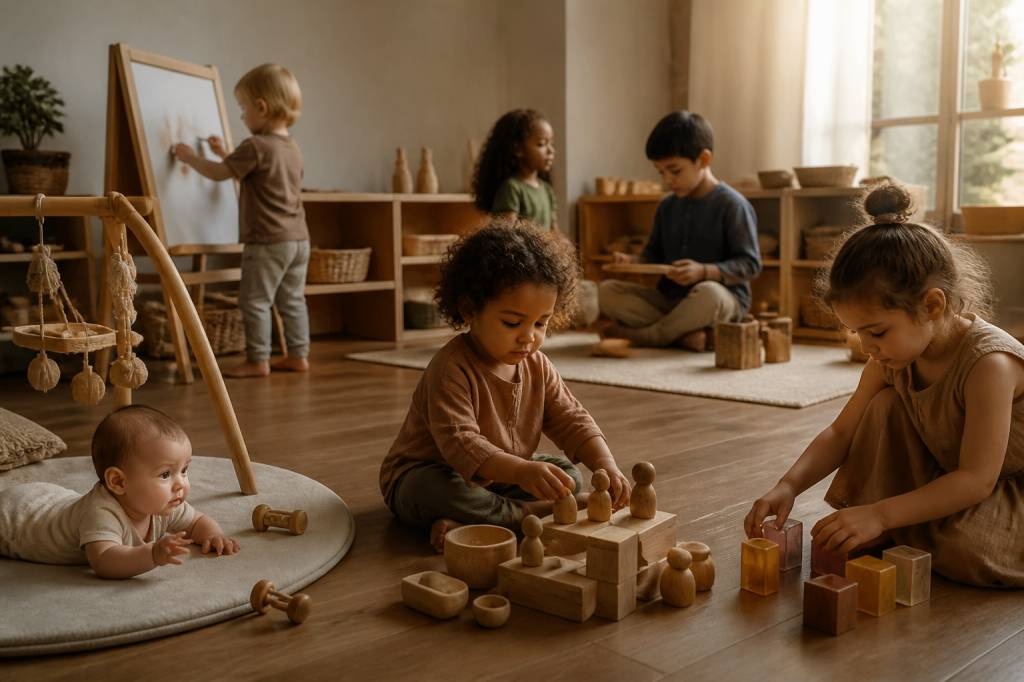
Play can look wonderfully simple from the outside: a baby shakes a rattle, a toddler fills and empties a cup, or two children build a tower that comes tumbling down within seconds. Yet beneath these ordinary moments, something remarkable is happening. Through play, children are testing ideas, practising relationships, strengthening their bodies, and learning how the world works.
As parents, we may sometimes wonder whether our child is “playing properly,” especially when they prefer to play alone or repeat the same activity again and again. The reassuring answer is that play develops in levels and stages. Each one offers valuable opportunities for growth, and children do not always move through them in a perfectly straight line.
Understanding these levels can help us observe more patiently, choose suitable activities, and support our children without taking over. After all, the cardboard box may be more exciting than the expensive toy inside it—and your little one may be learning far more than they appear to be.
What are the levels of play?
Child development experts often describe social play using six stages identified by sociologist Mildred Parten. These stages explain how children gradually move from being aware of their surroundings to playing cooperatively with others.
There are also different types of play based on what children are doing, such as physical play, constructive play, pretend play, and games with rules. These categories can overlap. A child might engage in pretend play alone, use construction materials with a friend, or learn early rules while playing a simple chasing game.
The most important point is that there is no single “correct” age for every level. Children develop at different rhythms, and the same child may move between stages depending on their mood, environment, confidence, and experience.
Unoccupied play: discovering the world
Unoccupied play is most common during infancy, although older children may also spend brief moments watching, moving, and exploring without following a clear plan. A baby may kick their legs, wave their arms, stare at light and shadow, or reach toward a nearby object.
It can look like very little is happening, but these early movements help babies develop body awareness and understand cause and effect. When a baby moves a hand and accidentally touches a soft toy, they begin to notice that their actions can change the world around them.
Parents can support this stage by providing a safe space with simple sensory experiences. A play mat, a few age-appropriate objects, and time to move freely may be all that is needed. There is no need to fill every moment with stimulation. Quiet observation is part of learning too.
- Place safe objects within easy reach.
- Offer different textures, shapes, and gentle sounds.
- Allow plenty of floor time for stretching, rolling, and reaching.
- Follow your baby’s cues and pause when they seem tired or overwhelmed.
Those tiny kicks and curious glances are not random. They are the first steps in a long journey of discovery.
Solitary play: learning through independent exploration
Solitary play usually appears in the toddler years, when children become increasingly interested in exploring objects and activities on their own. A child may stack blocks, look through a picture book, push toy cars, or complete a simple puzzle without seeking the involvement of another child.
This kind of play helps children build concentration, creativity, problem-solving skills, and independence. It is also a valuable opportunity for them to set their own pace. A toddler who spends fifteen minutes placing the same three blocks into a container is not wasting time. They may be practising coordination, comparing sizes, and enjoying the satisfaction of repetition.
It can be tempting to interrupt with suggestions: “Why don’t you build a house?” or “Look, the red block goes on top.” Sometimes, however, the best support is a warm presence without constant direction.
Try saying, “You’re working very carefully,” rather than telling your child what to do next. This shows interest while leaving ownership of the play in their hands.
Onlooker play: watching is an active process
During onlooker play, children watch other people play without joining in. They may observe siblings building a train track, stand near a group at the playground, or ask questions while another child plays with dolls.
Adults sometimes worry that a child who watches is being shy or missing out. In reality, observation can be an important way to gather information. Your child may be studying how the game works, deciding whether the other children seem welcoming, or building the confidence to participate.
You can gently support onlooker play by naming what your child notices: “They are taking turns with the ball,” or “You saw that Maya built a tall tower.” Avoid pressuring your child to join immediately. A calm invitation is more helpful than an enthusiastic push.
At home, books and photographs can also encourage observation. Ask open questions such as, “What do you think she is making?” or “What might happen next?” These conversations strengthen language and social understanding without turning play into a lesson.
Parallel play: side by side, but not yet together
Parallel play is common among toddlers and young preschoolers. Two children may sit close to one another, each playing with similar toys, while rarely interacting directly. One child pushes a truck along the floor while the other does the same. They may glance at each other, copy an action, or quietly share the space.
Although the children are not cooperating in the way adults might expect, they are learning important social skills. They are becoming comfortable around peers, noticing similarities and differences, and beginning to understand the idea of shared space.
Parallel play is especially useful for children who are still developing language or who need time to feel secure in a group. Setting up a few similar materials can make this stage easier. For example, provide two baskets of play food or several buckets and spades at the sandbox.
Conflicts may still happen, particularly over coveted objects. Instead of expecting young children to share perfectly, offer simple language and realistic choices: “You are using the blue truck. Leo can have the red one, or we can take turns when you are finished.” Learning to share is a gradual process, not a switch that flips on a child’s third birthday.
Associative play: connecting ideas and materials
In associative play, children begin interacting with one another, but they may not yet have a shared goal. They might exchange toys, talk about what they are doing, or combine their activities for a short time. One child may hand another a pretend spoon, while both continue playing in their own way.
This stage often develops during the preschool years. Children are practising communication, cooperation, and flexibility. They may begin using phrases such as “Can I have that?” or “Let’s make this here,” even if the plan changes every thirty seconds.
Adults can encourage associative play by offering open-ended materials that invite conversation and collaboration:
- Building blocks, magnetic tiles, or large cardboard boxes.
- Play dough with simple tools and natural objects.
- Dress-up clothes, scarves, and pretend household items.
- Art materials that can be shared without one “right” result.
When disagreements arise, stay nearby and help children express their needs. You might say, “You both want the basket. How could we use it together?” The goal is not to solve every problem for them, but to provide words and reassurance while they practise.
Cooperative play: creating and imagining together
Cooperative play is the stage many adults picture when they think of children playing together. Children share a purpose, assign roles, make plans, and adjust their ideas as they go. They may build a pretend restaurant, organise a game of doctor, create a fort, or work together on a large puzzle.
This type of play supports a wide range of development. Children practise negotiation, empathy, self-control, language, creativity, and problem-solving. They learn that other people may have different ideas—and that a shared game can continue when everyone makes room for one another.
Cooperative play does not always look peaceful. A lively game may include arguments, dramatic declarations, and at least one child announcing, “You’re not invited to my birthday!” These moments are not necessarily signs of failure. With supportive guidance, conflict becomes an opportunity to learn how to repair relationships and try again.
Offer help when emotions become too big for children to manage alone. Keep your words brief and neutral: “You wanted to be the shopkeeper, and Sam wanted that role too. Let’s think of another part for one of you, or take turns.” Over time, children become better at generating these solutions themselves.
Different types of play that support development
The social levels of play tell us how children engage with others. The type of activity tells us what skills they are practising. Several forms of play are especially important during the early years.
Physical play includes running, climbing, jumping, dancing, balancing, and throwing. It strengthens large muscles, coordination, confidence, and body awareness. A simple obstacle course made with cushions can provide rich learning without requiring special equipment.
Exploratory play happens when children investigate how things feel, move, fit, or work. Water play, sand, sensory bins, and safe household objects are wonderful for this. A child pouring water from one cup to another is exploring volume, movement, and control.
Constructive play involves making or building something. Blocks, cardboard, clay, recycled containers, and drawing materials encourage planning and persistence. The finished structure matters less than the thinking that happens along the way.
Pretend play allows children to explore emotions, relationships, and everyday experiences. A child who pretends to put a doll to bed may be replaying a familiar routine. A preschooler who turns a chair into a bus is developing imagination while practising language and social roles.
Games with rules become more accessible as children grow. Simple matching games, follow-the-leader, hide-and-seek, and turn-taking activities teach memory, patience, flexibility, and self-regulation. Start with short, clear rules and expect to adapt them. Young children are still learning that “the rules” are not simply whatever benefits them at that exact moment.
How parents can support healthy play
Children do not need adults to direct every game. They need time, safety, encouragement, and opportunities to explore. A few thoughtful habits can make a meaningful difference.
- Protect unhurried playtime. Constant activities and transitions can leave little room for deep concentration.
- Keep materials simple. Open-ended objects often inspire more creativity than toys with only one function.
- Observe before stepping in. Your child may be solving a problem or negotiating in a way that is not immediately obvious.
- Use descriptive language. Comment on effort and process: “You tried three ways to make the bridge stand.”
- Model kindness and turn-taking. Children learn social behaviour by watching how adults handle frustration and disagreement.
- Respect different temperaments. Some children rush into group play, while others prefer to watch first.
It is also helpful to remember that independent play is not a measure of your love or your parenting. A child who wants you nearby but not involved is still connected to you. You can offer a reassuring smile, answer a question, and let them return to their own discoveries.
When play feels difficult
Some children find group play challenging because of language delays, sensory sensitivities, anxiety, or differences in social development. This does not mean they cannot learn to connect. They may simply need smaller groups, predictable routines, extra preparation, or an adult who gently models how to enter a game.
Try practising at home with simple scripts: “Can I play too?” “What are you making?” or “Can I have a turn when you’re finished?” Role-play can make real situations feel less intimidating.
If you have ongoing concerns about your child’s communication, movement, attention, or ability to engage, speak with a paediatrician, teacher, or child development professional. Early support is not a label or a judgement. It is a way of giving your child the tools and encouragement they deserve.
Every level of play has something to teach us. The baby who watches a mobile, the toddler who lines up cars, and the preschoolers who build an imaginary castle are all learning in their own language. When we make space for play, we make space for curiosity, confidence, connection, and the joyful work of growing up.