
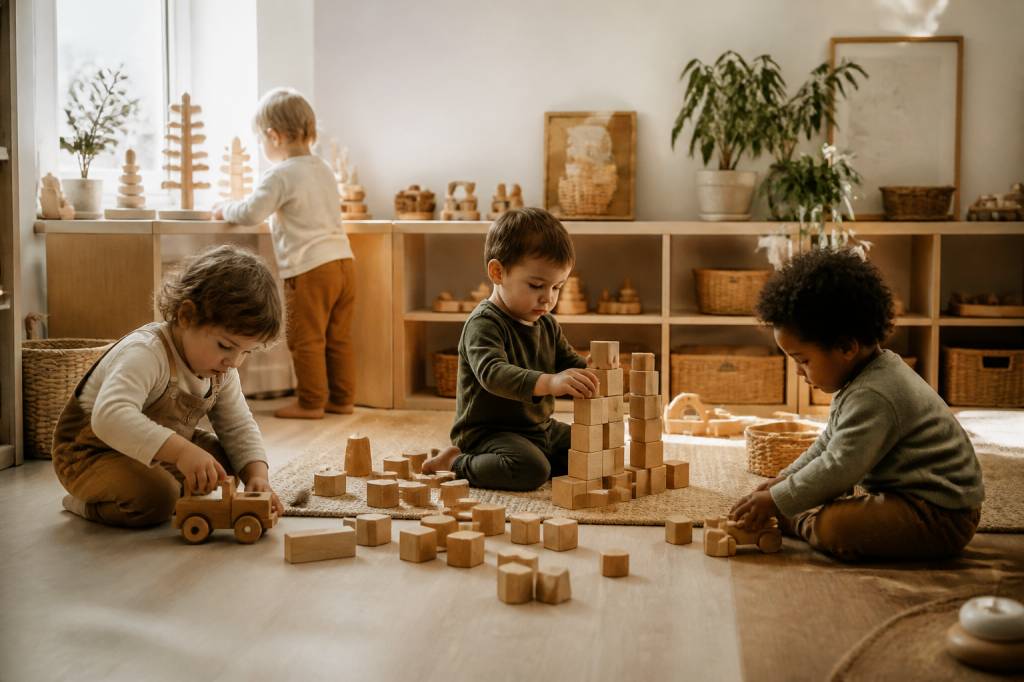
Play can look simple from the outside: a baby shakes a rattle, a toddler fills and empties a cup, a preschooler builds an elaborate tower and then knocks it down with great satisfaction. Yet behind these ordinary moments, something remarkable is happening. Through play, children are testing ideas, building relationships, strengthening their bodies, and learning how the world works.
As parents, we sometimes wonder whether we are offering enough stimulation. Should we buy more educational toys? Plan structured activities? Encourage our child to play “the right way”? Thankfully, healthy play does not require a perfectly curated playroom. Children learn through exploration, repetition, imagination, and connection. Our role is less about directing every moment and more about creating a safe space where curiosity can grow.
Play develops gradually, and each stage brings new discoveries. While children do not follow an identical timetable, understanding the main stages can help us recognize learning in action and respond with confidence.
Why play matters so much
Play is not separate from learning. For young children, it is one of the most natural and powerful ways to learn. When a baby reaches for a toy, they are practicing coordination. When a toddler pretends to feed a stuffed animal, they are exploring language, empathy, and everyday routines. When a preschooler negotiates the rules of a game, they are learning communication and self-control.
Play supports several areas of development at once:
When my own children were small, some of the richest play often happened with the least impressive objects. A cardboard box became a train, a shop, and eventually a rather questionable-looking robot. The box did not contain flashing lights or a dozen buttons, but it left room for imagination. That freedom is often where the deepest learning begins.
The first stage: exploratory play in infancy
During the first year, babies learn through their senses and their bodies. This early period is sometimes called exploratory or sensory play. Babies touch, mouth, shake, drop, rub, and stare at objects because they are gathering information.
A baby who repeatedly drops a spoon from the highchair is not simply trying to make mealtime more complicated. They are discovering gravity, sound, distance, and your wonderfully predictable response when you pick it up again. It may feel like a tiny scientific experiment conducted at the least convenient time of day, but it is learning nonetheless.
At this stage, offer simple, safe materials with different textures, shapes, weights, and sounds. Soft blocks, fabric books, teethers, stacking cups, rattles, and large sensory balls can all encourage exploration. Everyday interaction matters just as much as toys. Singing during a diaper change, copying your baby’s sounds, and pausing to let them respond all turn ordinary routines into playful exchanges.
Babies also learn through movement. Tummy time, reaching, rolling, crawling, and pulling up help develop the muscles needed for later play. Place an interesting object just within reach, but not so far away that your baby becomes frustrated. A little challenge is useful; overwhelming difficulty is not.
At this age, adults are the most important play resource. Your face, voice, gestures, and attention help babies feel secure enough to explore. You do not need to entertain constantly. A few warm minutes of focused interaction can be more meaningful than a room full of toys.
The second stage: solitary play and discovery
From infancy into the toddler years, children often engage in solitary play. This means playing independently, not necessarily feeling lonely. A child may sit beside a parent while concentrating on stacking blocks, turning pages, or fitting pieces into a simple puzzle.
Solitary play helps children develop focus and independence. They learn that they can make choices, try strategies, and enjoy their own ideas. It is perfectly normal for a toddler to become absorbed in an activity and resist interruption. That concentration is worth protecting, even when the activity involves moving every cushion from the sofa to the floor.
Parents can support this stage by providing a small selection of accessible toys rather than an overwhelming collection. Consider rotating materials every few days:
Open-ended materials are especially valuable because they can be used in many ways. A set of cups might become building blocks, pretend food, bath toys, or treasure containers. Instead of showing your child exactly what to do, try describing what you notice: “You put the small cup inside the big one,” or “You are making a very tall tower.” This kind of language supports learning without taking over the play.
The third stage: parallel play
Between approximately two and three years old, children often begin parallel play. They play near other children, using similar materials, but they may not yet cooperate or share a common plan. Two toddlers can sit side by side with toy cars, each deeply involved in their own road system. They are together, but not quite playing together.
Parallel play is an important bridge toward social interaction. Children observe one another, imitate actions, learn new possibilities, and become comfortable in a shared space. They may not be ready to take turns consistently, and that is developmentally normal. Expecting a two-year-old to share every beloved object with perfect grace is a little like expecting us to hand over the last piece of chocolate without a moment of emotional processing.
Adults can help by staying close and modeling simple social language:
Rather than forcing children to share immediately, guide them toward short, manageable turns. Offer duplicates of popular toys when possible, and remember that conflict is not always a sign that play has failed. With calm support, children gradually learn to express needs, tolerate frustration, and notice the feelings of others.
The fourth stage: associative play
Associative play commonly appears around the ages of three and four. Children begin interacting more directly, talking about what they are doing, exchanging materials, and borrowing ideas from one another. However, they may still be following separate goals rather than working toward one shared outcome.
For example, one child may build a garage while another drives cars around it. They may discuss the cars and occasionally add pieces to each other’s work, but there is not yet a clear group plan. This is a wonderful stage for language development because children are learning to explain, compare, request, and respond.
Parents can encourage associative play by providing materials that invite conversation and collaboration. Dress-up clothes, pretend kitchens, animal figures, art supplies, train tracks, and building sets work beautifully. You might say, “I wonder where the animals are going,” or “Your bridge connects to Leo’s road.” A gentle comment can open the door to richer storytelling without turning play into a lesson.
At this stage, children often begin using symbolic thinking. A wooden block can become a phone, a blanket can become a river, and an empty box can become a bed for a very large stuffed bear. Pretend play allows children to rehearse real experiences and process emotions. A child who repeatedly plays “doctor” may be exploring a recent appointment. A child who puts a doll to bed may be making sense of bedtime routines and care.
The fifth stage: cooperative and imaginative play
By around four or five years old, many children become more capable of cooperative play. They can create a shared story, assign roles, follow simple rules, and work toward a common goal. This might involve building a castle together, organizing a pretend restaurant, or inventing a game with its own complicated rules that somehow change every thirty seconds.
Cooperative play supports skills that children will use throughout school and family life. They practice listening, compromise, planning, leadership, flexibility, and conflict resolution. They also discover that other people may have ideas that are different from their own.
Imaginative play becomes increasingly complex during these years. Children may recreate events from daily life or invent entirely new worlds. They learn to use symbols, sequence events, develop characters, and understand different perspectives. A superhero game may look energetic and chaotic, but it can involve storytelling, problem-solving, emotional expression, and social negotiation.
Adults can support cooperative play by helping children put their ideas into words:
Try to avoid correcting every detail or insisting on a realistic outcome. If your child tells you that the teddy bear is flying to the moon in a saucepan, the saucepan is, at least for now, perfectly capable of space travel.
How play develops across different types of activity
Children benefit from a balance of active, creative, sensory, constructive, pretend, and social play. Each type offers different opportunities for growth.
These categories often overlap. A child making a pretend bakery with playdough is developing fine motor skills, counting imaginary cupcakes, practicing conversation, and inventing a story all at once. That is the beauty of play: one activity can nourish the whole child.
Ways parents can make play more meaningful
The most helpful play environment is not necessarily the most expensive or elaborate. Begin with safety, accessibility, and time. Keep a few age-appropriate materials where your child can reach them, and allow space for movement and mess when possible.
Follow your child’s interests. If they are fascinated by buses, read books about transportation, draw roads, count wheels, or visit a bus stop. If they love animals, create a small veterinary clinic with stuffed toys. Children are more engaged when learning grows from genuine curiosity.
Offer support without taking control. You can model a new possibility, then step back. If a tower keeps falling, ask, “What could make the bottom stronger?” instead of rebuilding it yourself. When frustration rises, acknowledge it: “That did not work the way you hoped. You can try another idea.” These small responses teach persistence and emotional regulation.
Make room for unstructured play. Children need time without constant adult instructions, scheduled activities, or digital entertainment. Boredom can feel uncomfortable at first, but it often gives imagination the quiet space it needs. You may hear, “There’s nothing to do,” shortly before your child invents an elaborate expedition involving three blankets and a spoon.
Finally, remember that development is not a race. Some children prefer physical play, while others spend long periods drawing or building. Some eagerly join group games; others need more time to observe. Milestones offer helpful guidelines, not strict deadlines. If you have concerns about your child’s communication, movement, social interaction, or ability to play, speak with a pediatrician or qualified child development professional.
Every time a child explores, pretends, builds, moves, wonders, or laughs, learning is taking place. A parent’s steady presence, encouraging words, and willingness to see the world through a child’s eyes can transform an ordinary afternoon into something deeply nourishing. Play does not need to be perfect. It simply needs room for curiosity, connection, and the joyful freedom to try again.