
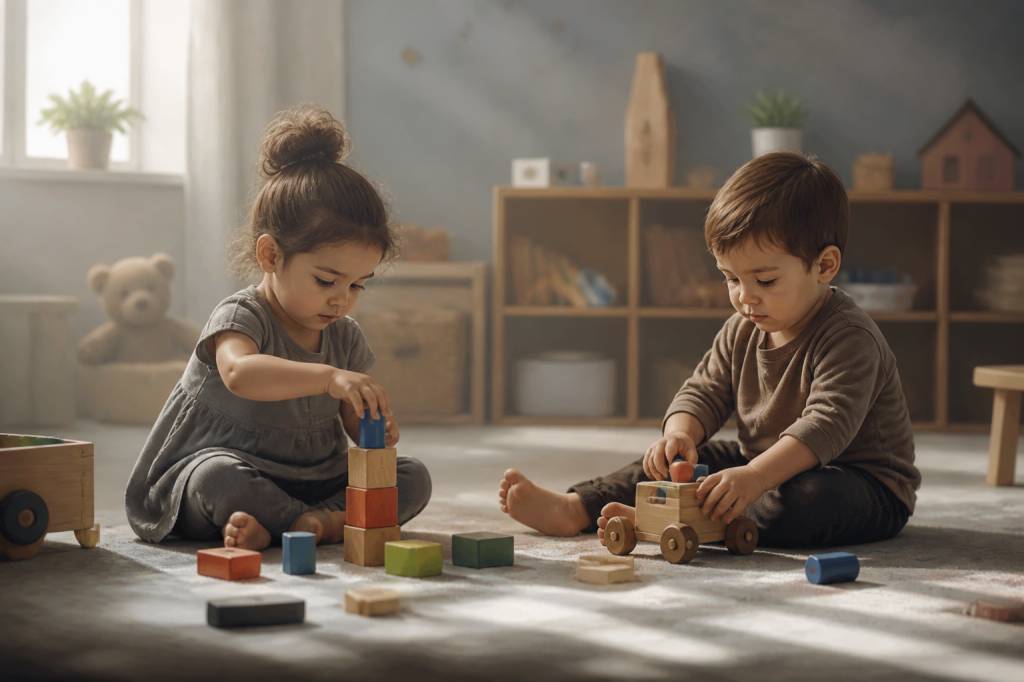
There is a particular kind of toddler gathering that looks almost like a playdate—but with very little actual playing together. One child pushes a truck across the rug. Another stacks blocks nearby. A third carefully feeds a stuffed animal, while all three occasionally glance at one another without joining the same game.
This is called parallel play, and it is a completely normal and important stage of early childhood development. To an adult, it may seem as though the children are ignoring each other. In reality, they are watching, learning, experimenting with social boundaries, and slowly discovering what it means to play alongside another person.
So, when does parallel play begin? What does it look like in everyday life? And how can parents support this stage without rushing toddlers into sharing, taking turns, or playing cooperatively before they are ready?
What is parallel play?
Parallel play happens when children play near one another, often with similar toys or activities, but do not yet play directly together. They may sit side by side, copy one another’s actions, exchange a few words, or briefly interact. Still, each child remains focused on their own play.
Imagine two toddlers at the park. One is filling a bucket with sand while the other fills a bucket beside them. They may use the same tools and enjoy being close, but they are not yet building one shared sandcastle. That is parallel play in its simplest form.
It is not a sign that children are unfriendly or unable to socialize. Toddlers are social beings, but they are also still developing language, emotional regulation, flexibility, and the ability to understand another child’s point of view. Playing beside someone is often the first comfortable step toward playing with them.
When does parallel play begin?
Parallel play commonly begins around 18 months to 2 years of age and becomes especially noticeable between ages 2 and 3. Every child develops at their own pace, so these ages are a helpful guide rather than a strict timetable.
Some children show early signs before their second birthday. Others prefer solitary play for longer and gradually become more interested in nearby children. Temperament, language development, sibling relationships, childcare experiences, and opportunities to socialize can all influence how this stage appears.
At first, a toddler may simply tolerate another child nearby. Over time, they may watch closely, imitate an action, offer a toy, or comment on what the other child is doing. These small moments are meaningful, even when they last only a few seconds.
It is also worth remembering that development is not a straight line. A child who happily plays with a friend one day may return to independent play the next, especially when tired, overwhelmed, hungry, or adjusting to a new environment. Toddlers are wonderfully consistent in their inconsistency.
The stages of early social play
Parallel play is one part of a broader progression. The stages may overlap, and children often move back and forth between them depending on the situation.
- Solitary play: A child plays independently and may show little interest in what others are doing. This is common in infancy and toddlerhood and remains perfectly healthy at any age when a child needs quiet focus.
- Onlooker play: A child watches others play without joining in. They may study the action, listen, or ask questions while remaining on the edge of the activity.
- Parallel play: Children play beside one another with limited direct interaction. They may imitate each other or use similar materials while following their own ideas.
- Associative play: Children begin to share toys, talk, and interact around a common activity, but they may not yet have one shared goal.
- Cooperative play: Children work together in an organized way, such as creating a pretend restaurant, building a fort, or playing a simple game with shared rules.
Cooperative play generally becomes more noticeable during the preschool years, often between ages 3 and 5. However, children will still enjoy solitary and parallel play long after they begin cooperating. Even adults sometimes need a little “parallel play” time—someone reading on the sofa while another person watches television nearby can feel wonderfully companionable.
Why parallel play matters for development
Parallel play may look quiet, but a great deal is happening beneath the surface. This stage gives children the chance to practice important skills in a low-pressure way.
Social awareness: A toddler learns that other children have their own actions, preferences, and boundaries. Watching someone nearby helps them notice facial expressions, movements, sounds, and reactions.
Imitation and learning: Children are natural observers. A toddler may see another child roll playdough, pour pretend tea, or place puzzle pieces together, then try the same action. Copying is one of the earliest ways children learn from one another.
Language development: Being near other children creates opportunities to hear new words and practice simple communication. A child might say “red car,” “my turn,” or “look!” Even brief exchanges support vocabulary and social communication.
Independence: Parallel play allows children to remain in control of their own activity while becoming comfortable in a group. They can choose what to do, how long to do it, and whether to interact.
Emotional regulation: Social situations can be intense for young children. Playing alongside others offers gentle exposure without requiring constant conversation or cooperation. It helps children build confidence gradually.
Early problem-solving: Two children reaching for the same truck, sitting in the same space, or using the same box may encounter small challenges. With adult support, these moments become practice for negotiation, patience, and flexible thinking.
What parallel play looks like at home
At home, parallel play may happen naturally between siblings, cousins, or a parent and child. You might notice your toddler arranging toy animals while an older sibling builds a road nearby. They are engaged in separate activities, but they may borrow ideas, exchange toys, or pause to observe each other.
Adults can also participate without taking over. Sit near your child and play with your own set of blocks. Describe what you are doing in simple language: “I’m making a tall tower.” Your child may continue with their own tower, copy you, or invite you into the activity. There is no need to turn the moment into a lesson.
During a playdate, two toddlers might each have a basket of large cars. They may drive the cars around the same room, occasionally bump into one another, and then return to their individual adventures. This is a perfectly successful playdate, even if nobody shares a pretend storyline.
Sometimes parallel play is easiest when there are enough similar materials available. Two toddlers are more likely to remain peaceful when both can hold a shovel, doll, train, or paintbrush. This does not prevent every disagreement—nothing can promise that with toddlers—but it can reduce unnecessary competition.
How parents can support this stage
Supporting parallel play does not require elaborate activities or a perfectly arranged playroom. Your calm presence and realistic expectations matter most.
- Create a welcoming space: Offer open-ended toys such as blocks, playdough, large crayons, toy animals, cars, dolls, or stacking cups. These materials allow children to follow their own ideas.
- Provide duplicates when possible: Two similar trucks or two sets of washable markers can make shared play more comfortable for toddlers who are not ready to take turns consistently.
- Stay nearby: Young children often explore social situations more confidently when a trusted adult is close. You do not need to direct every moment; simply being available can be reassuring.
- Describe rather than command: Try saying, “You’re building beside Maya,” or “Maya is using the blue cup,” instead of insisting, “Play nicely together.” Narration helps children understand what is happening without adding pressure.
- Model gentle interaction: You can demonstrate offering a toy, waiting, or asking for space. Keep the language short: “Can I have a turn when you’re finished?”
- Respect a child’s need for space: Some toddlers enjoy being near others but do not want another child touching their project. Acknowledge that feeling while helping everyone stay safe.
- Keep playdates manageable: Short visits with one or two familiar children may be easier than a crowded, noisy gathering. End the activity before everyone becomes overtired.
Does parallel play mean children should share?
Not necessarily. Sharing is a complex skill that develops gradually. A toddler may understand the words “share your toy” but still lack the impulse control and emotional maturity to hand over a favorite object easily. That is not selfishness; it is early childhood development.
Instead of demanding immediate sharing, try teaching simple turn-taking with support. You might say, “You are using the train. Leo can have a turn when you’re done,” or “Let’s find another car while we wait.” A visual timer can help older toddlers, but it should not be used as a rigid tool for every toy.
It is also helpful to put away a few treasured items before a playdate. Children deserve to have special belongings that remain theirs. Offering a selection of toys for general use can make the experience feel fairer for everyone.
When should parents seek advice?
Parallel play itself is not a concern. Children do not need to move through social stages on an exact schedule, and many healthy children prefer independent or parallel play for quite some time.
It may be useful to speak with your pediatrician or a child development professional if you notice broader concerns, such as a child who rarely responds to their name, shows very limited eye contact or communication, loses skills they previously had, seems consistently distressed around people, or does not show interest in connecting in any form as they grow.
One behavior alone rarely tells the whole story. Your observations over time are valuable, and asking questions early can provide reassurance, practical guidance, or support when needed. A conversation with a professional is not a label or a prediction—it is simply another way to understand your child.
Small moments, meaningful growth
The toddler who sits beside another child without joining in may appear to be doing very little. But in that quiet space, they are learning how to share an environment, notice another person, protect their own ideas, and perhaps imagine a future game together.
Parallel play gives children room to be close without being pushed. It honors their developing independence while gently opening the door to connection. One day, the two children filling separate buckets may build a sandcastle together. For now, sitting side by side is already a beautiful beginning.
When we slow down enough to notice these small steps, early social development becomes less about checking milestones and more about recognizing the thoughtful, sometimes messy ways children learn to belong.