
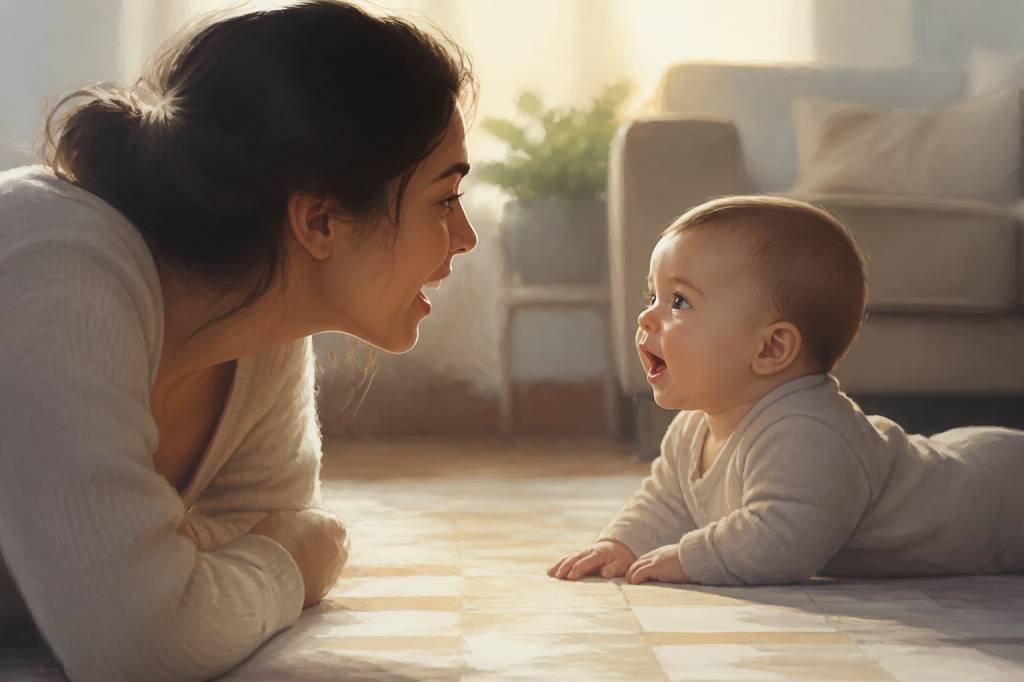
There is something wonderfully hopeful about a baby’s first sounds. A soft “oo,” an enthusiastic “ba-ba,” or a stream of joyful nonsense can make an ordinary afternoon feel like a conversation with the whole world. Even before babies say recognizable words, they are already practicing the rhythm, music, and turn-taking of language.
Babbling is not random noise. It is one of the earliest ways your baby experiments with communication, from discovering what their mouth can do to learning that a sound can make someone look, smile, or respond. While every child develops at a different pace, understanding the usual stages can help parents enjoy these little vocal discoveries and support language development with confidence.
What does babbling mean?
Babbling is the repetition and exploration of speech-like sounds. Your baby may combine vowels and consonants, stretch a sound, squeal, whisper, or repeat a syllable such as “ba-ba-ba” or “da-da-da.” These sounds may not have a specific meaning yet, but they are important building blocks for spoken language.
Think of babbling as your baby’s first language laboratory. Their tongue, lips, jaw, and vocal cords are learning to work together. At the same time, your baby is discovering a powerful social lesson: sounds get attention. When you answer with a smile or imitate a “ga-ga,” your baby begins to understand that communication goes both ways.
Sometimes a baby’s babble sounds remarkably like a real word. A repeated “mama” may warm your heart, naturally, but it does not always mean your baby is intentionally calling for you. In the early months, babies often practice sounds because they enjoy how they feel and sound. Intentional word use usually becomes clearer as their understanding, gestures, and vocal skills develop.
The early stages of baby sounds
Language development begins long before the first word. Here is what you may notice during the first year.
- Birth to around 2 months: Babies communicate mainly through crying, fussing, and vegetative sounds such as grunts or sighs. They also begin to make soft vowel-like sounds, often called cooing, especially when they are comfortable.
- Around 2 to 4 months: Cooing becomes more noticeable. Your baby may respond to your voice with “ahh,” “ooh,” squeals, and happy little sounds. This is often the beginning of delightful back-and-forth exchanges.
- Around 4 to 6 months: Babies experiment with pitch and volume. You may hear shrieks, growls, raspberries, and long vowel sounds. They are learning that their voice can be high, low, loud, soft, serious, or gloriously dramatic.
- Around 6 to 9 months: Canonical babbling often appears. This means your baby combines a consonant and vowel in repeated syllables, such as “ba-ba,” “ma-ma,” “da-da,” or “ga-ga.”
- Around 9 to 12 months: Babbling may sound more conversational. Your baby might vary the rhythm and pitch as if asking a question, imitate familiar sounds, and use gestures such as pointing or waving. Some babies say their first meaningful words during this period.
These time frames are general guides, not deadlines. Some babies babble early, while others take more time to become vocal. Premature babies may follow their own adjusted timeline, and children exposed to more than one language may distribute their sounds and words across both languages.
Common baby sounds and what they may communicate
Babies do not always use sounds in predictable ways, but certain vocal patterns can offer clues about what they are exploring or trying to express.
- “Ooh” and “ahh”: These gentle vowel sounds are common during cooing. Your baby may be relaxed, interested, or simply enjoying the sound of their own voice.
- “Ba-ba” or “da-da”: Repeated consonant-vowel combinations are a typical form of babbling. They usually represent practice rather than a specific person or object.
- Raspberries and bubbles: Blowing air through the lips helps babies strengthen oral movements and explore airflow. It can also be wonderfully messy, especially after a meal.
- Squeals and shrieks: These may show excitement, surprise, or frustration. Babies are learning how much power their voices have, and they are not always concerned about the volume.
- Growls and low sounds: Babies often play with resonance and pitch. A low rumble is usually vocal experimentation, not a sign that your little one is preparing to audition for a monster movie.
- Babbling with changing pitch: When sounds rise and fall like speech, your baby may be imitating the melody of conversations before understanding the words themselves.
Context matters. A tired baby may make a completely different sound from an excited baby. Watch facial expressions, body movements, gestures, and timing alongside the vocalization. Over time, you will become familiar with your child’s individual “sound dictionary.”
Why babbling is important for language development
Babbling supports several skills at once. First, it strengthens the muscles needed for speech. Moving the lips and tongue with increasing control prepares your baby to form more complex sounds.
Second, babbling teaches turn-taking. When your baby makes a sound and you pause before responding, they learn the basic rhythm of conversation: I make a sound, you answer, then I have another turn. This simple exchange is the foundation of social communication.
Babbling also helps babies connect sound with meaning. They hear words repeated in familiar situations, such as “milk,” “bath,” “more,” or “bye-bye.” Gradually, they begin to recognize that certain sounds refer to people, actions, or objects.
Finally, babbling is influenced by the languages babies hear around them. A baby exposed to English, Spanish, French, or several languages may practice different sound patterns depending on their environment. Hearing multiple languages does not confuse babies or cause language delay. It gives them a rich opportunity to notice how communication can work in different ways.
How to encourage your baby’s babbling
You do not need special flashcards, expensive toys, or a perfectly organized learning corner to support language development. Your everyday interactions are powerful.
- Respond to every attempt: When your baby says “ga,” answer with “ga-ga” or a simple phrase such as, “I hear you!” This shows that their communication matters.
- Pause and wait: Give your baby a few quiet seconds to respond. It can feel long, especially when you are used to filling every moment, but the pause creates space for a conversation.
- Speak face-to-face: Get down to your baby’s level so they can watch your eyes, lips, and facial expressions. Babies learn from the whole face, not just the words.
- Use clear, expressive speech: A warm, slightly slower voice with natural repetition helps babies notice sounds. “Here is your cup. Cup. You want your cup!” is useful without needing to sound like a cartoon character.
- Imitate and expand: If your baby says “ba-ba,” you might reply, “Ba-ba! Ball!” If they say “ma,” you can say, “Mama is here.” This gently adds meaning to their sounds.
- Read picture books: You do not have to read every sentence. Point to pictures, name objects, imitate animal sounds, and let your baby turn pages or vocalize.
- Sing together: Songs provide repetition, rhythm, and changing pitch. Simple nursery rhymes are especially helpful because familiar patterns invite participation.
- Narrate daily life: Talk while dressing, feeding, shopping, or washing hands. “Socks on. One sock, two socks.” These ordinary moments offer plenty of meaningful language.
- Follow your baby’s interest: If your baby is staring at a fan, talk about the fan. Shared attention is more engaging than trying to redirect them toward a toy you chose five minutes ago.
Above all, keep interactions enjoyable. Language grows through connection, not performance. Your baby does not need to be tested throughout the day; they need to feel heard.
When babbling sounds like a conversation
Many parents notice a charming change between six and twelve months: their baby begins to babble with a speech-like rhythm. The sounds may rise at the end as though asking a question or pause as though waiting for an answer. Your baby might even “tell” you a long story while waving a wooden spoon.
Take these moments seriously, even when the subject appears to be the spoon. Look at your baby, listen, and respond naturally. You might say, “You have something important to tell me. Is that your spoon?” This kind of interaction teaches your baby that communication includes attention, emotion, and shared meaning.
Gestures often develop alongside babbling. Pointing, reaching, waving, clapping, and showing objects are all meaningful forms of communication. A baby who points toward a dog and then looks at you is inviting you to share their interest. Responding with “Yes, a dog! The dog is walking” connects the gesture, the object, and the words.
What if your baby is quieter?
Some babies are naturally chatty, while others observe the world quietly before joining in. Temperament matters. A calm baby may babble less frequently but still communicate through eye contact, smiles, gestures, and attentive listening.
Rather than comparing your baby with a cousin, neighbor, or social media milestone chart, look for steady progress. Is your baby making more varied sounds over time? Do they react to familiar voices? Do they seem interested in interaction? Are they using gestures or facial expressions to communicate?
If your baby rarely makes sounds, does not respond to loud noises or familiar voices, stops using skills they previously had, or seems not to engage socially, mention your observations to a pediatrician. It is also wise to discuss any concerns about hearing, since hearing plays a central role in speech and language development. Seeking advice early is not an overreaction; it is a caring way to understand what your child needs.
Language grows in relationship
Babbling is one of those small, easily missed milestones that carries enormous meaning. Behind every “ba-ba” is a baby practicing movement, listening to the people around them, and discovering that their voice can reach someone they love.
So answer the little sounds. Smile at the squeals. Leave room for pauses. Talk about the laundry, the rain, the banana on the floor, and the mysterious spoon that has apparently become the centerpiece of the afternoon. These exchanges may seem ordinary, but they are the first threads in your child’s lifelong relationship with language.
There will be days when your baby babbles through every diaper change and others when they seem far more interested in chewing the book than hearing the story. Both belong to the process. With patience, warmth, and plenty of responsive conversation, those early sounds slowly begin to take shape—and one day, amidst all the beautiful babbling, a meaningful word will arrive.