
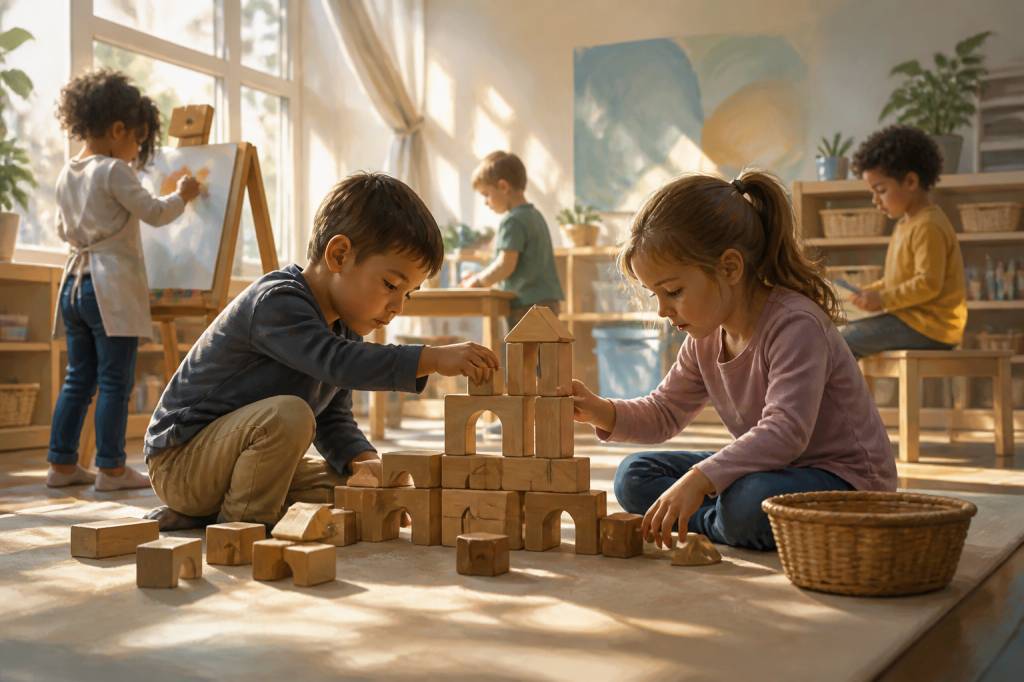
Play is often the first language children speak. Before they can explain an idea, button a coat, or tell us what happened during their day, they are already learning through movement, imitation, imagination, and discovery. A cardboard box becomes a house. A wooden spoon becomes a microphone. A pile of cushions turns into a mountain that must, naturally, be climbed immediately.
These ordinary moments are not “just play.” They are opportunities for children to develop essential skills that support communication, problem-solving, physical coordination, emotional growth, and early learning. The good news for parents is that meaningful play does not require a perfectly designed playroom or a shelf full of expensive toys. It begins with time, attention, and a little room for curiosity.
Why play matters in early childhood
Young children learn best when they are actively involved. Play allows them to experiment without the pressure of getting everything right. They can build, knock down, try again, change the rules, and make sense of the world at their own pace.
Through playful experiences, children gradually develop:
- Physical skills: balance, coordination, strength, fine motor control, and body awareness.
- Language skills: vocabulary, listening, storytelling, and conversation.
- Cognitive skills: memory, attention, planning, problem-solving, and early mathematical thinking.
- Social skills: cooperation, turn-taking, negotiation, and empathy.
- Emotional skills: self-regulation, confidence, flexibility, and the ability to express feelings.
As parents, we sometimes feel tempted to turn every activity into a lesson. But children do not need a worksheet attached to every experience. When play is enjoyable and appropriately challenging, learning is already happening beneath the surface.
Start with unstructured play
Unstructured play is child-led and open-ended. Instead of following a set of instructions, children decide what to do, how to do it, and when to change direction. This kind of freedom is especially important because it encourages initiative and creativity.
Try placing a few simple materials within reach and stepping back:
- Building blocks or wooden cubes
- Fabric scraps, scarves, and blankets
- Cardboard boxes and paper tubes
- Plastic containers and safe kitchen utensils
- Crayons, paper, and washable paint
- Animal figures, dolls, or toy vehicles
You may be surprised by what happens when there are fewer toys available. A child who has too many choices can become overwhelmed, while a small collection of flexible materials often invites deeper play. Rotating toys every few weeks can also make familiar objects feel fresh again.
Rather than asking, “What are you making?” every few minutes, try observing quietly. You might say, “I see you put the small block on top,” or “You are carrying the baby carefully.” These simple comments show interest without taking control of the play.
Build physical skills through everyday movement
Gross motor skills involve the large muscles of the body. Running, jumping, climbing, crawling, and balancing help children become more confident and coordinated. They also support healthy physical development and provide an important outlet for all that wonderful early-childhood energy.
Outdoor play is ideal, but it is not the only option. On rainy days, create a small indoor obstacle course using cushions, painter’s tape, and a few sturdy boxes. Invite your child to:
- Walk along a taped line like a tightrope
- Crawl under a table covered with a blanket
- Jump over soft pillows
- Carry a toy from one station to another
- Balance on one foot while counting slowly
Keep the activity playful rather than competitive. Some children enjoy a challenge immediately; others need time to watch first. A gentle “Would you like to try it with me?” is often more encouraging than “Come on, you can do it!”
Fine motor skills develop through smaller movements involving the hands and fingers. Drawing, threading, stacking, turning pages, and using child-safe scissors all strengthen the muscles children later use for writing, dressing, and feeding themselves.
Simple ideas include transferring pom-poms with kitchen tongs, building towers with small blocks, peeling stickers, kneading play dough, or placing coins into a slot in a homemade cardboard container. Always choose materials that are appropriate for your child’s age and supervise small objects closely.
Encourage pretend play and imagination
Pretend play gives children a safe way to explore daily experiences, relationships, and emotions. A child may tuck a doll into bed after experiencing a new bedtime routine, or line up stuffed animals for a doctor’s appointment after visiting the pediatrician. Through these stories, children process what they have seen and felt.
You can support imaginative play with a few familiar objects:
- A blanket can become a cape, picnic mat, or shop counter.
- An empty box can become a bus, oven, boat, or animal home.
- A basket can hold pretend groceries, soft toys, or dress-up clothes.
- A spoon and bowl can become part of a make-believe restaurant.
Try joining the story without directing every detail. If your child says, “The teddy is sick,” you might respond, “What does the teddy need?” This encourages language, sequencing, and empathy. If the story suddenly changes from a hospital to a spaceship, follow along. Childhood logic has its own delightful timetable.
Pretend play also offers opportunities to teach emotional vocabulary naturally. “The puppy looks worried. What could help him feel safe?” Questions like this help children connect actions, feelings, and solutions without turning play into an interrogation.
Use play to strengthen language
Language grows through warm, responsive interaction. Children need adults who listen, answer, describe, and give them time to respond. Everyday play provides countless moments for this kind of connection.
During block play, talk about size, shape, position, and quantity: “You have three blue blocks. Which one should go underneath?” While cooking pretend soup, introduce words such as “stir,” “pour,” “empty,” “full,” “hot,” and “smooth.” During a walk, describe what you notice together rather than testing your child constantly.
Picture books are another powerful tool. You do not have to read every word exactly as printed. Pause to look at the illustrations, ask what might happen next, and invite your child to point, imitate sounds, or retell familiar parts of the story.
For younger children, repetition is valuable. The same song or book may be requested twenty times, often before breakfast. It can feel a little like living with a very small, very determined radio host, but repeated exposure helps children remember sounds, words, and patterns.
Give children opportunities to communicate in different ways. Singing, puppets, rhymes, drawing, movement, and storytelling all support language development. If a child is still using few words, gestures, facial expressions, and sounds are meaningful forms of communication too. Respond to the message, not only to the vocabulary.
Develop early thinking and problem-solving skills
Children are natural investigators. They want to know what happens when a tower gets taller, when water moves from one container to another, or when a toy car travels down different surfaces. Resist the urge to solve every problem immediately. A little productive struggle can be deeply valuable.
When a tower falls, try saying, “It fell. What could we change?” If a puzzle piece does not fit, ask, “What do you notice about the shape?” These prompts encourage children to observe, predict, and test ideas.
Everyday activities can support early mathematical thinking:
- Sort laundry by color or type.
- Count steps while walking upstairs.
- Compare which container holds more water.
- Arrange toys from smallest to largest.
- Find shapes around the house.
- Make patterns with blocks, beads, or pieces of fruit.
There is no need to rush toward formal academic work. When children explore quantity, sequence, space, and patterns through real experiences, they are building a strong foundation in a way that feels natural and memorable.
Support social skills through shared play
Playing with others can be joyful, but it is also complex. Sharing, waiting, communicating, and managing disappointment are skills that take time to develop. A toddler who grabs a toy is not being deliberately unkind; they are still learning that another person has wishes too.
Adults can model the language children need:
- “You were using the truck. Maya would like a turn when you are finished.”
- “You both want the red cup. Let’s think of a solution.”
- “It is hard to wait. You can hold the timer while you wait.”
- “You may say, ‘Stop, I don’t like that.’”
Short, supported playdates are often easier for young children than long gatherings. Two children and a few simple materials may create more successful interaction than a crowded room filled with toys. Stay nearby, but allow them space to attempt small negotiations before stepping in.
Board games and cooperative activities can also teach turn-taking, although expectations should match the child’s age. For very young children, a game may last only a few minutes before the pieces become snacks, hats, or mysterious objects under the sofa. That is perfectly normal.
Make space for sensory play
Sensory play engages touch, sight, hearing, smell, and sometimes taste. It can be calming, stimulating, and an excellent way to help children explore new concepts. Water play, play dough, sand, rice, finger paint, and textured fabrics all invite hands-on discovery.
For a simple activity, place water in a shallow basin with cups, sponges, and a few floating objects. Ask, “Which one will sink?” or simply let your child pour and splash. On another day, hide large toy animals in homemade play dough or create a texture basket filled with cotton, wood, foil, and soft fabric.
Sensory preferences vary. Some children adore messy play; others dislike wet hands or sticky textures. Never force participation. Offer tools such as scoops, paintbrushes, or gloves, and allow children to observe until they feel ready. Respecting their boundaries helps them feel secure enough to explore.
Follow the child while staying emotionally present
The most effective play support is not constant entertainment. It is thoughtful presence. Put your phone aside when possible, get down to your child’s level, and give them a few uninterrupted minutes of your attention. Even ten focused minutes can feel special in a busy household.
Follow your child’s interests rather than imposing your own agenda. If they are fascinated by wheels, look for wheels everywhere: on cars, strollers, suitcases, and toy carts. If they love animals, use animal sounds to introduce movement, storytelling, and counting. Interest is the doorway through which learning enters.
At the same time, remember that children need opportunities to play independently. You are not required to be the director, narrator, and audience every minute of the day. A calm “I am nearby if you need help” can reassure your child while leaving room for independent discovery.
Create a playful rhythm at home
Children benefit from predictable routines, but a routine does not have to feel rigid. A daily rhythm might include active movement in the morning, quiet books after lunch, outdoor exploration in the afternoon, and pretend play before dinner.
Keep materials accessible in low baskets so children can make choices and participate in tidying. Store small collections together: blocks in one basket, art supplies in another, and dress-up items where little hands can reach them safely. A manageable environment encourages independence and reduces the familiar parental phrase, “Where did all these pieces come from?”
Most importantly, protect play from perfection. Paint may land beside the paper. A carefully built castle may collapse in seconds. The play dough may become an unidentifiable creature with three eyes and a tiny hat. These moments are not failures; they are part of the process.
When children play, they are practicing how to move through the world: how to try, communicate, imagine, cooperate, recover, and begin again. With a little time, a safe environment, and an attentive adult nearby, even the simplest game can become a rich beginning.