
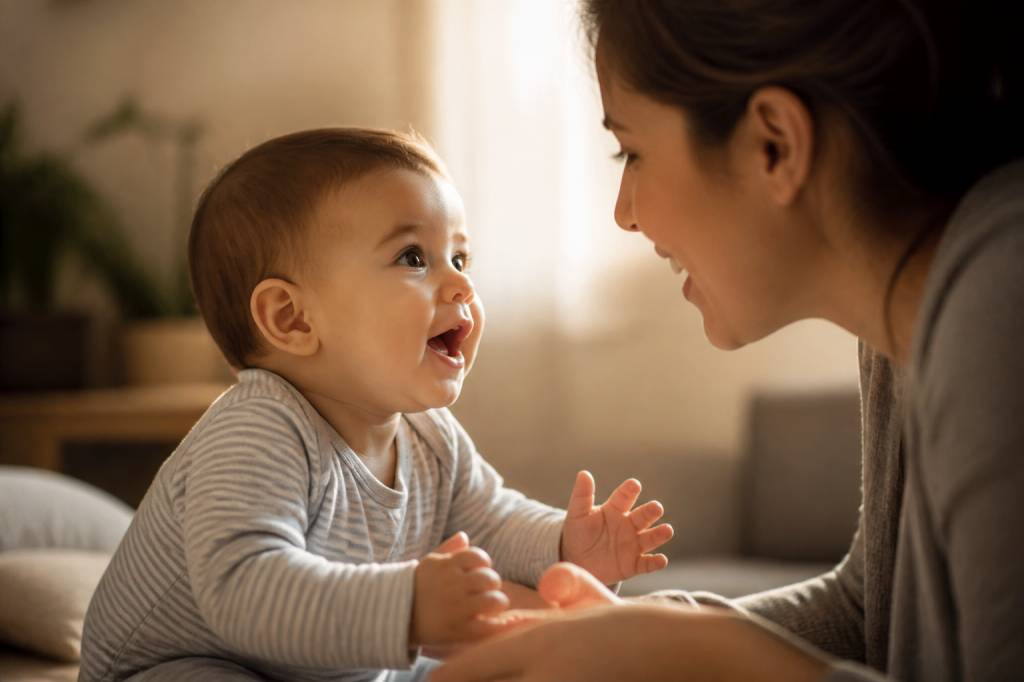
One day, your baby’s sounds may seem like little bubbles floating through the room: “ah-ah,” “oo-oo,” and then, suddenly, something that sounds remarkably like “ba-ba.” Babbling is one of those small but unforgettable steps that makes communication feel wonderfully close. Your baby is not simply making noise. They are experimenting with their voice, listening to your response, and beginning to discover the rhythm of conversation.
For many parents, babbling brings a mixture of delight and questions. When should it begin? What counts as babbling? How can you encourage your baby without turning every sound into a lesson? The reassuring news is that early communication develops gradually, and there is a wide range of normal. Your warm attention is one of the most powerful tools your baby has.
What is babbling?
Babbling is the stage when babies begin combining vowel sounds and, later, consonants. It is different from crying, cooing, or making random noises. Babbling often sounds more intentional and varied, as though your little one is practicing a brand-new language—which, in a way, they are.
Early sounds may include long vowel-like noises such as “aaaah” or “oooooh.” Later, babies begin adding consonants, producing sounds like “ba,” “da,” “ma,” or “ga.” With time, these sounds may become repeated syllables: “ba-ba-ba,” “da-da-da,” or “ma-ma-ma.” Some babies babble constantly, while others prefer to observe quietly before joining the conversation.
Babbling is not yet the same as using words with a clear meaning. When a baby says “mama,” they may not specifically be calling for their mother. Still, these repeated sounds are important preparation for meaningful speech. Your baby is learning how sounds are made, how they feel in the mouth, and how people respond when they hear them.
When does babbling usually start?
Every baby follows a personal timetable, but communication tends to develop in a familiar sequence. During the first weeks, crying is your baby’s main way to express hunger, discomfort, tiredness, or the need for closeness. Around two months, many babies begin cooing and making soft vowel sounds. These gentle exchanges often become the first little “conversations” between you.
Babbling with consonant sounds commonly emerges between four and six months. At first, your baby may experiment with individual sounds, such as “ba” or “ga.” Between six and nine months, many babies begin repeating syllables and changing the pitch of their voice. They may sound as though they are telling you a very serious story about the family pet, the ceiling fan, or the fascinating spoon on the table.
By nine to twelve months, babies often use a wider variety of sounds and may imitate the rhythm of adult speech. They may pause while you speak, take a turn, or use sounds together with gestures such as pointing, reaching, waving, or shaking their head. Some babies say their first recognizable words around their first birthday, while others need more time.
These age ranges are general guides, not deadlines. Premature babies may reach communication milestones according to their corrected age. Temperament also plays a role. A thoughtful observer may babble less frequently than a lively little performer who seems determined to narrate every moment of the day.
Why babbling matters
Babbling supports much more than pronunciation. It helps babies practice the movements needed for speech, including coordinating the lips, tongue, jaw, and breath. It also teaches them that their voice can influence the people around them.
When your baby makes a sound and you smile, answer, or move closer, they begin to understand the foundations of social communication. They learn that communication is a two-way experience. Someone speaks, someone listens, and both people share a moment.
Babbling also encourages listening skills. Babies begin noticing differences in pitch, volume, rhythm, and tone. They hear the musical pattern of your language long before they understand its vocabulary. This is one reason everyday talking, singing, and reading are so valuable—even when your baby appears far more interested in chewing the book than hearing the story.
How to encourage early communication
You do not need flashcards, expensive programs, or a perfectly quiet home to support language development. The most helpful activities are simple, frequent, and woven into ordinary family life.
- Respond to every sound. When your baby babbles, answer as if they have said something important. You might say, “Ba-ba! Did you see the ball?” This shows your baby that their voice is worth listening to.
- Copy your baby’s sounds. If they say “ga-ga,” try saying “ga-ga” back. Pause and give them time to respond. This playful imitation teaches the rhythm of taking turns.
- Use face-to-face time. Sit close enough for your baby to see your eyes and mouth. Babies learn by watching facial expressions and the movements involved in making sounds.
- Speak naturally and clearly. A warm, expressive voice is wonderful, but you do not need to exaggerate every word. Use simple phrases and give your baby plenty of time to process what they hear.
- Describe daily routines. Talk while changing a diaper, preparing lunch, or getting dressed. “Here is your blue shirt. One arm in, and now the other arm.” Ordinary moments offer countless opportunities for language.
- Sing songs and nursery rhymes. Repetition, rhythm, and melody help babies notice patterns in speech. You do not need a perfect singing voice; your baby is a very forgiving audience.
- Read together every day. Point to pictures, name familiar objects, and let your baby touch and explore the pages. Even a few minutes can become a treasured communication ritual.
- Use gestures with words. Wave while saying “bye-bye,” point to a cup when naming it, or open your hands when saying “all gone.” Gestures give babies another way to understand and express meaning.
- Limit background noise during conversations. Turning off the television or putting away your phone for a few minutes makes it easier for your baby to focus on your voice and face.
Make room for pauses
One of the most useful habits is learning to wait. Adults often fill silence quickly, especially when a baby is quiet. Try saying a short sentence, then pause for several seconds. Your baby may look at you, smile, move their mouth, or make a sound in response.
These pauses teach the structure of conversation. They also give your baby time to organize a response. If you immediately continue talking, you may accidentally miss their contribution. A quiet moment is not empty; it may be your baby’s way of preparing to join in.
Imagine a small exchange during breakfast. You say, “Would you like more banana?” Your baby looks at you, opens their mouth, and says, “Mm.” You can respond, “More banana? Here you go.” The conversation may be brief, but it is meaningful. Your baby has communicated, and you have shown that you understand and respond.
Follow your baby’s interests
Language grows most naturally when babies are engaged. Watch what captures your little one’s attention and talk about it. If they are staring at a lamp, say, “You see the light. The light is bright.” If they reach for a stuffed animal, name it: “Bear! You want your bear.”
Following your baby’s lead makes communication feel relevant rather than forced. It also helps connect words with real people, objects, and actions. Your baby may not repeat the word immediately, but they are listening and building an understanding of what words mean.
Try to avoid turning play into a constant test. Instead of repeatedly asking, “What’s that?” you can offer the answer and enjoy the moment together. Babies learn through connection, not pressure. The goal is not to produce a performance; it is to create a safe, language-rich relationship.
Technology, pacifiers, and communication
Babies learn communication best through responsive human interaction. A screen may produce sounds and images, but it cannot replace the back-and-forth exchange of looking, listening, waiting, and responding. Whenever possible, prioritize talking, singing, reading, and playing together over passive screen time.
Pacifiers can be soothing and useful, especially during sleep, but frequent use while your baby is awake may reduce opportunities to babble. If your baby is alert and ready to interact, gently remove the pacifier so they can freely move their mouth and make sounds. There is no need for a dramatic negotiation; a calm, practical approach is usually enough.
What if my baby is not babbling yet?
Some babies babble later than others, and a quiet period does not automatically mean something is wrong. Begin by observing the whole picture. Does your baby respond to familiar voices? Startle or turn toward sounds? Smile socially? Make eye contact? Use facial expressions or gestures to communicate?
It is worth discussing your concerns with your pediatrician if your baby is not making cooing sounds by around three months, is not babbling by around seven months, does not respond to sounds or their name, or seems to lose communication skills they previously had. A lack of response to sound may sometimes be related to hearing, and a hearing check can provide important information.
Trust your instincts. Parents often notice subtle changes before anyone else. Raising a concern does not mean you are overreacting; it means you are paying close attention. Your healthcare provider can review your baby’s development, consider hearing and other factors, and recommend an evaluation with a speech-language professional or early intervention service when appropriate.
Celebrate the little conversations
Babbling can happen anywhere: during a morning cuddle, in the car seat, while folding tiny socks, or just before sleep. It may arrive as a single unexpected “ba,” followed by a delighted pause. Then, perhaps, your baby repeats it because your face lit up the first time.
These exchanges are easy to overlook when the day is busy, but they are the beginnings of a lifelong relationship with language. Answer your baby’s sounds. Let them see your face. Sing the same song again, even if you are both slightly tired of it. Leave space for their reply.
Your baby does not need a perfect teacher. They need a responsive, loving person who notices their attempts and answers with patience. In the soft back-and-forth of early babbling, your child is learning not only how to communicate, but also that their voice matters.